Department of Ecology and Evolutionary Biology, Brown University, 80 Waterman St., Providence, RI 02912, USA.
J Exp Bot. 2012 Oct;63(17):6297-308. doi: 10.1093/jxb/ers282. Epub 2012 Oct 17.
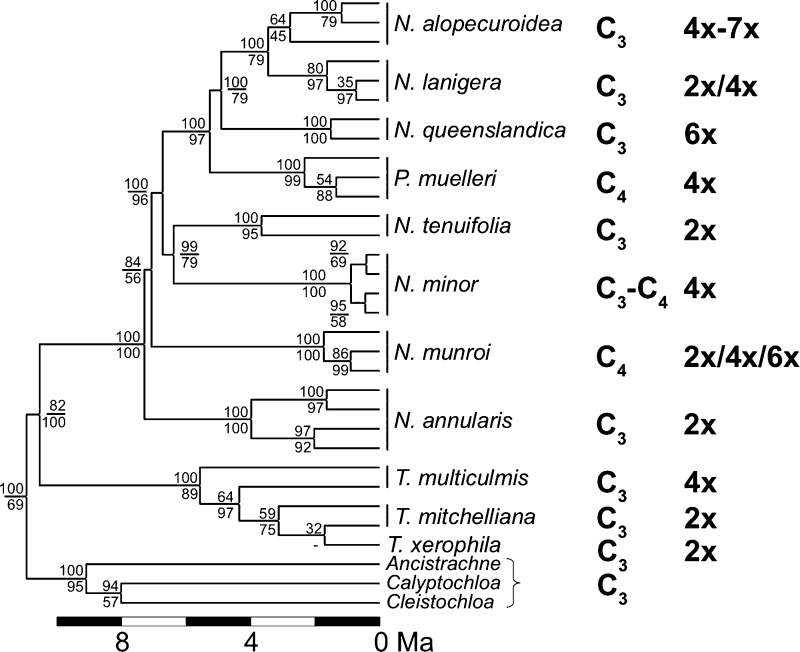
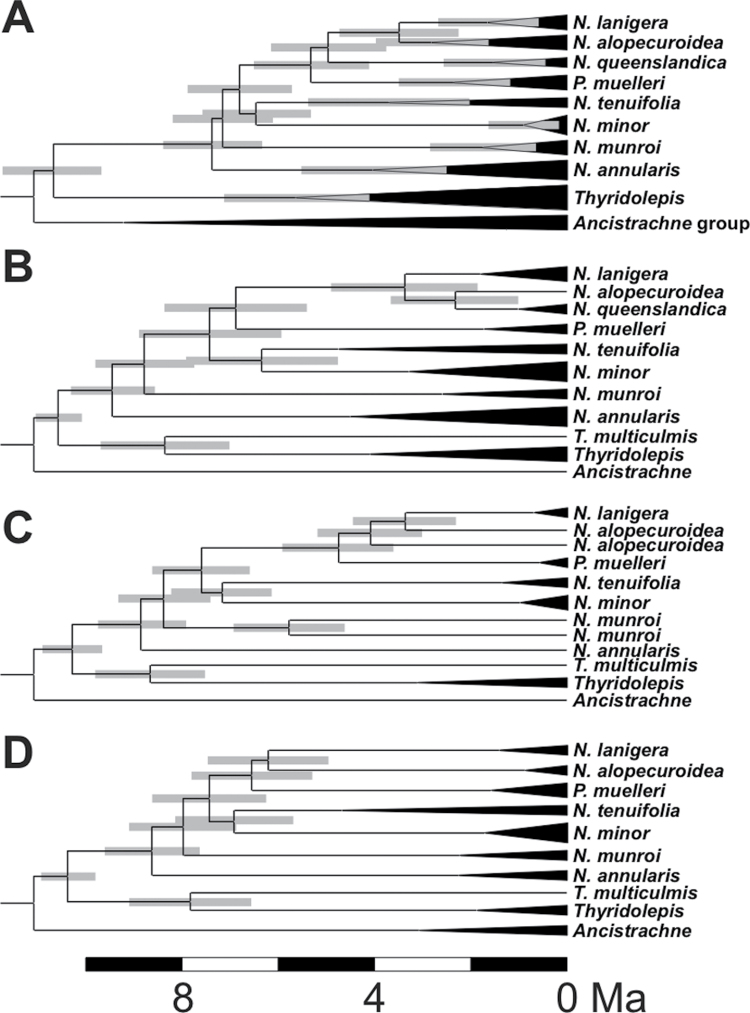
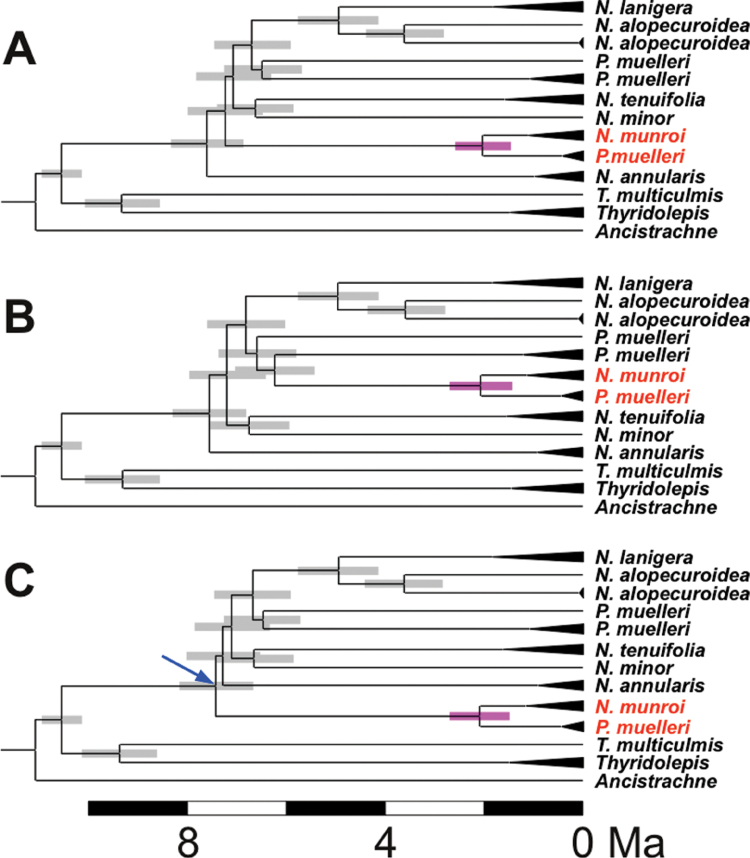
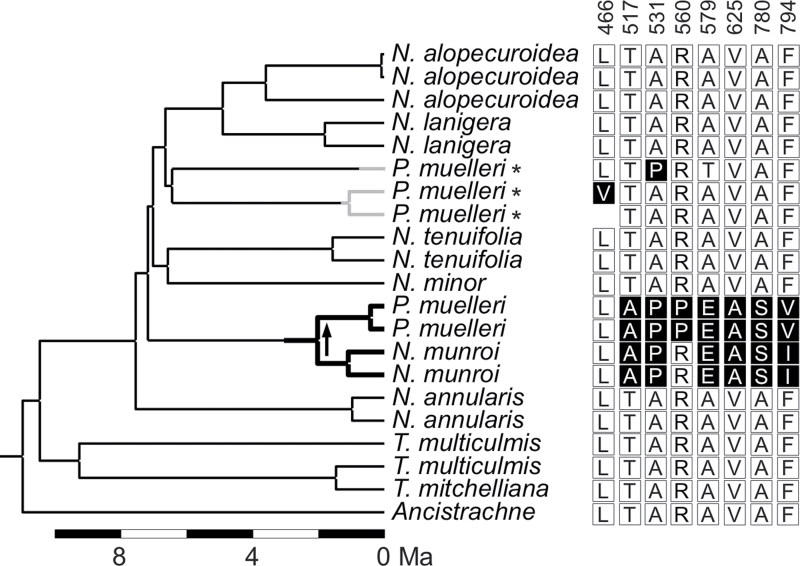
The Neurachninae is the only grass lineage known to contain C(3), C(4), and C(3)-C(4) intermediate species, and as such has been suggested as a model system for studies of photosynthetic pathway evolution in the Poaceae; however, a lack of a robust phylogenetic framework has hindered this possibility. In this study, plastid and nuclear markers were used to reconstruct evolutionary relationships among Neurachninae species. In addition, photosynthetic types were determined with carbon isotope ratios, and genome sizes with flow cytometry. A high frequency of autopolyploidy was found in the Neurachninae, including in Neurachne munroi F.Muell. and Paraneurachne muelleri S.T.Blake, which independently evolved C(4) photosynthesis. Phylogenetic analyses also showed that following their separate C(4) origins, these two taxa exchanged a gene encoding the C(4) form of phosphoenolpyruvate carboxylase. The C(3)-C(4) intermediate Neurachne minor S.T.Blake is phylogenetically distinct from the two C(4) lineages, indicating that intermediacy in this species evolved separately from transitional stages preceding C(4) origins. The Neurachninae shows a substantial capacity to evolve new photosynthetic pathways repeatedly. Enablers of these transitions might include anatomical pre-conditions in the C(3) ancestor, and frequent autopolyploidization. Transfer of key C(4) genetic elements between independently evolved C(4) taxa may have also facilitated a rapid adaptation of photosynthesis in these grasses that had to survive in the harsh climate appearing during the late Pliocene in Australia.
神经草族是唯一已知含有 C(3)、C(4) 和 C(3)-C(4) 中间类型的禾本科植物,因此被认为是研究禾本科光合作用途径进化的模式系统;然而,缺乏稳健的系统发育框架阻碍了这一可能性。本研究利用质体和核标记重建了神经草族物种的进化关系。此外,利用碳同位素比确定了光合作用类型,用流式细胞术测定了基因组大小。神经草族中存在高频的自倍性,包括 Neurachne munroi F.Muell.和 Paraneurachne muelleri S.T.Blake,它们独立进化出 C(4)光合作用。系统发育分析还表明,在它们分别起源 C(4)之后,这两个类群交换了一个编码 C(4)形式磷酸烯醇式丙酮酸羧化酶的基因。C(3)-C(4)中间类型 Neurachne minor S.T.Blake 在系统发育上与两个 C(4)谱系明显不同,表明该物种的中间状态是独立于 C(4)起源之前的过渡阶段进化而来的。神经草族显示出重复进化新的光合作用途径的巨大能力。这些转变的促进因素可能包括 C(3)祖先的解剖学预先条件,以及频繁的自倍性。在独立进化的 C(4)类群之间转移关键的 C(4)遗传元件可能也促进了这些禾本科植物光合作用的快速适应,它们必须在澳大利亚上新世晚期出现的恶劣气候中生存。