Department of Biotechnology & Bioinformatics, North-Eastern Hill University, India.
Microbes Environ. 2013;28(1):33-41. doi: 10.1264/jsme2.me12074. Epub 2012 Oct 19.
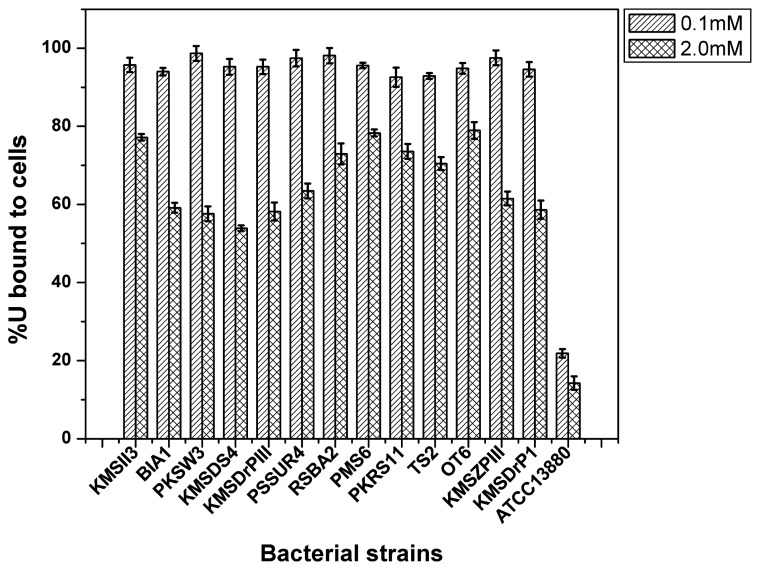
Uranium (U)-tolerant aerobic chemo-heterotrophic bacteria were isolated from the sub-surface soils of U-rich deposits in Domiasiat, North East India. The bacterial community explored at molecular level by amplified ribosomal DNA restriction analysis (ARDRA) resulted in 51 distinct phylotypes. Bacterial community assemblages at the U mining site with the concentration of U ranging from 20 to 100 ppm, were found to be most diverse. Representative bacteria analysed by 16S rRNA gene sequencing were affiliated to Firmicutes (51%), Gammaproteobacteria (26%), Actinobacteria (11%), Bacteroidetes (10%) and Betaproteobacteria (2%). Representative strains removed more than 90% and 53% of U from 100 µM and 2 mM uranyl nitrate solutions, respectively, at pH 3.5 within 10 min of exposure and the activity was retained until 24 h. Overall, 76% of characterized isolates possessed phosphatase enzyme and 53% had PIB-type ATPase genes. This study generated baseline information on the diverse indigenous U-tolerant bacteria which could serve as an indicator to estimate the environmental impact expected to be caused by mining in the future. Also, these natural isolates efficient in uranium binding and harbouring phosphatase enzyme and metal-transporting genes could possibly play a vital role in the bioremediation of metal-/radionuclide-contaminated environments.
从印度东北部铀丰富矿床的地下土壤中分离出了耐铀的需氧化能异养细菌。通过扩增核糖体 DNA 限制分析(ARDRA)在分子水平上对细菌群落进行了研究,结果产生了 51 个不同的基因型。在铀矿区,细菌群落的组合在铀浓度为 20 至 100ppm 时最为多样。通过 16S rRNA 基因测序分析的代表性细菌属于厚壁菌门(51%)、γ-变形菌纲(26%)、放线菌门(11%)、拟杆菌门(10%)和β-变形菌纲(2%)。代表性菌株在 pH 值为 3.5 时,在 10 分钟内从 100µM 和 2mM 硝酸铀酰溶液中去除了超过 90%和 53%的铀,并且在 24 小时内保持活性。总的来说,76%的特征菌株具有磷酸酶酶活性,53%的菌株具有 PIB 型 ATP 酶基因。本研究为多样化的本土耐铀细菌提供了基线信息,这些细菌可以作为估计未来采矿可能造成的环境影响的指标。此外,这些能够有效结合铀并具有磷酸酶酶和金属转运基因的天然分离物,可能在金属/放射性核素污染环境的生物修复中发挥重要作用。