Department of Microbiology, University of Granada, 18071 Granada, Spain.
Centro de Instrumentación Científica (CIC), University of Granada, 18071 Granada, Spain.
Molecules. 2019 Oct 27;24(21):3868. doi: 10.3390/molecules24213868.
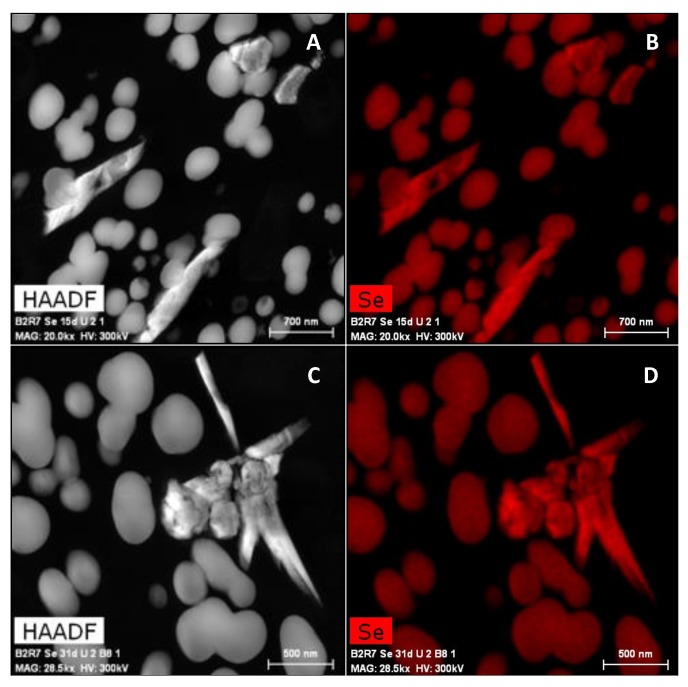
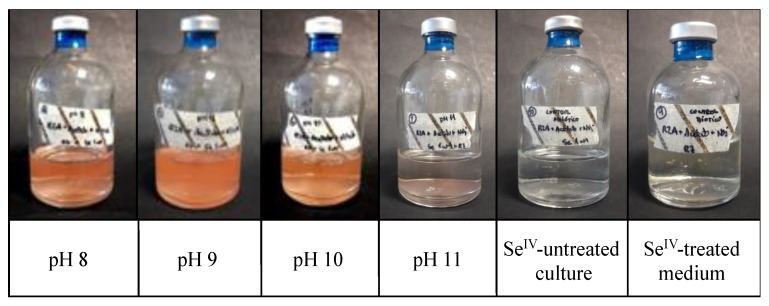
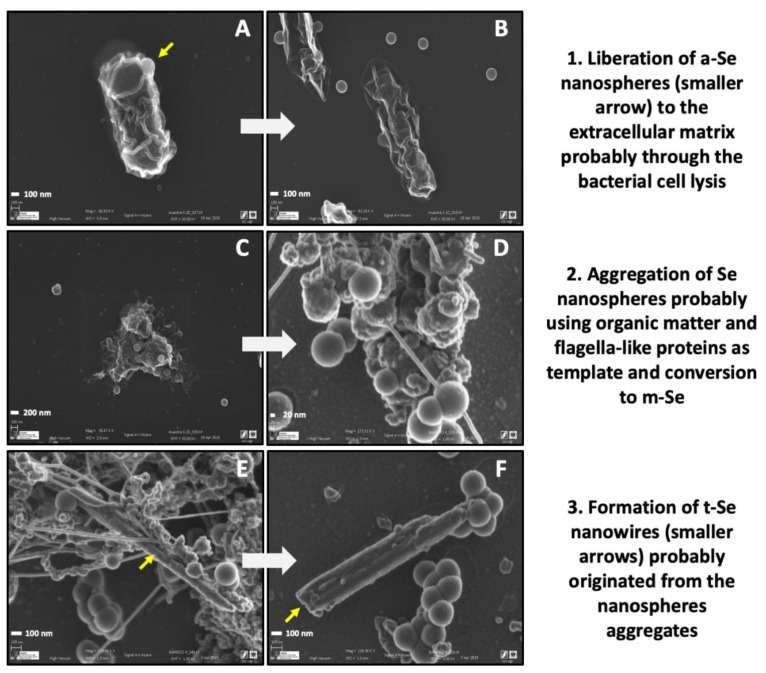
The environmental conditions for the planned geological disposal of radioactive waste -including hyper-alkaline pH, radiation or anoxia-are expected to be extremely harsh for microbial activity. However, it is thought that microbial communities will develop in these repositories, and this would have implications for geodisposal integrity and the control of radionuclide migration through the surrounding environment. Nuclear waste contains radioactive isotopes of selenium (Se) such as Se, which has been identified as one of the main radionuclides in a geodisposal system. Here, we use the bacterial species , isolated from bentonites serving as an artificial barrier reference material in repositories, to study the reduction of selenite (Se) under simulated geodisposal conditions. This bacterium is able to reduce toxic Se anaerobically from a neutral to alkaline initial pH (up to pH 10), thereby producing elemental selenium (Se) nanospheres and nanowires. A transformation process from amorphous Se (a-Se) nanospheres to trigonal Se (t-Se) nanowires, through the formation of monoclinic Se (m-Se) aggregates as an intermediate step, is proposed. The lesser solubility of Se and t-Se makes a potential candidate to positively influence the security of a geodisposal system, most probably with lower efficiency rates than those obtained aerobically.
计划中的放射性废物地质处置的环境条件——包括高碱性 pH 值、辐射或缺氧——预计对微生物活动极为苛刻。然而,人们认为微生物群落将在这些处置库中发展,这将对地质处置的完整性以及控制放射性核素通过周围环境的迁移产生影响。核废料中含有放射性同位素硒(Se),如 Se,它被确定为地质处置系统中的主要放射性核素之一。在这里,我们使用从膨润土中分离出来的细菌物种 来研究在模拟地质处置条件下亚硒酸盐(Se)的还原。这种细菌能够在中性到碱性初始 pH 值(高达 pH 10)下将有毒的 Se 进行厌氧还原,从而产生元素硒(Se)纳米球和纳米线。提出了一个从无定形硒(a-Se)纳米球到三角硒(t-Se)纳米线的转化过程,通过形成单斜硒(m-Se)聚集体作为中间步骤。Se 和 t-Se 的溶解度较低,使得 成为影响地质处置系统安全性的潜在候选物,其效率可能比有氧条件下获得的效率低。