Department of Entomology, China Agricultural University, Haidian District, Beijing 100193, China.
Molecules. 2012 Oct 15;17(10):12049-60. doi: 10.3390/molecules171012049.
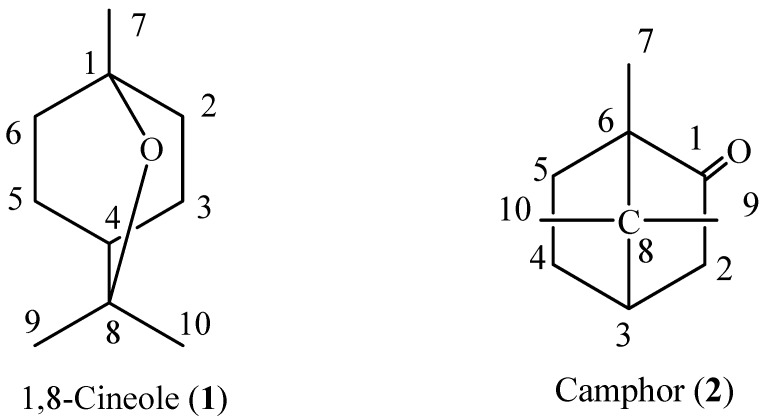
The aim of this research was to determine the chemical composition and insecticidal activity of the essential oil of Curcuma wenyujin Y.H. Chen et C. Ling rhizomes against the booklouse Liposcelis bostrychophila Badonnel and to isolate any insecticidal constituents from the essential oil. The essential oil of C. wenyujin rhizomes was obtained by hydrodistillation and analyzed by GC-MS. A total of 43 components of the essential oil were identified and the principal compounds in the essential oil were 1,8-cineole (15.26%), camphor (10.12%), germacrone (6.86%), β-elemene (6.33%), curzerene (6.70%), and β-elemenone (5.23%). followed by curzerenone (4.52%), curdione (4.45%) and linalool (4.43%). Based on bioactivity-guided fractionation, the two main active constituents were isolated from the essential oil and identified as 1,8-cineole and camphor. The essential oil of C. wenyujin rhizomes exhibited contact toxicity against L. bostrychophila with an LD₅₀ value of 208.85 µg/cm². Camphor (LD₅₀ = 207.26 µg/cm²) exhibited stronger contact toxicity than 1,8-cineole (LD₅₀ = 1048.75 µg/cm²) against booklouse. The essential oil of C. wenyujin (LC₅₀ = 2.76 mg/L air) also possessed fumigant toxicity against L. bostrychophila, while the two constituents, camphor and 1,8-cineole had LC₅₀ values of 1.03 mg/L air and 1.13 mg/L air, respectively. The results indicate that the essential oil of C. wenyujin rhizomes and its constituent compounds have potential for development as natural insecticides or fumigants for control of insects in stored grains.
本研究旨在确定温郁金根茎精油的化学成分和杀虫活性,以对抗书虱 Liposcelis bostrychophila Badonnel,并从精油中分离出任何杀虫成分。温郁金根茎精油采用水蒸馏法提取,并用 GC-MS 进行分析。鉴定出精油的 43 种成分,其中主要化合物为 1,8-桉叶素(15.26%)、樟脑(10.12%)、大根香叶烯酮(6.86%)、β-榄香烯(6.33%)、莪术烯(6.70%)和β-榄烯酮(5.23%)。其次是莪术二酮(4.52%)、莪术酮(4.45%)和芳樟醇(4.43%)。基于生物活性导向的分级分离,从精油中分离出两种主要活性成分,并鉴定为 1,8-桉叶素和樟脑。温郁金根茎精油对书虱表现出接触毒性,LD₅₀ 值为 208.85 µg/cm²。樟脑(LD₅₀ = 207.26 µg/cm²)对书虱的接触毒性强于 1,8-桉叶素(LD₅₀ = 1048.75 µg/cm²)。温郁金精油(LC₅₀ = 2.76 mg/L 空气)对书虱也具有熏蒸毒性,而樟脑和 1,8-桉叶素的 LC₅₀ 值分别为 1.03 mg/L 空气和 1.13 mg/L 空气。结果表明,温郁金根茎精油及其成分化合物具有作为天然杀虫剂或熏蒸剂开发的潜力,可用于防治储粮害虫。