University of Utah Department of Family and Preventive Medicine, Salt Lake City, Utah 84108, USA.
Environ Health Perspect. 2013 Jan;121(1):79-84. doi: 10.1289/ehp.1104231. Epub 2012 Oct 25.
Above-ground and underground nuclear weapon detonation at the Nevada Test Site (1951-1992) has resulted in radioiodine exposure for nearby populations. Although the long-term effect of environmental radioiodine exposure on thyroid disease has been well studied, little is known regarding the effect of childhood radioiodine exposure on subsequent fertility.
We investigated early childhood thyroid radiation exposure from nuclear testing fallout (supplied predominantly by radioactive isotopes of iodine) and self-reported lifetime incidence of male or female infertility or sterility.
Participants were members of the 1965 Intermountain Fallout Cohort, schoolchildren at the time of exposure who were reexamined during two subsequent study phases to collect dietary and reproductive histories. Thyroid radiation exposure was calculated via an updated dosimetry model. We used multivariable logistic regression with robust sandwich estimators to estimate odds ratios for infertility, adjusted for potential confounders and (in separate models) for a medically confirmed history of thyroid disease.
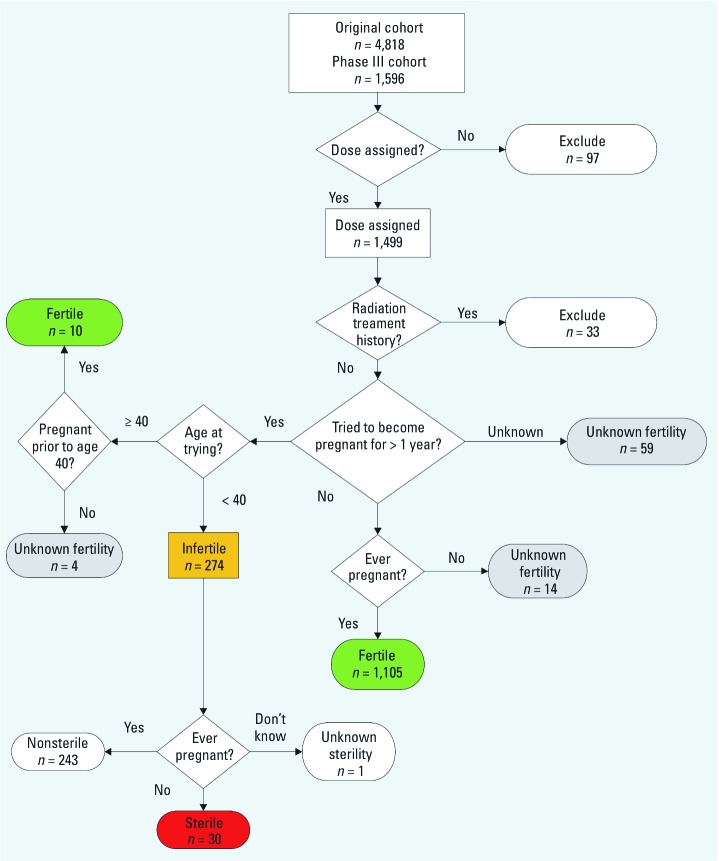
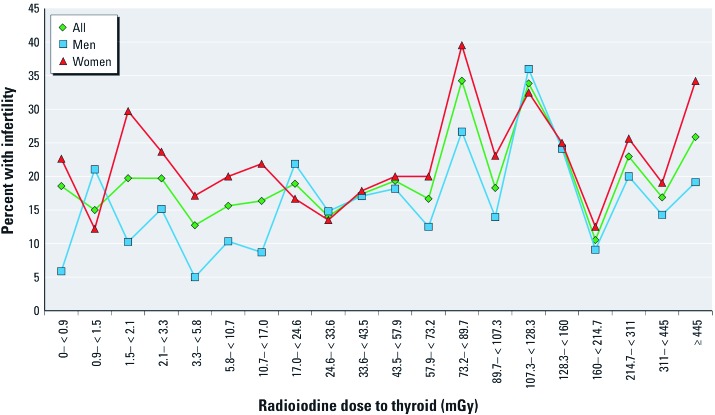
Of 1,389 participants with dosimetry and known fertility history, 274 were classified as infertile, including 30 classified as sterile. Childhood thyroid radiation dose was possibly associated with infertility [adjusted odds ratio (AOR) = 1.17; 95% CI: 0.82, 1.67 and AOR = 1.35; 95% CI: 0.96, 1.90 for the middle and upper tertiles vs. the first tertile of exposure, respectively]. The odds ratios were attenuated (AOR = 1.08; 95% CI: 0.75, 1.55 and AOR = 1.29; 95% CI: 0.91, 1.83 for the middle and upper tertiles, respectively) after adjusting for thyroid disease. There was no association of childhood radiation dose and sterility.
Our findings suggest that childhood radioiodine exposure from nuclear testing may be related to subsequent adult infertility. Further research is required to confirm this.
内华达州试验场(1951-1992 年)的地上和地下核武器爆炸导致附近居民接触放射性碘。尽管环境放射性碘暴露对甲状腺疾病的长期影响已得到充分研究,但对于儿童时期放射性碘暴露对随后生育能力的影响知之甚少。
我们研究了核试验沉降物(主要由放射性碘同位素提供)导致的儿童早期甲状腺辐射暴露以及自我报告的男性或女性不孕或不育的终身发生率。
参与者为 1965 年山间沉降物队列的成员,是暴露时的学童,在随后的两个研究阶段接受重新检查,以收集饮食和生殖史。甲状腺辐射暴露通过更新的剂量模型进行计算。我们使用多变量逻辑回归和稳健的夹心估计量来估计不孕的优势比,调整潜在混杂因素,并(在单独模型中)调整医学上确认的甲状腺疾病史。
在 1389 名具有剂量测定和已知生育史的参与者中,有 274 名被归类为不孕,其中 30 名被归类为不育。儿童期甲状腺辐射剂量可能与不孕有关(调整后的优势比(AOR)=1.17;95%置信区间:0.82,1.67 和 AOR=1.35;95%置信区间:0.96,1.90,分别为暴露的中、上三分位数与第一三分位数相比)。调整甲状腺疾病后,比值比减弱(AOR=1.08;95%置信区间:0.75,1.55 和 AOR=1.29;95%置信区间:0.91,1.83,分别为中、上三分位数)。儿童期辐射剂量与不育之间没有关联。
我们的发现表明,核试验引起的儿童期放射性碘暴露可能与随后的成人不孕有关。需要进一步的研究来证实这一点。