Haasenritter Jorg, Stanze Damaris, Widera Grit, Wilimzig Christian, Abu Hani Maren, Sonnichsen Andreas C, Bosner Stefan, Rochon Justine, Donner-Banzhoff Norbert
Philipps-Universitat Marburg, Abteilung fur Allgemeinmedizin, Praventive und Rehabilitative Medizin, Karl-von-Frisch-Strasse 4, Marburg, Germany.
Croat Med J. 2012 Oct;53(5):432-41. doi: 10.3325/cmj.2012.53.432.
To determine the diagnostic value of single symptoms and signs for coronary heart disease (CHD) in patients with chest pain.
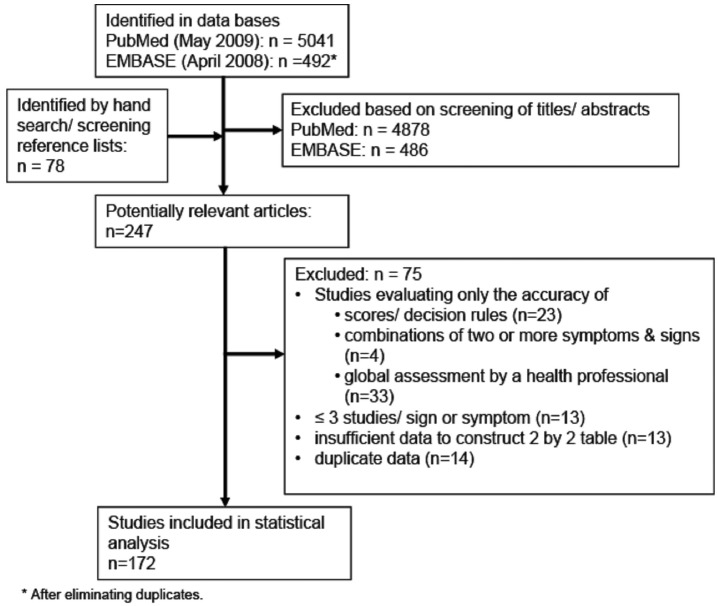
Searches of two electronic databases (EMBASE 1980 to March 2008, PubMed 1966 to May 2009) and hand searching in seven journals were conducted. Eligible studies recruited patients presenting with acute or chronic chest pain. The target disease was CHD, with no restrictions regarding case definitions, eg, stable CHD, acute coronary syndrome (ACS), acute myocardial infarction (MI), or major cardiac event (MCE). Diagnostic tests of interest were items of medical history and physical examination. Bivariate random effects model was used to derive summary estimates of positive (pLR) and negative likelihood ratios (nLR).
We included 172 studies providing data on the diagnostic value of 42 symptoms and signs. With respect to case definition of CHD, diagnostically most useful tests were history of CHD (pLR=3.59), known MI (pLR=3.21), typical angina (pLR=2.35), history of diabetes mellitus (pLR=2.16), exertional pain (pLR=2.13), history of angina pectoris (nLR=0.42), and male sex (nLR=0.49) for diagnosing stable CHD; pain radiation to right arm/shoulder (pLR=4.43) and palpitation (pLR=0.47) for diagnosing MI; visceral pain (pLR=2.05) for diagnosing ACS; and typical angina (pLR=2.60) and pain reproducible by palpation (pLR=0.13) for predicting MCE.
We comprehensively reported the accuracy of a broad spectrum of single symptoms and signs for diagnosing myocardial ischemia. Our results suggested that the accuracy of several symptoms and signs varied in the published studies according to the case definition of CHD.
确定胸痛患者中单一症状和体征对冠心病(CHD)的诊断价值。
检索了两个电子数据库(EMBASE,1980年至2008年3月;PubMed,1966年至2009年5月),并对七种期刊进行了手工检索。纳入的合格研究招募了有急性或慢性胸痛症状的患者。目标疾病为冠心病,对病例定义无限制,如稳定型冠心病、急性冠状动脉综合征(ACS)、急性心肌梗死(MI)或重大心脏事件(MCE)。感兴趣的诊断测试为病史和体格检查项目。采用双变量随机效应模型得出阳性似然比(pLR)和阴性似然比(nLR)的汇总估计值。
我们纳入了172项研究,这些研究提供了42种症状和体征诊断价值的数据。就冠心病的病例定义而言,诊断最有用的测试为冠心病病史(pLR = 3.59)、已知心肌梗死(pLR = 3.21)、典型心绞痛(pLR = 2.35)、糖尿病病史(pLR = 2.16)、劳力性疼痛(pLR = 2.13)、心绞痛病史(nLR = 0.42)以及男性(nLR = 0.49),用于诊断稳定型冠心病;疼痛放射至右臂/肩部(pLR = 4.43)和心悸(pLR = 0.47),用于诊断心肌梗死;内脏性疼痛(pLR = 2.05),用于诊断急性冠状动脉综合征;典型心绞痛(pLR = 2.60)和触诊可再现的疼痛(pLR = 0.13),用于预测重大心脏事件。
我们全面报告了一系列单一症状和体征诊断心肌缺血的准确性。我们的结果表明,根据冠心病的病例定义,已发表研究中几种症状和体征的准确性有所不同。