Tilea Ioan, Varga Andreea, Serban Razvan Constantin
Department M4, Clinical Sciences, Faculty of Medicine, "G. E. Palade" University of Medicine, Pharmacy, Science and Technology of Targu Mures, 540142 Targu Mures, Romania.
Department of Cardiology II, Emergency Clinical County Hospital, 540042 Targu Mures, Romania.
Diagnostics (Basel). 2021 May 15;11(5):881. doi: 10.3390/diagnostics11050881.
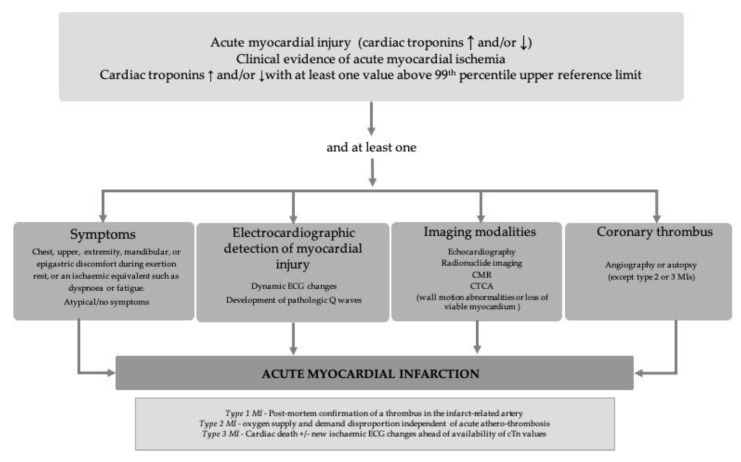
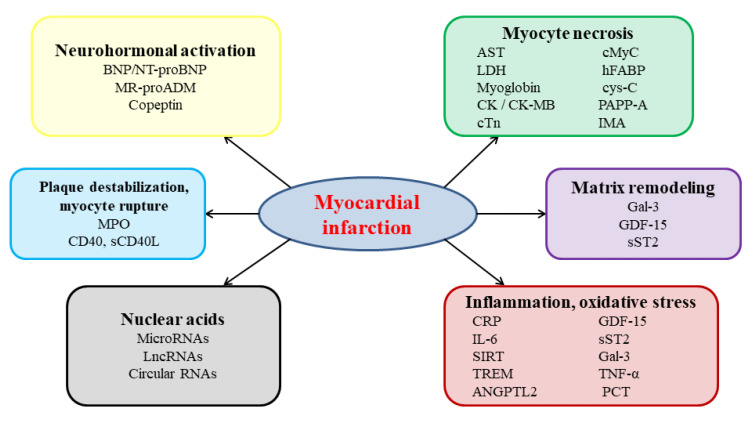
Despite important advancements in acute myocardial infarction (AMI) management, it continues to represent a leading cause of mortality worldwide. Fast and reliable AMI diagnosis can significantly reduce mortality in this high-risk population. Diagnosis of AMI has relied on biomarker evaluation for more than 50 years. The upturn of high-sensitivity cardiac troponin testing provided extremely sensitive means to detect cardiac myocyte necrosis, but this increased sensitivity came at the cost of a decrease in diagnostic specificity. In addition, although cardiac troponins increase relatively early after the onset of AMI, they still leave a time gap between the onset of myocardial ischemia and our ability to detect it, thus precluding very early management of AMI. Newer biomarkers detected in processes such as inflammation, neurohormonal activation, or myocardial stress occur much earlier than myocyte necrosis and the diagnostic rise of cardiac troponins, allowing us to expand biomarker research in these areas. Increased understanding of the complex AMI pathophysiology has spurred the search of new biomarkers that could overcome these shortcomings, whereas multi-omic and multi-biomarker approaches promise to be game changers in AMI biomarker assessment. In this review, we discuss the evolution, current application, and emerging blood biomarkers for the diagnosis of AMI; we address their advantages and promises to improve patient care, as well as their challenges, limitations, and technical and diagnostic pitfalls. Questions that remain to be answered and hotspots for future research are also emphasized.
尽管急性心肌梗死(AMI)管理取得了重要进展,但它仍是全球主要的死亡原因之一。快速可靠的AMI诊断可显著降低这一高危人群的死亡率。50多年来,AMI的诊断一直依赖于生物标志物评估。高敏心肌肌钙蛋白检测的出现提供了极其灵敏的手段来检测心肌细胞坏死,但这种灵敏度的提高是以诊断特异性的降低为代价的。此外,尽管心肌肌钙蛋白在AMI发作后相对较早升高,但它们仍在心肌缺血发作与我们检测到它的能力之间留下了时间间隔,从而排除了对AMI的极早期管理。在炎症、神经激素激活或心肌应激等过程中检测到的新型生物标志物比心肌细胞坏死和心肌肌钙蛋白的诊断性升高出现得更早,这使我们能够在这些领域扩展生物标志物研究。对复杂的AMI病理生理学的深入了解促使人们寻找能够克服这些缺点的新型生物标志物,而多组学和多生物标志物方法有望成为AMI生物标志物评估的变革者。在本综述中,我们讨论了用于AMI诊断的生物标志物的演变、当前应用和新兴的血液生物标志物;我们阐述了它们在改善患者护理方面的优势和前景,以及它们面临的挑战、局限性以及技术和诊断陷阱。还强调了有待回答的问题和未来研究的热点。