Division of Virology, Department of Infection and Immunity, Jichi Medical University School of Medicine, 3311-1 Yakushiji, Shimotsuke, Tochigi, 329-0498, Japan.
J Gastroenterol. 2013 Feb;48(2):147-58. doi: 10.1007/s00535-012-0682-0. Epub 2012 Oct 27.
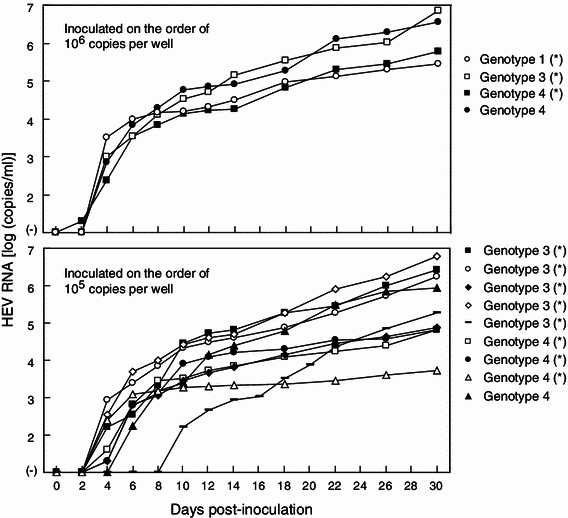
The lack of an efficient cell culture system for hepatitis E virus (HEV) has greatly hampered detailed analyses of this virus. The first efficient cell culture systems for HEV that were developed were capable of secreting infectious HEV progenies in high titers into culture media, using PLC/PRF/5 cells derived from human hepatocellular carcinoma and A549 cells derived from human lung cancer as host cells. The success achieved with the original genotype 3 JE03-1760F strain has now been extended to various HEV strains in fecal and serum samples obtained from hepatitis E patients and to HEV strains in fecal and serum samples and liver tissues obtained from pigs and wild boar across species barriers. In addition, infectious HEV cDNA clones of the wild-type JE03-1760F strain and its variants have been engineered. Cell culture-generated HEV particles and those in circulating blood were found to be associated with lipids and open reading frame 3 (ORF3) protein, thereby likely contributing to the assembly and release of HEV from infected cells both in vivo and in vitro. The ORF3 protein interacts with the tumor susceptibility gene 101, a critical cellular protein required for the budding of enveloped viruses, through the Pro, Ser, Ala, and Pro (PSAP) motif in infected cells; ORF3 is co-localized with multivesicular bodies (MVBs) in the cytoplasm of infected cells, thus suggesting that HEV requires the MVB pathway for the egress of virus particles. This article reviews the development of efficient cell culture systems for a wide variety of infectious HEV strains obtained from humans, pigs, and wild boar, and also provides details of a new model for virion egress.
缺乏有效的戊型肝炎病毒 (HEV) 细胞培养系统极大地阻碍了对该病毒的详细分析。最初开发的用于 HEV 的高效细胞培养系统能够以高滴度在培养基中分泌传染性 HEV 后代,使用源自人肝癌的 PLC/PRF/5 细胞和源自人肺癌的 A549 细胞作为宿主细胞。使用原始基因型 3 JE03-1760F 株取得的成功现已扩展到从戊型肝炎患者粪便和血清样本中获得的各种 HEV 株以及从猪和野猪粪便和血清样本和肝组织中获得的 HEV 株。此外,还构建了野生型 JE03-1760F 株及其变体的感染性 HEV cDNA 克隆。在细胞培养中产生的 HEV 颗粒和循环血液中的颗粒被发现与脂质和开放阅读框 3 (ORF3) 蛋白相关,从而可能有助于病毒在体内和体外从受感染细胞中组装和释放。ORF3 蛋白通过感染细胞中的 Pro, Ser, Ala, and Pro (PSAP) 基序与肿瘤易感性基因 101 相互作用,该蛋白是包裹病毒出芽所必需的关键细胞蛋白;ORF3 在感染细胞的细胞质中与多泡体 (MVB) 共定位,因此表明 HEV 出芽需要 MVB 途径。本文综述了从人类、猪和野猪中获得的各种传染性 HEV 株的高效细胞培养系统的发展,并详细介绍了一种新的病毒粒子出芽模型。