Department of Radiology, University of Arkansas for Medical Sciences, 4301 West Markham Street Slot #556, Little Rock, AR 72205, USA.
J Vasc Interv Radiol. 2012 Dec;23(12):1677-1684.e1. doi: 10.1016/j.jvir.2012.08.019. Epub 2012 Oct 27.
To quantify the effects of microbubble (MB) size, elasticity, and pulsed ultrasonic parameters on in vitro sonothrombolysis (ultrasound [US]-mediated thrombolysis) efficacy.
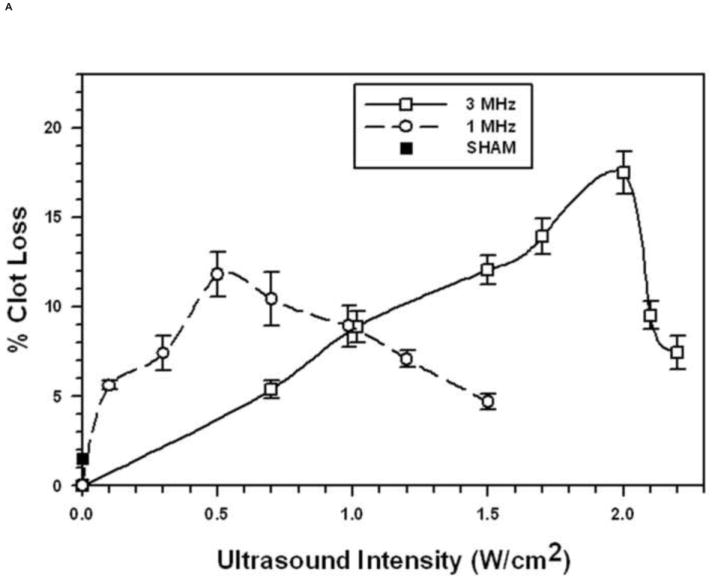
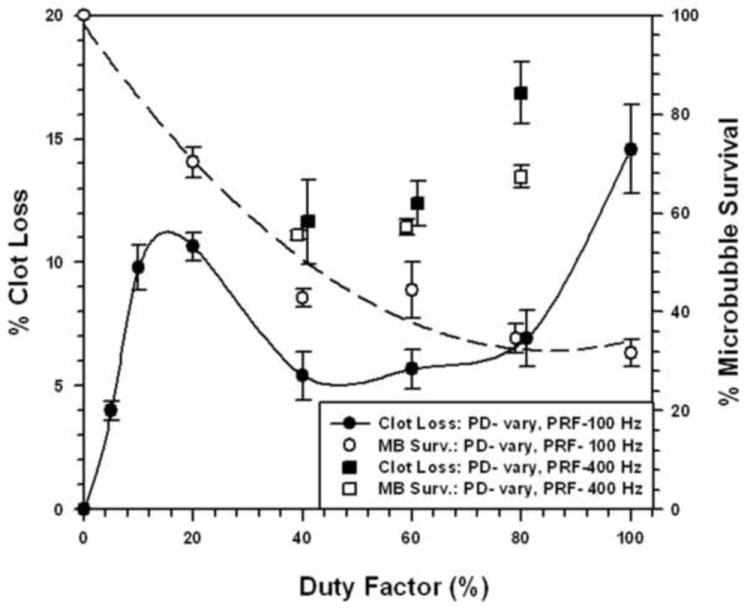
Monodispersive MBs with diameters of 1 μm or 3 μm were exposed to pulsed US (1 MHz or 3 MHz) to lyse rabbit blood clots. Sonothrombolysis efficacy (clot mass loss) was measured as functions of MB size and concentration, ultrasonic frequency and intensity, pulse duration (PD), pulse repeat frequency (PRF), and duty factor.
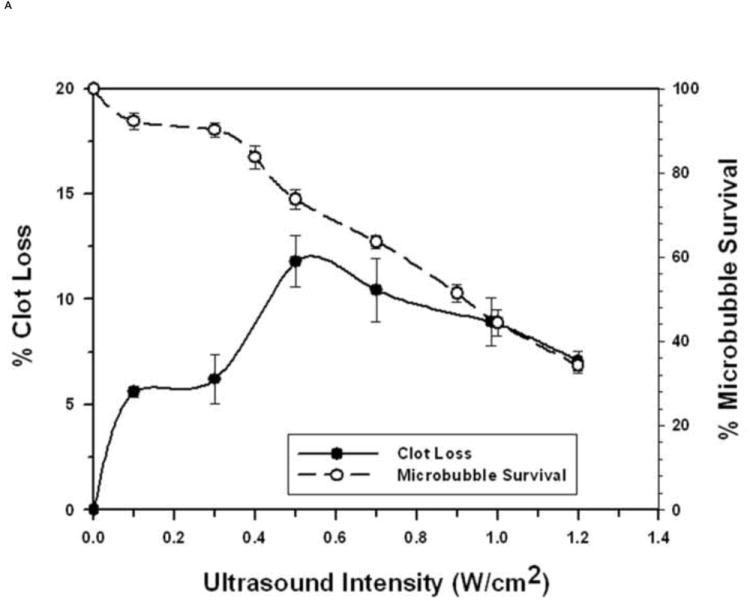
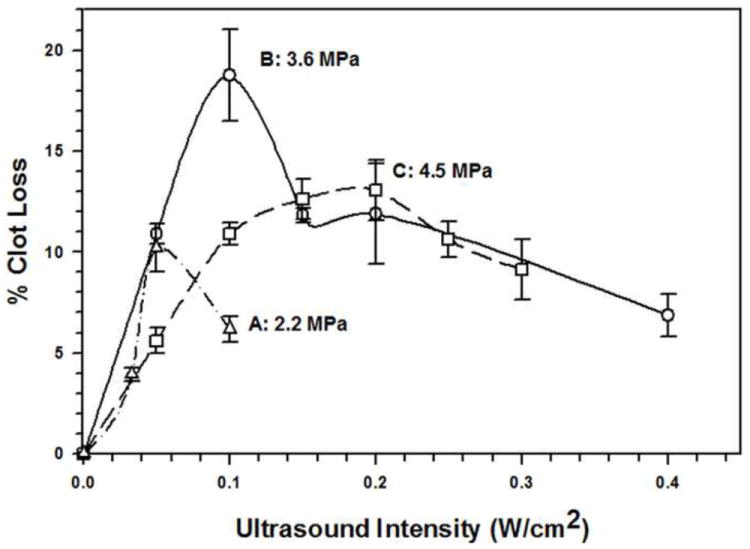
Sonothrombolysis at 1 MHz was more effective using 3-μm MBs and at 3 MHz using 1-μm MBs. Sonothrombolysis was more effective at 1 MHz when≥75% of MBs remained intact, especially for 3-μm MBs; improving sonothrombolysis by increasing PRF from 100 Hz to 400 Hz at 3 MHz was associated with increasing 3-μm MB survival. However, 60% of 1-μm MBs were destroyed during maximal sonothrombolysis at 3 MHz, indicating that considerable MB collapse may be required for sonothrombolysis under these conditions.
The ability to control MB size and elasticity permits using a wide range of US parameters (eg, frequency, intensity) to produce desired levels of sonothrombolysis. Comparable, maximal sonothrombolysis efficacy was achieved at 20-fold lower intensity with 3-μm MBs (0.1W/cm(2)) than with 1-μm MBs (2.0W/cm(2)), a potential safety issue for in vivo sonothrombolysis. US parameters that maximized MB survival yielded maximal sonothrombolysis efficacy except with 1-μm MBs at 3MHz where most MBs were destroyed.
定量研究微泡(MB)大小、弹性和脉冲超声参数对体外超声溶栓(超声介导溶栓)效果的影响。
将直径为 1μm 或 3μm 的单分散 MB 暴露于脉冲超声(1MHz 或 3MHz)中以溶解兔血凝块。作为 MB 大小和浓度、超声频率和强度、脉冲持续时间(PD)、脉冲重复频率(PRF)和占空比的函数,测量超声溶栓效果(血凝块质量损失)。
1MHz 时,3μm MB 更有效,3MHz 时,1μm MB 更有效。当≥75%的 MB 保持完整时,1MHz 时的超声溶栓效果更好,特别是对于 3μm MB;在 3MHz 时,将 PRF 从 100Hz 增加到 400Hz,可提高超声溶栓效果,同时伴随着 3μm MB 存活率的增加。然而,在 3MHz 时最大超声溶栓时,60%的 1μm MB 被破坏,这表明在这些条件下进行超声溶栓可能需要相当大的 MB 塌陷。
控制 MB 大小和弹性的能力允许使用广泛的超声参数(例如,频率、强度)来产生所需水平的超声溶栓。使用 3μm MB(0.1W/cm²)时,可实现与使用 1μm MB(2.0W/cm²)时相当的最大超声溶栓效果,但强度低 20 倍,这是体内超声溶栓的一个潜在安全问题。除了在 3MHz 时大多数 MB 被破坏的 1μm MB 外,使 MB 存活率最大化的超声参数可产生最大的超声溶栓效果。