Department of Physical Therapy, University of British Columbia, 212-2177 Wesbrook Mall, Vancouver, BC V6T 1Z3, Canada.
BMC Neurol. 2012 Oct 30;12:126. doi: 10.1186/1471-2377-12-126.
Maintaining cognitive function is essential for healthy aging and to function autonomously within society. White matter lesions (WMLs) are associated with reduced cognitive function in older adults. However, whether their anatomical location moderates these associations is not well-established. This review systematically evaluates peer-reviewed evidence on the role of anatomical location in the association between WMLs and cognitive function.
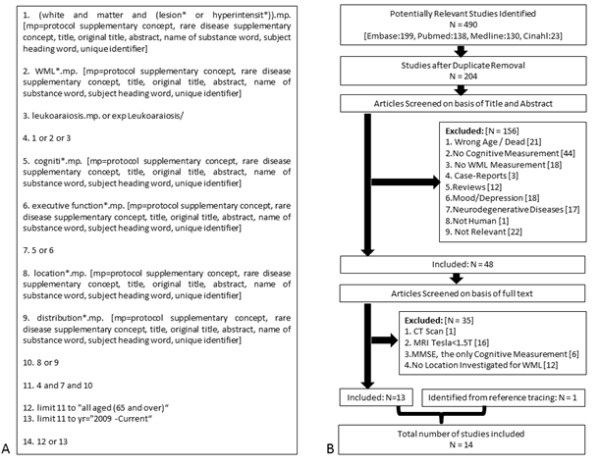
In accordance with the preferred reporting items for systematic reviews and meta-analysis (PRISMA) statement, databases of EMBASE, PUBMED, MEDLINE, and CINAHL, and reference lists of selected papers were searched. We limited our search results to adults aged 60 years and older, and studies published in the English language from 2000 to 2011. Studies that investigated the association between cognitive function and WML location were included. Two independent reviewers extracted: 1) study characteristics including sample size, sample characteristic, and study design; 2) WML outcomes including WML location, WML quantification method (scoring or volume measurement), strength of the MRI magnet in Tesla, and MRI sequence used for WML detection; and 3) cognitive function outcomes including cognitive tests for two cognitive domains of memory and executive function/processing speed.
Of the 14 studies included, seven compared the association of subcortical versus periventricular WMLs with cognitive function. Seven other studies investigated the association between WMLs in specific brain regions (e.g., frontal, parietal lobes) and cognitive function. Overall, the results show that a greater number of studies have found an association between periventricular WMLs and executive function/processing speed, than subcortical WMLs. However, whether WMLs in different brain regions have a differential effect on cognitive function remains unclear.
Evidence suggests that periventricular WMLs may have a significant negative impact on cognitive abilities of older adults. This finding may be influenced by study heterogeneity in: 1) MRI sequences, WML quantification methods, and neuropsychological batteries; 2) modifying effect of cardiovascular risk factors; and 3) quality of studies and lack of sample size calculation.
保持认知功能对于健康老龄化和在社会中自主生活至关重要。脑白质病变(WMLs)与老年人认知功能下降有关。然而,其解剖位置是否调节这些关联尚不清楚。本综述系统评估了同行评议文献中关于 WML 解剖位置与认知功能之间关联的作用。
根据系统评价和荟萃分析的首选报告项目(PRISMA)声明,检索了 EMBASE、PUBMED、MEDLINE 和 CINAHL 数据库以及选定论文的参考文献列表。我们将搜索结果限制为年龄在 60 岁及以上的成年人,以及 2000 年至 2011 年期间以英文发表的研究。纳入了研究认知功能与 WML 位置之间关系的研究。两名独立的评审员提取了以下内容:1)研究特征,包括样本量、样本特征和研究设计;2)WML 结果,包括 WML 位置、WML 量化方法(评分或体积测量)、MRI 磁体的特斯拉强度以及用于检测 WML 的 MRI 序列;3)认知功能结果,包括两个认知领域(记忆和执行功能/处理速度)的认知测试。
在纳入的 14 项研究中,有 7 项比较了皮质下与脑室周围 WML 与认知功能的关系。另外 7 项研究调查了特定脑区(如额叶、顶叶)的 WML 与认知功能之间的关系。总体而言,结果表明,更多的研究发现脑室周围 WML 与执行功能/处理速度之间存在关联,而皮质下 WML 则不然。然而,不同脑区的 WML 是否对认知功能有不同的影响尚不清楚。
有证据表明,脑室周围 WML 可能对老年人的认知能力产生重大负面影响。这种发现可能受到以下因素的影响:1)MRI 序列、WML 量化方法和神经心理学测试;2)心血管危险因素的修饰作用;3)研究质量和缺乏样本量计算。