Anaraki Abdolreza Najafi, Mirzaei Kamran
Department of Anesthesia, Bushehr University of Medical Sciences, Bushehr, Iran.
Int J Prev Med. 2012 Oct;3(10):706-12.
This study was performed to compare the effect of different doses of intrathecal meperidine on the incidence and intensity of shivering and other side-effects after spinal anesthesia for cesarean delivery.
One hundred and fifty-six parturient women scheduled for elective cesarean delivery were enrolled in four groups. Spinal anesthesia consisted of heavy bupivacaine 0.5% (10 mg) in the standard group (Group I), heavy bupivacaine 0.5% (10 mg) plus meperidine (0.2 mg per kg) in Group II, heavy bupivacaine 0.5% (10 mg) plus meperidine (0.3 mg per kg) in Group III, heavy bupivacaine 0.5% (10 mg) plus meperidine (0.4 mg per kg) in Group IV. The signs and symptoms were recorded by an observer unaware of the study groups. Data were analyzed using analysis of variance, Kruskal-Wallis H-test and chi-square. A P value less than 0.05 was considered to be significant.
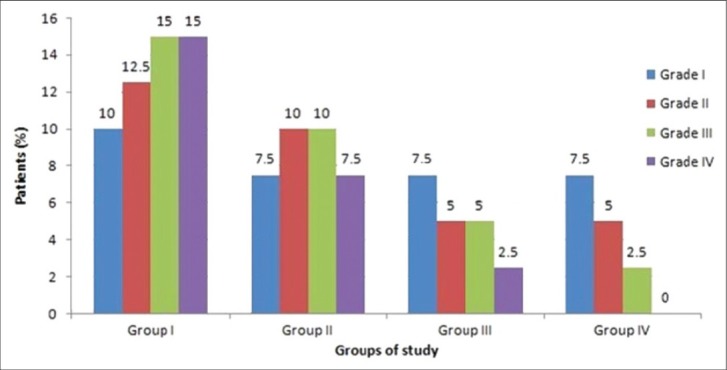
The systolic blood pressure, amount of bleeding, Pulse Rate, O2 saturation, neonatal apgar scores, core temperatures and sensory level revealed no difference between groups (P>0.05). The incidence (47.5%, 37.5%, 27.5% and 15.0%, respectively) and intensity of shivering decreased as the dose of meperidine increased (P=0.002) but the incidence of nausea and vomiting (8.0%, 15.4%, 25.9% and 35.8%, respectively) (P=0.000) and pruritis (25.64, 28.21, 38.46, and 48.72 respectively) increased as the dose of meperidine increased (P=0.000).
The high dose of intrathecal meperidine is effective in reducing the incidence and intensity of shivering associated with spinal anesthesia for cesarean delivery but the high incidence of nausea and vomiting is unpleasant for the patient and can be a major problem with a high dose of meperdine.
本研究旨在比较不同剂量鞘内注射哌替啶对剖宫产脊髓麻醉后寒战的发生率、严重程度及其他副作用的影响。
156例计划行择期剖宫产的产妇被纳入四组。标准组(I组)脊髓麻醉采用0.5%重比重布比卡因(10mg),II组采用0.5%重比重布比卡因(10mg)加哌替啶(0.2mg/kg),III组采用0.5%重比重布比卡因(10mg)加哌替啶(0.3mg/kg),IV组采用0.5%重比重布比卡因(10mg)加哌替啶(0.4mg/kg)。由不了解研究分组的观察者记录体征和症状。采用方差分析、Kruskal-Wallis H检验和卡方检验分析数据。P值小于0.05被认为具有统计学意义。
各组间收缩压、出血量、脉搏率、血氧饱和度、新生儿阿氏评分、核心体温及感觉平面无差异(P>0.05)。随着哌替啶剂量增加,寒战的发生率(分别为47.5%、37.5%、27.5%和15.0%)及严重程度降低(P=0.002),但恶心呕吐的发生率(分别为8.0%、15.4%、25.9%和35.8%)(P=0.000)及瘙痒发生率(分别为25.64、28.21、38.46和48.72)随哌替啶剂量增加而升高(P=0.000)。
高剂量鞘内注射哌替啶可有效降低剖宫产脊髓麻醉相关寒战的发生率及严重程度,但恶心呕吐的高发生率会给患者带来不适,且高剂量哌替啶可能是一个主要问题。