Eidi Mahmoud, Kolahdouzan Khosro, Hosseinzadeh Hamzeh, Tabaqi Razieh
Department of Anesthesiology, Imam Reza Hospital, Faculty of Medicine, Tabriz University of Medical Sciences, Tabriz, Iran.
Iran J Med Sci. 2012 Sep;37(3):166-72.
Nausea and vomiting are common complications of anesthesia and surgery. Patients undergoing tympanoplasty are exposed to a higher risk of postoperative nausea vomiting (PONV). These complications may alter the results of reconstruction and anatomical alignments. Numerous antiemetics have been studied to prevent and treat PONV in patients undergoing tympanoplasty. The aim of this study was to compare the effect of intravenous ondansetron and dexamethasone on post-tympanoplasty PONV.
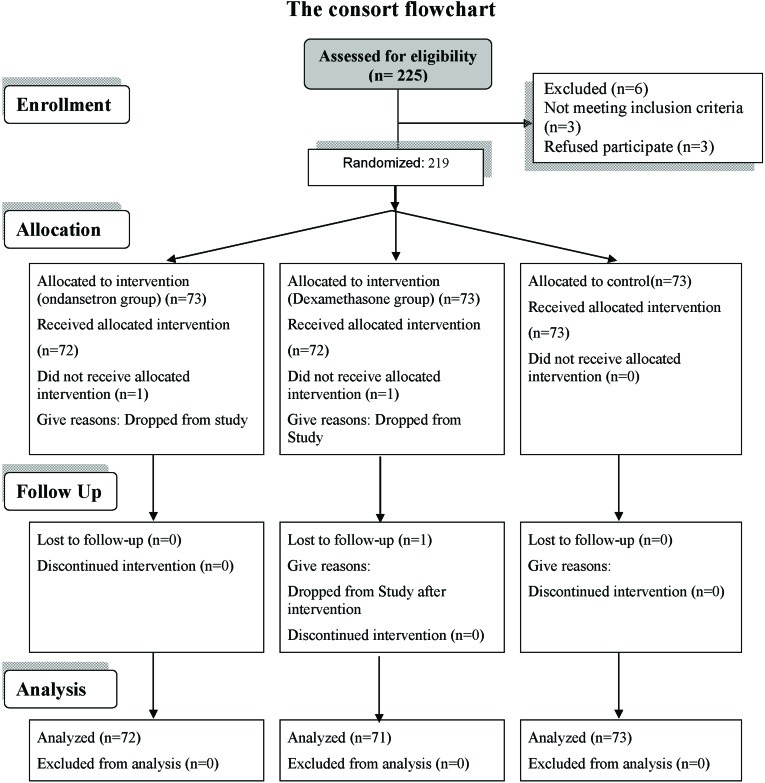
In a double-blind randomized controlled clinical trial, 219 patients were divided into three groups including one receiving ondansetron, one receiving dexamethazone, and one receiving distilled water. All patients were subjected to tympanoplasty type I. The patients in the first group received ondansetron (4 mg IV), second group received oexamethasone (8 mg IV), and third group received distilled water prior to induction of anesthesia. Using Bellivelle(')s scoring system, the incidence of PONV and its severity during the 24-hour period after surgery were measured and compared.
There was no significant difference among PONV in the three groups in the first two hours after the surgery. However, in 2-8, 8-16 and 16-24 hours after the surgery the PONV in ondansetron and dexamethasone groups were significantly lower than that in the control group.
Ondansetron and dexamethasone were more effective than placebo in controlling PONV after tympanoplasty surgeries. Moreover, dexamethasone was more effective than ondansetron in preventing PONV.
IRCT201106154005N4.
恶心和呕吐是麻醉和手术常见的并发症。接受鼓室成形术的患者术后恶心呕吐(PONV)风险更高。这些并发症可能会改变重建结果和解剖结构的对齐情况。为预防和治疗鼓室成形术患者的PONV,人们对多种止吐药进行了研究。本研究的目的是比较静脉注射昂丹司琼和地塞米松对鼓室成形术后PONV的影响。
在一项双盲随机对照临床试验中,219例患者被分为三组,一组接受昂丹司琼,一组接受地塞米松,一组接受蒸馏水。所有患者均接受I型鼓室成形术。第一组患者在麻醉诱导前接受昂丹司琼(静脉注射4毫克),第二组接受地塞米松(静脉注射8毫克),第三组接受蒸馏水。使用贝利韦尔评分系统,测量并比较术后24小时内PONV的发生率及其严重程度。
术后前两小时,三组患者的PONV发生率无显著差异。然而,在术后2至8小时、8至16小时和16至24小时,昂丹司琼组和地塞米松组的PONV发生率显著低于对照组。
昂丹司琼和地塞米松在控制鼓室成形术后PONV方面比安慰剂更有效。此外,地塞米松在预防PONV方面比昂丹司琼更有效。
IRCT201106154005N4。