Research Center for Child Mental Development, Hamamatsu University School of Medicine, 1-20-1 Handayama, Hamamatsu, 431 3192, Japan.
Department of Psychiatry and Neurology, Hamamatsu University School of Medicine, 1-20-1 Handayama, Hamamatsu, 431 3192, Japan.
Mol Autism. 2012 Nov 1;3(1):12. doi: 10.1186/2040-2392-3-12.
Mitochondrial dysfunction (MtD) has been observed in approximately five percent of children with autism spectrum disorders (ASD). MtD could impair highly energy-dependent processes such as neurodevelopment, thereby contributing to autism. Most of the previous studies of MtD in autism have been restricted to the biomarkers of energy metabolism, while most of the genetic studies have been based on mutations in the mitochondrial DNA (mtDNA). Despite the mtDNA, most of the proteins essential for mitochondrial replication and function are encoded by the genomic DNA; so far, there have been very few studies of those genes. Therefore, we carried out a detailed study involving gene expression and genetic association studies of genes related to diverse mitochondrial functions.
For gene expression analysis, postmortem brain tissues (anterior cingulate gyrus (ACG), motor cortex (MC) and thalamus (THL)) from autism patients (n=8) and controls (n=10) were obtained from the Autism Tissue Program (Princeton, NJ, USA). Quantitative real-time PCR arrays were used to quantify the expression of 84 genes related to diverse functions of mitochondria, including biogenesis, transport, translocation and apoptosis. We used the delta delta Ct (∆∆Ct) method for quantification of gene expression. DNA samples from 841 Caucasian and 188 Japanese families were used in the association study of genes selected from the gene expression analysis. FBAT was used to examine genetic association with autism.
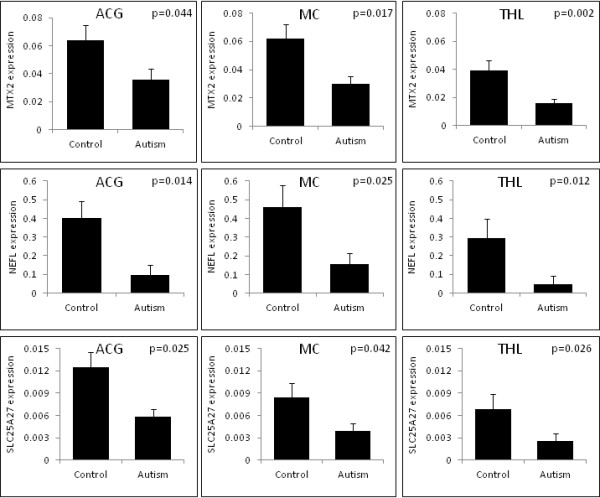
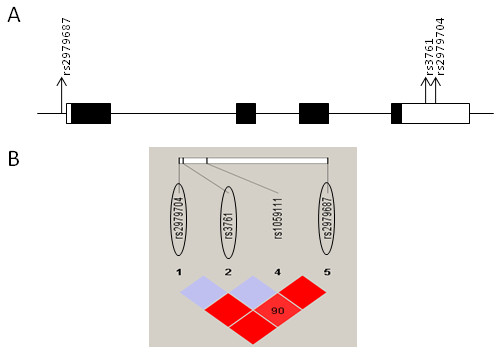
Several genes showed brain region-specific expression alterations in autism patients compared to controls. Metaxin 2 (MTX2), neurofilament, light polypeptide (NEFL) and solute carrier family 25, member 27 (SLC25A27) showed consistently reduced expression in the ACG, MC and THL of autism patients. NEFL (P = 0.038; Z-score 2.066) and SLC25A27 (P = 0.046; Z-score 1.990) showed genetic association with autism in Caucasian and Japanese samples, respectively. The expression of DNAJC19, DNM1L, LRPPRC, SLC25A12, SLC25A14, SLC25A24 and TOMM20 were reduced in at least two of the brain regions of autism patients.
Our study, though preliminary, brings to light some new genes associated with MtD in autism. If MtD is detected in early stages, treatment strategies aimed at reducing its impact may be adopted.
约有 5%的自闭症谱系障碍(ASD)儿童存在线粒体功能障碍(MtD)。MtD 可能会损害神经发育等高度依赖能量的过程,从而导致自闭症。以前关于自闭症中 MtD 的大多数研究都局限于能量代谢的生物标志物,而大多数遗传研究则基于线粒体 DNA(mtDNA)的突变。尽管 mtDNA 是大多数与线粒体复制和功能相关的必需蛋白质的编码,但到目前为止,对这些基因的研究非常少。因此,我们进行了一项详细的研究,涉及与多种线粒体功能相关的基因的表达和遗传关联研究。
为了进行基因表达分析,我们从自闭症患者(n=8)和对照者(n=10)的自闭症组织计划(新泽西州普林斯顿,美国)中获得了死后脑组织(前扣带回皮质(ACG)、运动皮层(MC)和丘脑(THL))。使用定量实时 PCR 阵列来定量 84 个与线粒体多种功能相关的基因的表达,包括生物发生、转运、易位和凋亡。我们使用 delta delta Ct(∆∆Ct)方法进行基因表达的定量。使用从基因表达分析中选择的基因的 841 个白种人和 188 个日本家族的 DNA 样本进行与自闭症相关的基因关联研究。使用 FBAT 检查与自闭症的遗传关联。
与对照组相比,一些基因在自闭症患者的大脑区域表现出特定的表达改变。Metaxin 2(MTX2)、神经丝轻多肽(NEFL)和溶质载体家族 25,成员 27(SLC25A27)在自闭症患者的 ACG、MC 和 THL 中表现出一致的表达降低。NEFL(P=0.038;Z 分数 2.066)和 SLC25A27(P=0.046;Z 分数 1.990)在白种人和日本样本中分别与自闭症存在遗传关联。在至少两个自闭症患者的脑区中,DNAJC19、DNM1L、LRPPRC、SLC25A12、SLC25A14、SLC25A24 和 TOMM20 的表达降低。
虽然我们的研究还处于初步阶段,但它揭示了一些与自闭症中的 MtD 相关的新基因。如果在早期阶段检测到 MtD,可以采用旨在减少其影响的治疗策略。