
染色体保留的 RNA 介导同源配对。
Chromosomally-retained RNA mediates homologous pairing.
机构信息
Advanced ICT Research Institute Kobe, National Institute of Information and Communication Technology, Kobe, Japan.
出版信息
Nucleus. 2012 Nov-Dec;3(6):516-9. doi: 10.4161/nucl.22732. Epub 2012 Nov 1.
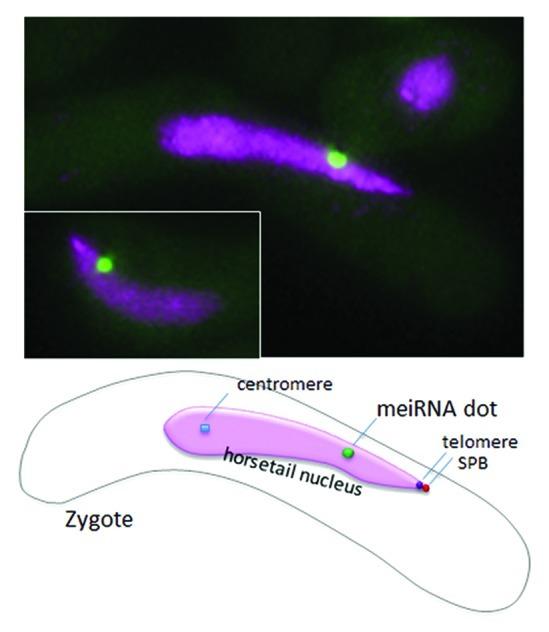
Pairing and recombination of homologous chromosomes are essential for ensuring correct segregation of chromosomes in meiosis. In S. pombe, chromosomes are first bundled at the telomeres (forming a telomere bouquet) and then aligned by oscillatory movement of the elongated "horsetail" nucleus. Telomere clustering and subsequent chromosome alignment promote pairing of homologous chromosomes. However, this telomere-bundled alignment of chromosomes cannot be responsible for the specificity of chromosome pairing. Thus, there must be some mechanism to facilitate recognition of homologous partners after telomere clustering. Recent studies in S. pombe have shown that RNA transcripts retained on the chromosome, or RNA bodies, may play a role in recognition of homologous chromosomes for pairing. Acting as fiducial markers of homologous loci they would abrogate the need for direct DNA sequence homology searching.
同源染色体的配对和重组对于确保减数分裂中染色体的正确分离至关重要。在 S. pombe 中,染色体首先在端粒处聚集(形成端粒花束),然后通过拉长的“马尾”核的振荡运动进行排列。端粒聚集和随后的染色体排列促进同源染色体的配对。然而,这种端粒捆绑的染色体排列不能负责染色体配对的特异性。因此,一定有某种机制可以促进端粒聚集后同源伴侣的识别。最近在 S. pombe 中的研究表明,染色体上保留的 RNA 转录本或 RNA 体可能在识别同源染色体进行配对中发挥作用。作为同源基因座的基准标记,它们可以消除对直接 DNA 序列同源性搜索的需求。


 Zotero 插件