Douglas Mental Health University Institute, Montréal, Québec, Canada.
PLoS One. 2012;7(10):e47922. doi: 10.1371/journal.pone.0047922. Epub 2012 Oct 31.
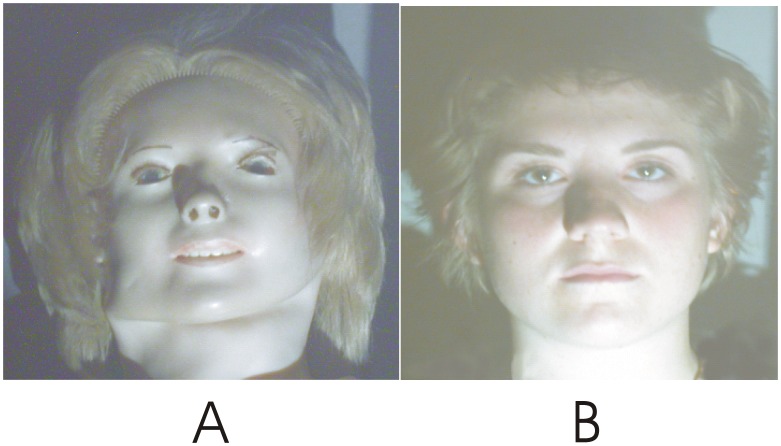
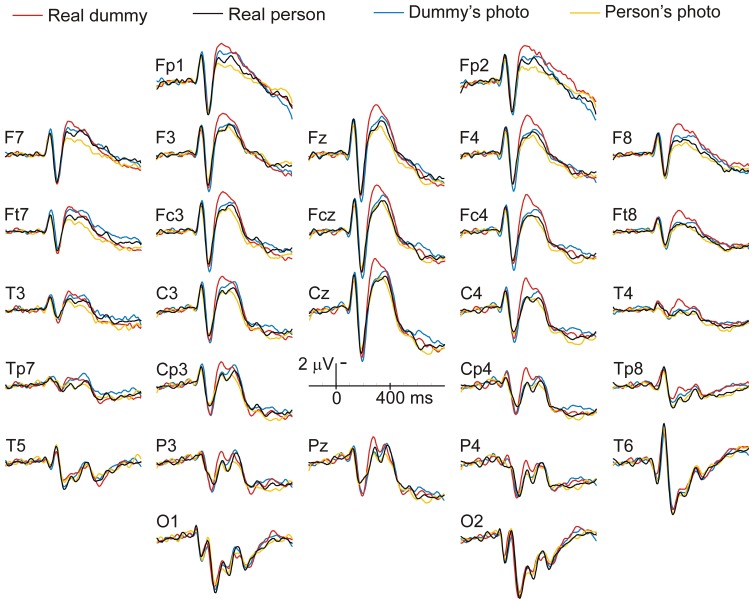
Pictures of objects have been shown to automatically activate affordances, that is, actions that could be performed with the object. Similarly, pictures of faces are likely to activate social affordances, that is, interactions that would be possible with the person whose face is being presented. Most interestingly, if it is the face of a real person that is shown, one particular type of social interactions can even be carried out while event-related potentials (ERPs) are recorded. Indeed, subtle eye movements can be made to achieve an eye contact with the person with minimal artefacts on the EEG. The present study thus used the face of a real person to explore the electrophysiological correlates of affordances in a situation where some of them (i.e., eye contacts) are actually performed. The ERPs this person elicited were compared to those evoked by another 3D stimulus: a real dummy, and thus by a stimulus that should also automatically activate eye contact affordances but with which such affordances could then be inhibited since they cannot be carried out with an object. The photos of the person and of the dummy were used as matching stimuli that should not activate social affordances as strongly as the two 3D stimuli and for which social affordances cannot be carried out. The fronto-central N300s to the real dummy were found of greater amplitudes than those to the photos and to the real person. We propose that these greater N300s index the greater inhibition needed after the stronger activations of affordances induced by this 3D stimulus than by the photos. Such an inhibition would not have occurred in the case of the real person because eye contacts were carried out.
物体的图片已被证明可以自动激活可供使用的功能,也就是说,可以用该物体执行的操作。同样,人脸的图片很可能会激活社交可供使用的功能,也就是说,与呈现的人脸的人可能会进行交互。最有趣的是,如果显示的是真实人物的脸,即使在记录事件相关电位 (ERP) 的情况下,甚至可以进行一种特殊类型的社交互动。事实上,可以进行微妙的眼球运动,以与人进行最小化 EEG 伪影的眼神接触。因此,本研究使用真实人物的面孔来探索在某些情况下(即眼神接触)实际进行的可供使用的功能的电生理相关性。与另一个 3D 刺激(即真实的假人)相比,比较了这个人引起的 ERP,从而与也应自动激活眼神接触可供使用的功能但无法执行的刺激进行了比较因为它们不能与物体一起执行。该人的照片和假人的照片被用作匹配刺激,不应像两个 3D 刺激那样强烈地激活社交可供使用的功能,并且不能执行社交可供使用的功能。发现对真实假人的额中央 N300 的幅度大于对照片和对真实人的 N300。我们提出,这些更大的 N300 反映了与照片相比,这种 3D 刺激引起的可供使用的功能更强激活后需要更大的抑制作用。在这种情况下,由于进行了眼神接触,因此不会发生这种抑制作用。