Department of Psychology, University of Chicago, Chicago, Illinois, USA.
PLoS One. 2012;7(10):e48076. doi: 10.1371/journal.pone.0048076. Epub 2012 Oct 31.
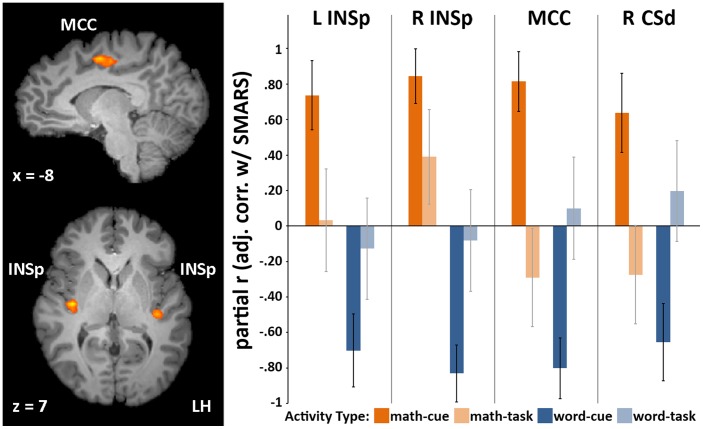
Math can be difficult, and for those with high levels of mathematics-anxiety (HMAs), math is associated with tension, apprehension, and fear. But what underlies the feelings of dread effected by math anxiety? Are HMAs' feelings about math merely psychological epiphenomena, or is their anxiety grounded in simulation of a concrete, visceral sensation - such as pain - about which they have every right to feel anxious? We show that, when anticipating an upcoming math-task, the higher one's math anxiety, the more one increases activity in regions associated with visceral threat detection, and often the experience of pain itself (bilateral dorso-posterior insula). Interestingly, this relation was not seen during math performance, suggesting that it is not that math itself hurts; rather, the anticipation of math is painful. Our data suggest that pain network activation underlies the intuition that simply anticipating a dreaded event can feel painful. These results may also provide a potential neural mechanism to explain why HMAs tend to avoid math and math-related situations, which in turn can bias HMAs away from taking math classes or even entire math-related career paths.
数学可能很难,对于那些有高度数学焦虑(HMAs)的人来说,数学与紧张、忧虑和恐惧联系在一起。但是,数学焦虑所产生的恐惧感觉的基础是什么?HMAs 对数学的感觉仅仅是心理上的现象,还是他们的焦虑是基于对一种具体的、内在感觉的模拟——比如疼痛——他们有理由感到焦虑?我们表明,当人们预期即将进行的数学任务时,他们的数学焦虑程度越高,与内脏威胁检测相关的区域的活动就会增加,而且通常还会体验到疼痛本身(双侧背侧后岛叶)。有趣的是,在进行数学计算时并没有观察到这种关系,这表明并不是数学本身造成了伤害;相反,对数学的预期是痛苦的。我们的数据表明,疼痛网络的激活是这样一种直觉的基础,即仅仅预期一个可怕的事件就会感到痛苦。这些结果也可能为解释为什么 HMAs 倾向于避免数学和与数学相关的情况提供了一个潜在的神经机制,这反过来又会使 HMAs 远离上数学课甚至整个与数学相关的职业道路。