Tamanna Sadeka, Ullah M Iftekhar, Pope Chelle R, Holloman Garland, Koch Christian A
Division of General Internal Medicine, Department of Medicine, University of Mississippi Medical Center, Jackson, MS 39216, USA.
J Med Case Rep. 2012 Nov 6;6:380. doi: 10.1186/1752-1947-6-380.
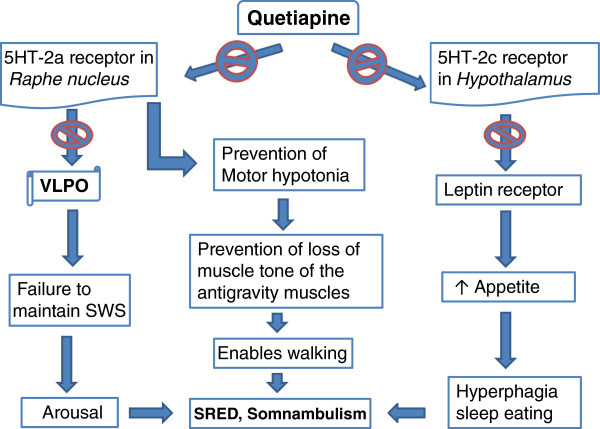
Somnambulism or sleepwalking is a disorder of arousal from non-rapid eye movement sleep. The prevalence of sleep-related eating disorder has been found to be approximately between 1% and 5% among adults. Many cases of medication-related somnambulism and sleep-related eating disorder-like behavior have been reported in the literature. Quetiapine, an atypical antipsychotic medication, has been associated with somnambulism but has not yet been reported to be associated with sleep-related eating disorder.
Case 1 is a 51-year-old obese African American male veteran with a body mass index of 34.11kg/m2 and severe sleep apnea who has taken 150mg of quetiapine at bedtime for more than one year for depression. He developed sleepwalking three to four nights per week which resolved after stopping quetiapine while being compliant with bi-level positive pressure ventilation therapy. At one year follow-up, his body mass index was 32.57kg/m2.Case 2 is a 50-year-old African American female veteran with a body mass index of 30.5kg/m2 and mild sleep apnea who has taken 200mg of quetiapine daily for more than one year for depression. She was witnessed to sleepwalk three nights per week which resolved after discontinuing quetiapine while being treated with continuous positive airway pressure. At three months follow-up, her body mass index was 29.1kg/m2.
These cases illustrate that quetiapine may precipitate complex motor behavior including sleep-related eating disorder and somnambulism in susceptible patients. Atypical antipsychotics are commonly used in psychiatric and primary care practice, which means the population at risk of developing parasomnia may often go unrecognized. It is important to recognize this potential adverse effect of quetiapine and, to prevent injury and worsening obesity, discuss this with the patients who are prescribed these medications.
梦游症是一种从非快速眼动睡眠中觉醒的障碍。据发现,与睡眠相关的进食障碍在成年人中的患病率约为1%至5%。文献中已报道了许多与药物相关的梦游症及类似与睡眠相关进食障碍的行为病例。喹硫平是一种非典型抗精神病药物,与梦游症有关,但尚未有报道称其与睡眠相关进食障碍有关。
病例1是一名51岁的肥胖非裔美国男性退伍军人,体重指数为34.11kg/m²,患有严重睡眠呼吸暂停,因抑郁症已在睡前服用150mg喹硫平一年多。他每周出现三到四个晚上的梦游症状,在停用喹硫平并坚持双水平正压通气治疗后症状消失。在一年的随访中,他的体重指数为32.57kg/m²。病例2是一名50岁的非裔美国女性退伍军人,体重指数为30.5kg/m²,患有轻度睡眠呼吸暂停,因抑郁症已每天服用200mg喹硫平一年多。有人目睹她每周有三个晚上梦游,在停用喹硫平并接受持续气道正压通气治疗后症状消失。在三个月的随访中,她的体重指数为29.1kg/m²。
这些病例表明,喹硫平可能在易感患者中引发复杂的运动行为,包括与睡眠相关的进食障碍和梦游症。非典型抗精神病药物在精神科和初级保健实践中常用,这意味着有发生异态睡眠风险的人群可能常常未被识别。认识到喹硫平的这种潜在不良反应,并为防止受伤和肥胖加重,与服用这些药物的患者进行讨论很重要。