Children's Hospital Los Angeles, Department of Pediatric Surgery/Developmental Biology and Regenerative Medicine, Los Angeles, California, United States of America.
PLoS One. 2012;7(11):e49127. doi: 10.1371/journal.pone.0049127. Epub 2012 Nov 1.
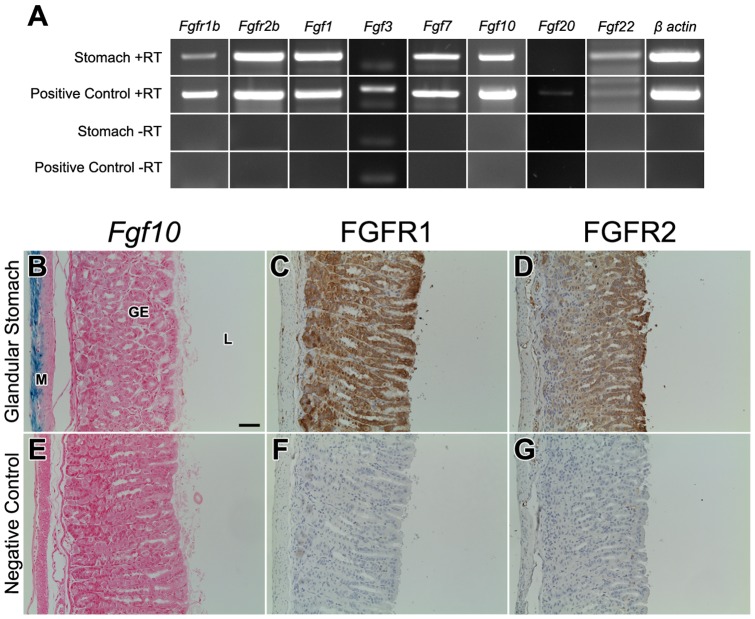
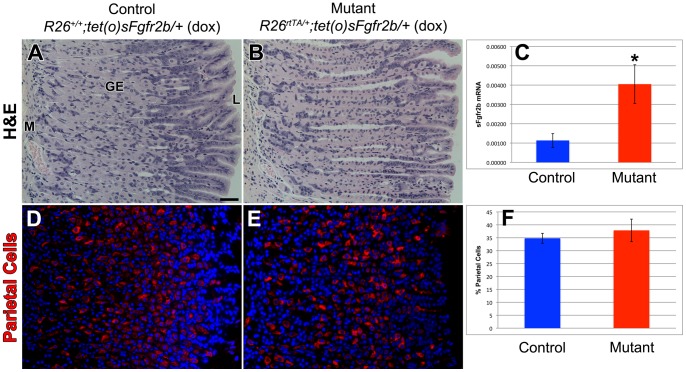
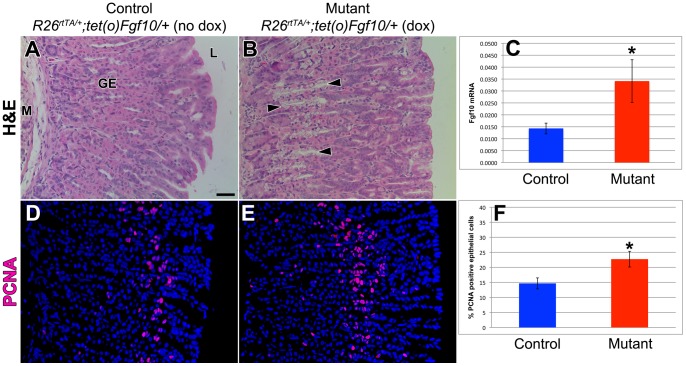
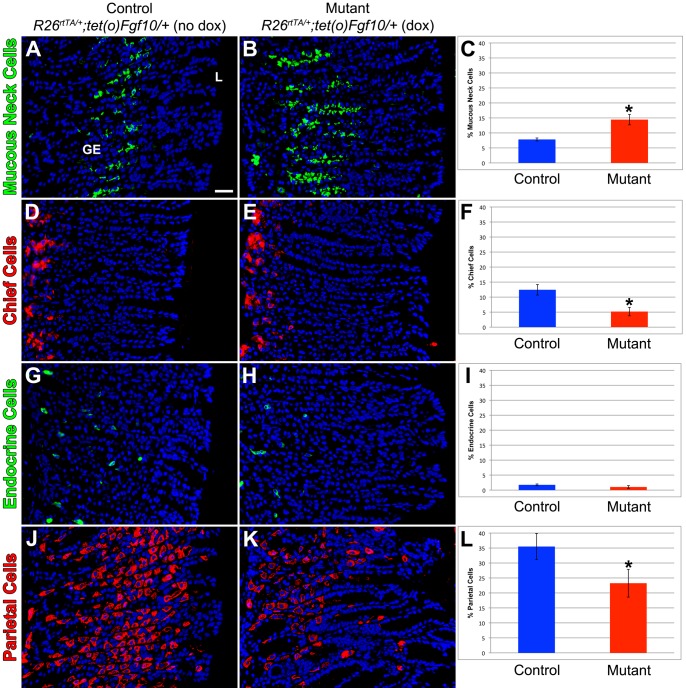
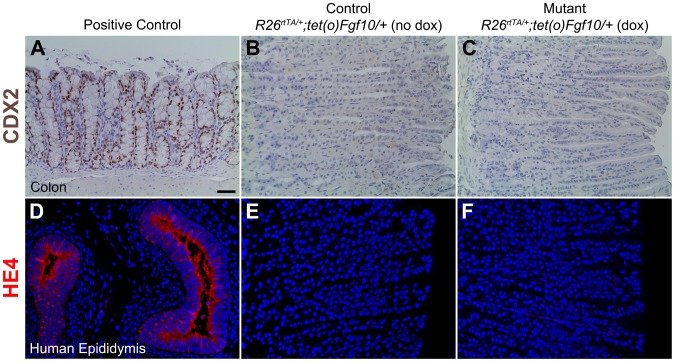
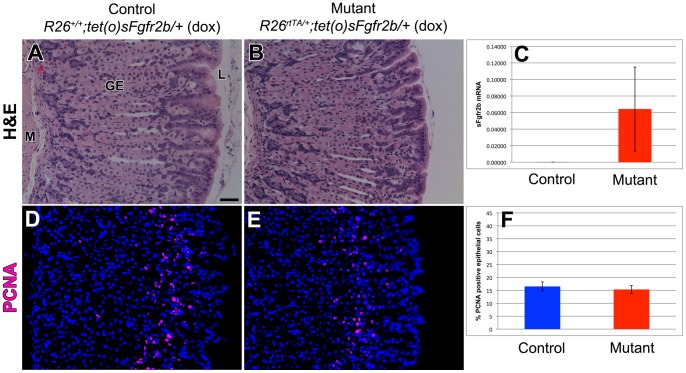
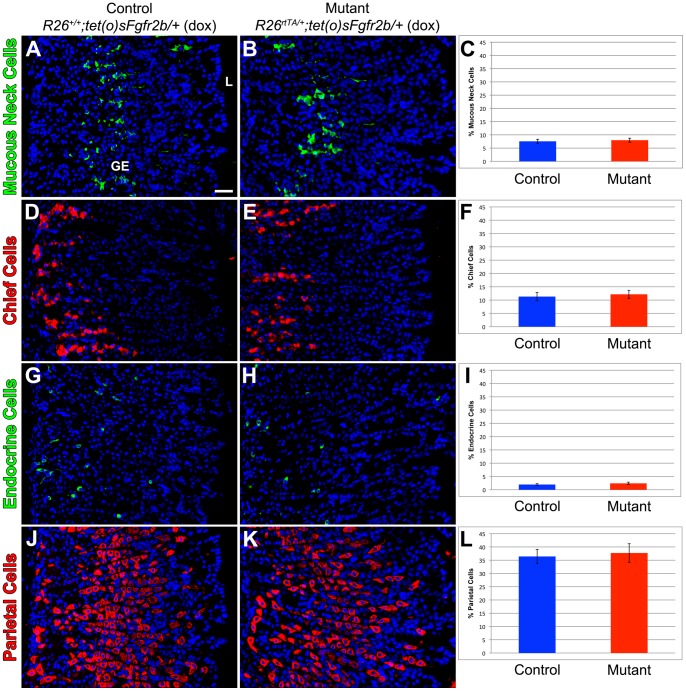
The signaling pathways that are essential for gastric organogenesis have been studied in some detail; however, those that regulate the maintenance of the gastric epithelium during adult homeostasis remain unclear. In this study, we investigated the role of Fibroblast growth factor 10 (FGF10) and its main receptor, Fibroblast growth factor receptor 2b (FGFR2b), in adult glandular stomach homeostasis. We first showed that mouse adult glandular stomach expressed Fgf10, its receptors, Fgfr1b and Fgfr2b, and most of the other FGFR2b ligands (Fgf1, Fgf7, Fgf22) except for Fgf3 and Fgf20. Fgf10 expression was mesenchymal whereas FGFR1 and FGFR2 expression were mostly epithelial. Studying double transgenic mice that allow inducible overexpression of Fgf10 in adult mice, we showed that Fgf10 overexpression in normal adult glandular stomach increased epithelial proliferation, drove mucous neck cell differentiation, and reduced parietal and chief cell differentiation. Although a similar phenotype can be associated with the development of metaplasia, we found that Fgf10 overexpression for a short duration does not cause metaplasia. Finally, investigating double transgenic mice that allow the expression of a soluble form of Fgfr2b, FGF10's main receptor, which acts as a dominant negative, we found no significant changes in gastric epithelial proliferation or differentiation in the mutants. Our work provides evidence, for the first time, that the FGF10-FGFR2b signaling pathway is not required for epithelial proliferation and differentiation during adult glandular stomach homeostasis.
对于胃器官发生所必需的信号通路已经进行了一些详细的研究;然而,那些调节成年期内胃上皮维持的信号通路仍不清楚。在这项研究中,我们研究了成纤维细胞生长因子 10(FGF10)及其主要受体成纤维细胞生长因子受体 2b(FGFR2b)在成年腺胃稳态中的作用。我们首先表明,小鼠成年腺胃表达 Fgf10、其受体 Fgfr1b 和 Fgfr2b 以及除 Fgf3 和 Fgf20 之外的大多数其他 FGFR2b 配体(Fgf1、Fgf7、Fgf22)。Fgf10 表达为间充质,而 FGFR1 和 FGFR2 表达主要为上皮。研究允许在成年小鼠中诱导性过表达 Fgf10 的双转基因小鼠,我们表明,正常成年腺胃中 Fgf10 的过表达增加了上皮细胞增殖,驱动粘蛋白颈细胞分化,并减少壁细胞和主细胞分化。尽管类似的表型可能与化生的发展有关,但我们发现 Fgf10 的短时间过表达不会导致化生。最后,研究允许表达 FGF10 的主要受体可溶性形式 FGFR2b 的双转基因小鼠,一种显性负性,我们发现突变体中胃上皮细胞增殖或分化没有明显变化。我们的工作首次提供了证据,表明 FGF10-FGFR2b 信号通路在成年腺胃稳态期间上皮细胞增殖和分化中不是必需的。