Lv Yu-Qing, Wu Jin, Li Xiao-Kun, Zhang Jin-San, Bellusci Saverio
Key Laboratory of Interventional Pulmonology of Zhejiang Province, Department of Pulmonary and Critical Care Medicine, The First Affiliated Hospital of Wenzhou Medical University, Wenzhou, China.
Institute of Life Sciences, Wenzhou University, Wenzhou, China.
Front Cell Dev Biol. 2019 Dec 10;7:326. doi: 10.3389/fcell.2019.00326. eCollection 2019.
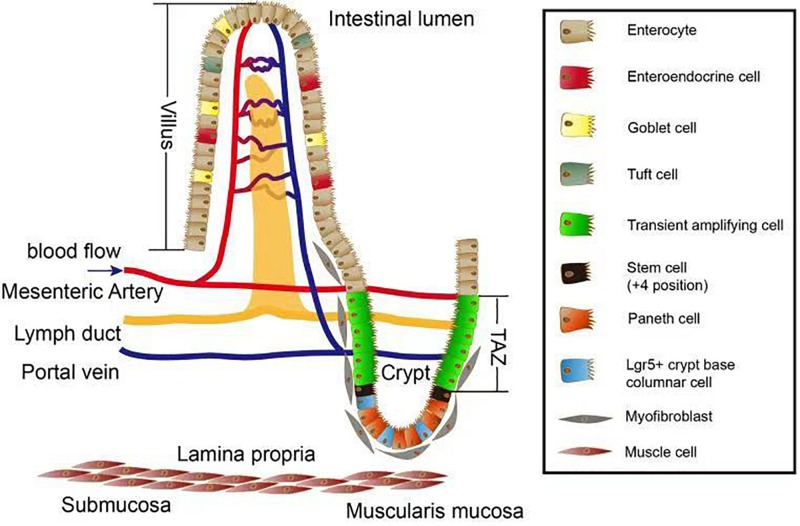
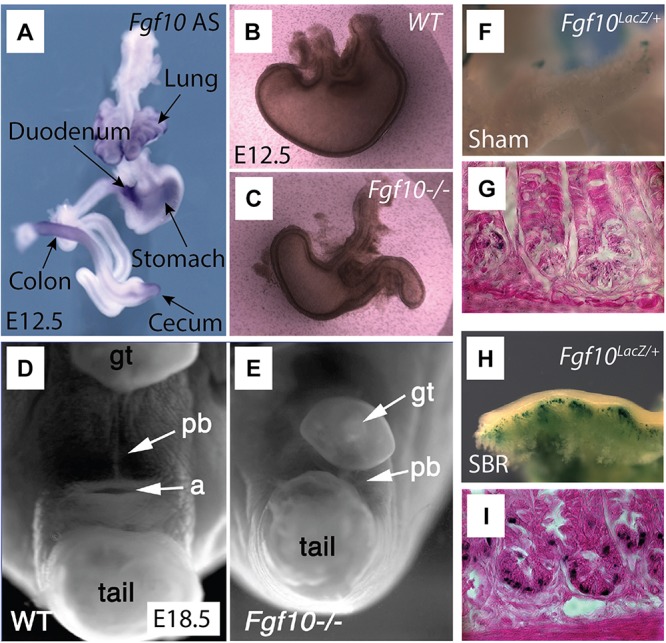
During embryonic development, the rudimentary digestive tract is initially a tube-like structure. It is composed of epithelial cells surrounded by mesenchymal cells. Reciprocal epithelial-mesenchymal interactions progressively subdivide this primitive tube into distinct functional regions: the tongue, the pharynx, the esophagus, the stomach, the duodenum, the small intestine, the cecum, the large intestine, the colon, and the anus as well as the pancreas and the liver. Fibroblast growth factors (Fgfs) constitute a family of conserved small proteins playing crucial roles during organogenesis, homeostasis, and repair after injury. Among them, fibroblast growth factor 10 (Fgf10) has been reported to orchestrate epithelial-mesenchymal interactions during digestive tract development. In mice, loss of function of as well as its receptor fibroblast growth factor receptor 2b () lead to defective taste papillae in the tongue, underdeveloped and defective differentiation of the stomach, duodenal, cecal, and colonic atresias, anorectal malformation, as well as underdeveloped pancreas and liver. Fgf signaling through Fgfr2b receptor is also critical for the repair process after gut injury. In the adult mice, a malabsorption disorder called small bowel syndrome is triggered after massive small bowel resection (SBR). In wild-type mice, SBR leads to a regenerative process called gut adaptation characterized by an increase in the diameter of the remaining small intestine as well as by the presence of deeper crypts and longer villi, altogether leading to increased intestinal surface. Intestinal stem cells are key for this regeneration process. Induction of expression in the Paneth cells located in the crypt following SBR suggests a critical role for this growth factor in the process of gut adaptation.
在胚胎发育过程中,原始消化道最初是一个管状结构。它由被间充质细胞包围的上皮细胞组成。上皮-间充质的相互作用逐步将这个原始管道细分为不同的功能区域:舌头、咽、食管、胃、十二指肠、小肠、盲肠、大肠、结肠和肛门,以及胰腺和肝脏。成纤维细胞生长因子(Fgfs)是一类保守的小蛋白家族,在器官发生、体内平衡和损伤后修复过程中发挥关键作用。其中,成纤维细胞生长因子10(Fgf10)已被报道在消化道发育过程中协调上皮-间充质相互作用。在小鼠中,Fgf10及其受体成纤维细胞生长因子受体2b(Fgfr2b)功能丧失会导致舌头味蕾缺陷、胃、十二指肠、盲肠和结肠闭锁发育不全及分化缺陷、肛门直肠畸形,以及胰腺和肝脏发育不全。通过Fgfr2b受体的Fgf信号传导对肠道损伤后的修复过程也至关重要。在成年小鼠中,大规模小肠切除(SBR)后会引发一种称为小肠综合征的吸收不良障碍。在野生型小鼠中,SBR会导致一个称为肠道适应的再生过程,其特征是剩余小肠直径增加,隐窝更深,绒毛更长,从而导致肠表面积增加。肠道干细胞是这个再生过程的关键。SBR后位于隐窝的潘氏细胞中Fgf10表达的诱导表明该生长因子在肠道适应过程中起关键作用。