Division of Physics and Applied Physics, School of Physical and Mathematical Sciences, Nanyang Technological University, 21 Nanyang Link, Singapore 637371, Singapore.
Sci Rep. 2012;2:784. doi: 10.1038/srep00784. Epub 2012 Nov 7.
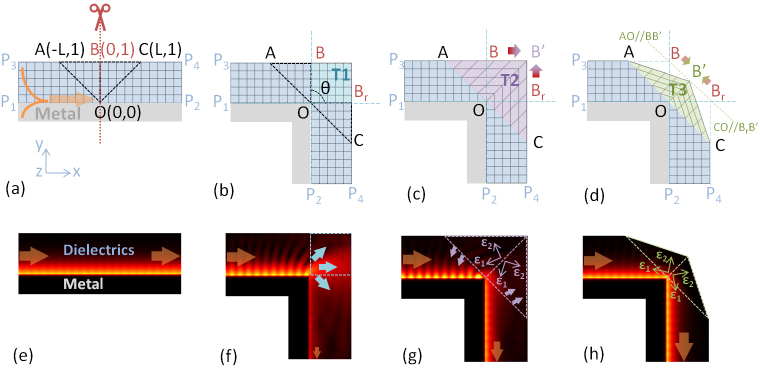
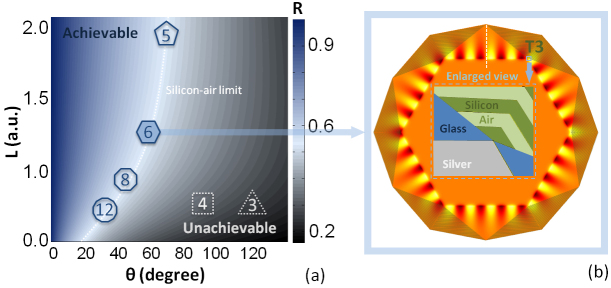
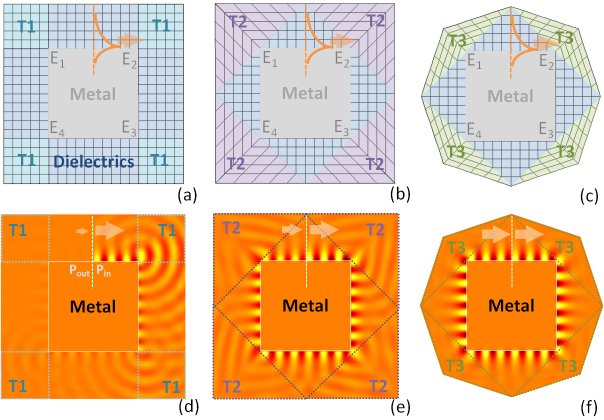
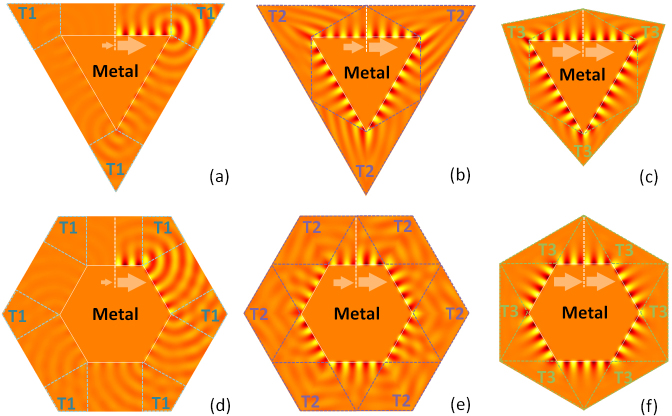
How to confine light energy associated with surface plasmon polaritons (SPPs) in a physical space with minimal radiation loss whereas creating maximum interacting section with surrounding environment is of particular interest in plasmonic optics. By virtue of transformation optics, we propose a design method of forming a polygonal surface-plasmonic resonator in fully open structures by applying the nonmagnetic affine transformation optics strategy. The radiation loss can be suppressed because SPPs that propagate in the designed open structures will be deceived as if they were propagating on a flat metal/dielectric interface without radiation. Because of the nonmagnetic nature of the transformation strategy, this design can be implemented with dielectric materials available in nature. An experimentally verifiable model is subsequently proposed for future experimental demonstration. Our design may find potential applications in omnidirectional sensing, light harvesting, energy storage and plasmonic lasing.
如何在最小辐射损耗的情况下将与表面等离激元(SPP)相关的光能限制在物理空间中,同时与周围环境形成最大的相互作用截面,这在等离子体光学中是一个特别感兴趣的问题。通过变换光学,我们提出了一种通过应用非磁性仿射变换光学策略在完全开放结构中形成多边形表面等离子体谐振器的设计方法。由于在设计的开放结构中传播的 SPP 会被欺骗为在没有辐射的情况下在平金属/电介质界面上传播,因此可以抑制辐射损耗。由于变换策略的非磁性性质,这种设计可以用自然界中存在的介电材料来实现。随后提出了一个可验证的实验模型,以便将来进行实验验证。我们的设计可能在全向传感、光捕获、能量存储和等离子体激光方面有潜在的应用。