Akahane Manabu, Tanabe Seizan, Koike Soichi, Ogawa Toshio, Horiguchi Hiromasa, Yasunaga Hideo, Imamura Tomoaki
Department of Public Health, Health Management and Policy, Nara Medical University School of Medicine, 840 Shijo-cho, Kashihara, Nara, 634-8521, Japan.
Int J Emerg Med. 2012 Nov 9;5(1):41. doi: 10.1186/1865-1380-5-41.
A growing elderly population along with advances in equipment and approaches for pre-hospital resuscitation necessitates up-to-date information when developing policies to improve elderly out-of-hospital cardiac arrest (OHCA) outcomes. We examined the effects of bystander type (family or non-family) intervention on 1-month outcomes of witnessed elderly OHCA patients.
Data from a total of 85,588 witnessed OHCA events in patients aged ≥65 years, which occurred from 2005 to 2008, were obtained from a nationwide population-based database. Patients were stratified into three age categories (65-74, 75-84, ≥85 years), and the effects of bystander type (family or non-family) on initial cardiac rhythm, rate of bystander cardiopulmonary resuscitation (CPR), and 1-month outcomes were assessed.
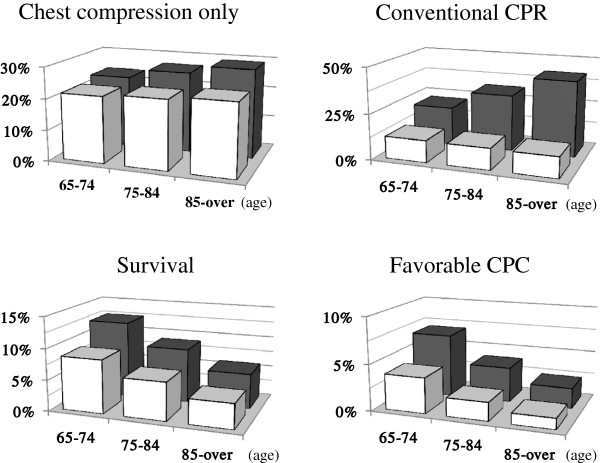
The overall survival rate was 6.9% (65-74 years: 9.8%, 75-84 years: 6.9%, ≥85 years: 4.6%). Initial VF/VT was recorded in 11.1% of cases with a family bystander and 12.9% of cases with a non-family bystander. The rate of bystander CPR was constant across the age categories in patients with a family bystander and increased with advancing age categories in patients with a non-family bystander. Patients having a non-family bystander were associated with significantly higher 1-month rates of survival (OR: 1.26; 95% CI: 1.19-1.33) and favorable neurological status (OR: 1.47; 95% CI: 1.34-1.60).
Elderly patient OHCA events witnessed by a family bystander were associated with worse 1-month outcomes than those witnessed by a non-family bystander. Healthcare providers should consider targeting potential family bystanders for CPR education to increase the rate and quality of bystander CPR.
随着老年人口的不断增加,以及院前复苏设备和方法的进步,在制定改善老年院外心脏骤停(OHCA)结局的政策时,需要最新信息。我们研究了旁观者类型(家人或非家人)干预对目击老年OHCA患者1个月结局的影响。
从一个全国性的基于人群的数据库中获取了2005年至2008年期间发生的总共85588例年龄≥65岁的目击OHCA事件的数据。将患者分为三个年龄组(65 - 74岁、75 - 84岁、≥85岁),并评估旁观者类型(家人或非家人)对初始心律、旁观者心肺复苏(CPR)率和1个月结局的影响。
总体生存率为6.9%(65 - 74岁:9.8%,75 - 84岁:6.9%,≥85岁:4.6%)。在有家人旁观者的病例中,11.1%记录到初始室颤/室速,在有非家人旁观者的病例中,12.9%记录到初始室颤/室速。在有家人旁观者的患者中,旁观者CPR率在各年龄组中保持不变,而在有非家人旁观者的患者中,旁观者CPR率随年龄增长而增加。有非家人旁观者的患者1个月生存率(比值比:1.26;95%置信区间:1.19 - 1.33)和良好神经功能状态(比值比:1.47;95%置信区间:1.34 - 1.60)显著更高。
家人旁观者目击的老年患者OHCA事件与非家人旁观者目击的事件相比,1个月结局更差。医疗服务提供者应考虑将潜在的家人旁观者作为CPR教育的目标人群,以提高旁观者CPR的比例和质量。