Ons Bart, Wagemans Johan
Laboratory of Experimental Psychology, University of Leuven (K.U. Leuven), Tiensestraat 102, box 3711, BE-3000 Leuven, Belgium; e-mail:
Iperception. 2011;2(2):121-36. doi: 10.1068/i0407. Epub 2011 May 19.
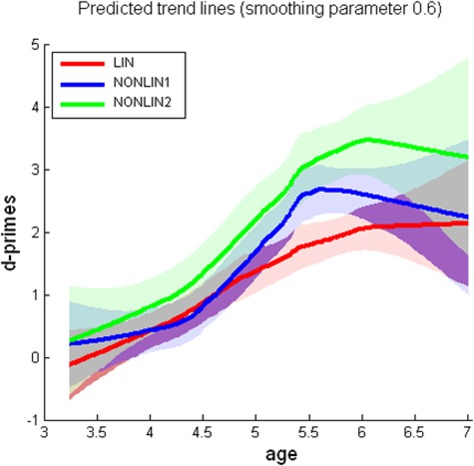
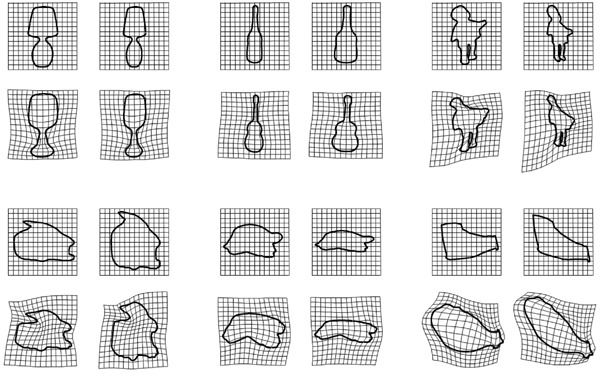
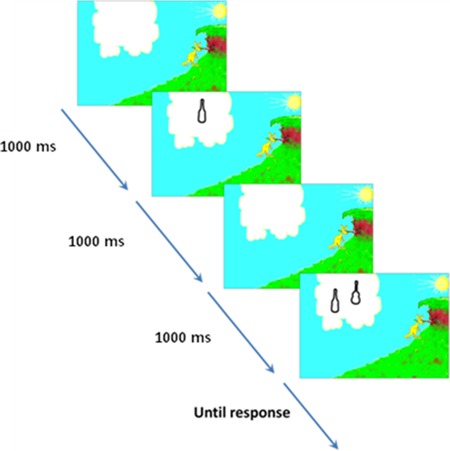
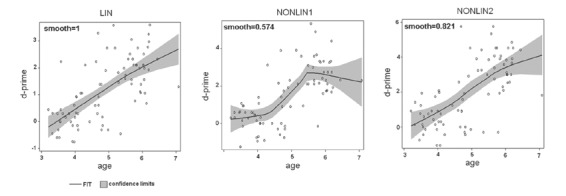
A shape bias for extending names to objects that look visually similar has been commonly accepted but it is hard to define which kind of shape dissimilarities are diagnostic for the identity of an object. Here, we present a transformational approach to describe shape differences that can incorporate many significant shape features. We introduce two kinds of transformations: one kind concerns linear transformations of the image plane (affine transformations), generally limiting shape variations within the borders of basic-level categories; the other kind concerns nonlinear continuous transformations of the image plane (topological transformations), allowing all kinds of shape variation crossing and not crossing the borders of basic-level categories. We administered stimulus pairs differing in these shape transformations to children of 3 years to 7 years old in a delayed match-to-sample task. With increasing age, especially between 5 years and 6 years, children became more sensitive to the topological deformations that are relevant for between-category distinctions, indicating that acquired categorical knowledge in early years induces perceptual learning of the relevant generic shape differences between categories.
将名称扩展到视觉上相似的物体时存在形状偏差,这一点已被普遍接受,但很难定义哪种形状差异对物体的识别具有诊断意义。在此,我们提出一种变换方法来描述形状差异,该方法可以纳入许多重要的形状特征。我们引入两种变换:一种涉及图像平面的线性变换(仿射变换),通常将形状变化限制在基本层次类别边界内;另一种涉及图像平面的非线性连续变换(拓扑变换),允许各种形状变化跨越或不跨越基本层次类别边界。我们在延迟匹配样本任务中,向3岁至7岁的儿童呈现了在这些形状变换上存在差异的刺激对。随着年龄增长,尤其是在5岁至6岁之间,儿童对与类别区分相关的拓扑变形变得更加敏感,这表明早年获得的类别知识会引发对类别之间相关通用形状差异的感知学习。