Chabris Christopher F, Weinberger Adam, Fontaine Matthew, Simons Daniel J
Department of Psychology, Union College, 807 Union Street, Schenectady, NY 12308 USA; e-mail:
Iperception. 2011;2(2):150-3. doi: 10.1068/i0436. Epub 2011 Jun 9.
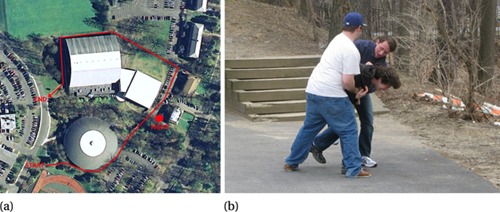
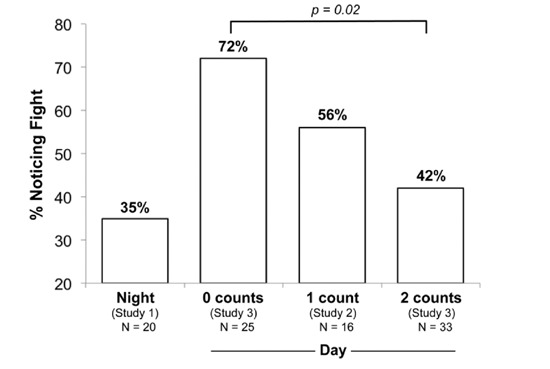
Inattentional blindness-the failure to see visible and otherwise salient events when one is paying attention to something else-has been proposed as an explanation for various real-world events. In one such event, a Boston police officer chasing a suspect ran past a brutal assault and was prosecuted for perjury when he claimed not to have seen it. However, there have been no experimental studies of inattentional blindness in real-world conditions. We simulated the Boston incident by having subjects run after a confederate along a route near which three other confederates staged a fight. At night only 35% of subjects noticed the fight; during the day 56% noticed. We manipulated the attentional load on the subjects and found that increasing the load significantly decreased noticing. These results provide evidence that inattentional blindness can occur during real-world situations, including the Boston case.
无意视盲——当一个人专注于其他事情时,未能看到明显且突出的事件——已被提出作为对各种现实世界事件的一种解释。在这样一个事件中,一名追捕嫌疑人的波士顿警察从一场残忍的袭击旁跑过,当他声称没有看到时,因伪证罪被起诉。然而,尚未有在现实世界条件下对无意视盲进行的实验研究。我们通过让受试者沿着一条路线追赶一名同谋来模拟波士顿事件,在这条路线附近有另外三名同谋上演了一场打斗。在夜间只有35%的受试者注意到了这场打斗;在白天有56%的受试者注意到了。我们操控了受试者的注意力负荷,发现增加负荷会显著减少注意到的情况。这些结果提供了证据,表明无意视盲可能发生在现实世界的情境中,包括波士顿事件。