Marine Plant Ecology Research Group, CCMAR - Centre of Marine Sciences, Universidade do Algarve Faro, Portugal.
Ecol Evol. 2012 Oct;2(10):2625-35. doi: 10.1002/ece3.333. Epub 2012 Sep 19.
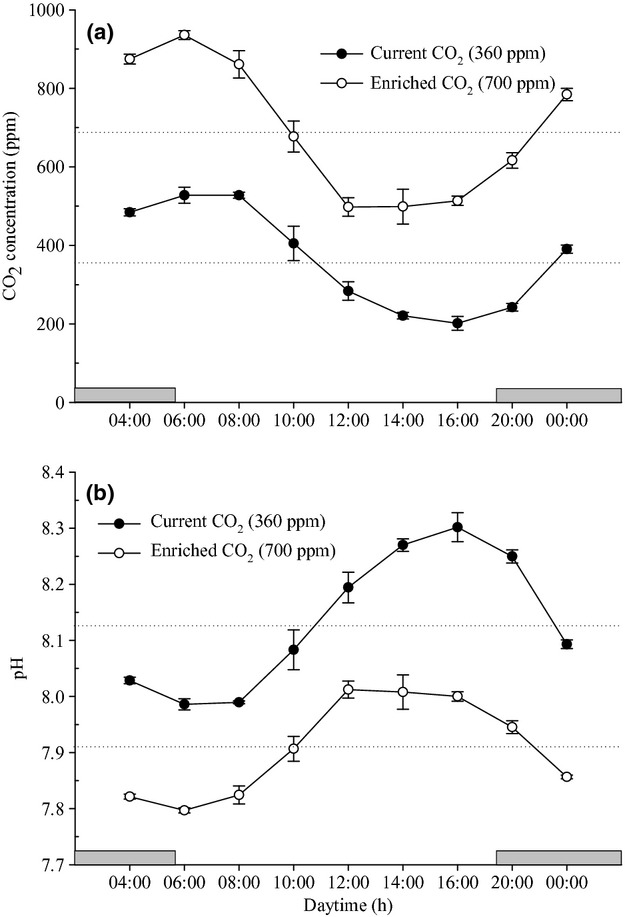
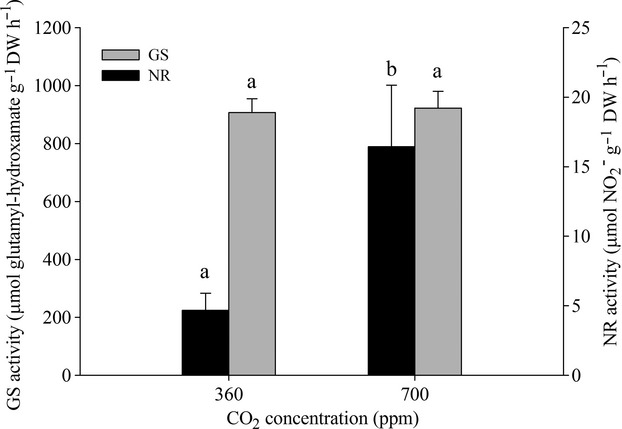
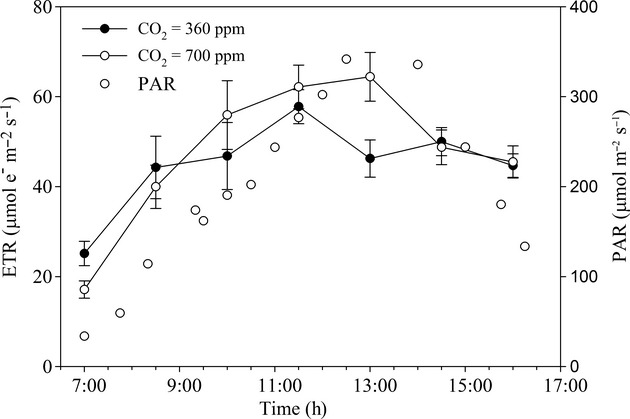
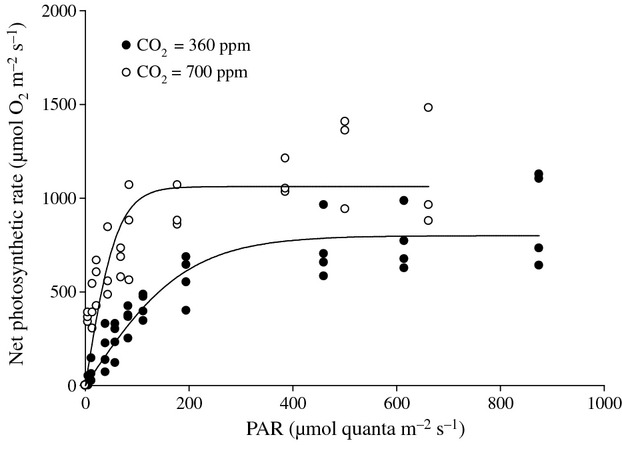
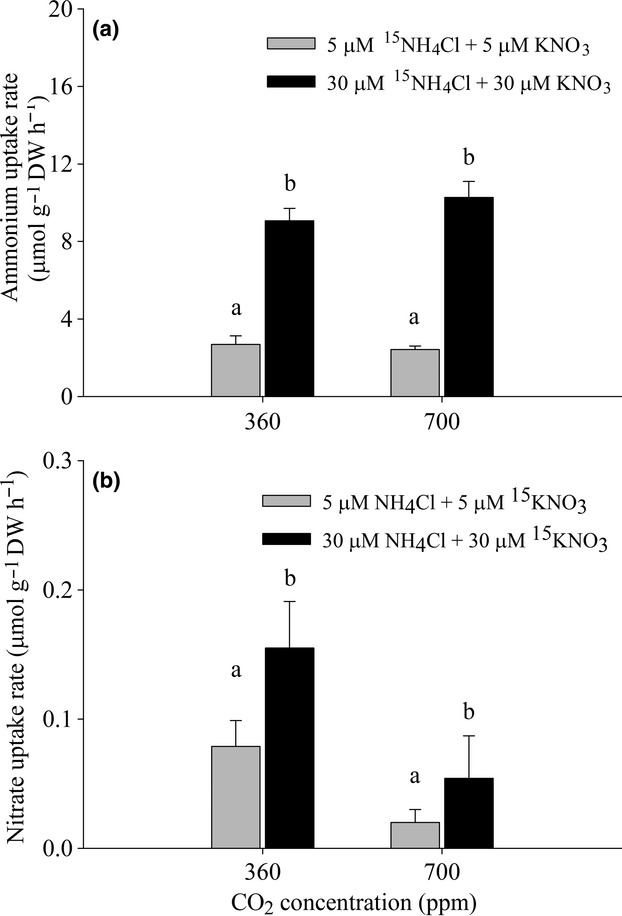
Seagrass ecosystems are expected to benefit from the global increase in CO(2) in the ocean because the photosynthetic rate of these plants may be C(i)-limited at the current CO(2) level. As well, it is expected that lower external pH will facilitate the nitrate uptake of seagrasses if nitrate is cotransported with H(+) across the membrane as in terrestrial plants. Here, we investigate the effects of CO(2) enrichment on both carbon and nitrogen metabolism of the seagrass Zostera noltii in a mesocosm experiment where plants were exposed for 5 months to two experimental CO(2) concentrations (360 and 700 ppm). Both the maximum photosynthetic rate (P(m)) and photosynthetic efficiency (α) were higher (1.3- and 4.1-fold, respectively) in plants exposed to CO(2)-enriched conditions. On the other hand, no significant effects of CO(2) enrichment on leaf growth rates were observed, probably due to nitrogen limitation as revealed by the low nitrogen content of leaves. The leaf ammonium uptake rate and glutamine synthetase activity were not significantly affected by increased CO(2) concentrations. On the other hand, the leaf nitrate uptake rate of plants exposed to CO(2)-enriched conditions was fourfold lower than the uptake of plants exposed to current CO(2) level, suggesting that in the seagrass Z. noltii nitrate is not cotransported with H(+) as in terrestrial plants. In contrast, the activity of nitrate reductase was threefold higher in plant leaves grown at high-CO(2) concentrations. Our results suggest that the global effects of CO(2) on seagrass production may be spatially heterogeneous and depend on the specific nitrogen availability of each system. Under a CO(2) increase scenario, the natural levels of nutrients will probably become limiting for Z. noltii. This potential limitation becomes more relevant because the expected positive effect of CO(2) increase on nitrate uptake rate was not confirmed.
海洋中二氧化碳(CO2)的增加预计会使海草生态系统受益,因为这些植物的光合作用速率可能会受到 C(i) 限制,而当前 CO2 水平下正是如此。此外,如果硝酸盐像陆地植物那样与 H(+)一起穿过细胞膜共转运,那么较低的外部 pH 值预计会促进海草对硝酸盐的吸收。在这里,我们在一个中观实验中研究了 CO2 富集对海草 Zostera noltii 的碳和氮代谢的影响,在该实验中,植物在两个实验 CO2 浓度(360 和 700 ppm)下暴露了 5 个月。暴露在 CO2 富集条件下的植物的最大光合作用速率(P(m))和光合作用效率(α)分别高出(分别高出 1.3 倍和 4.1 倍)。另一方面,CO2 富集对叶片生长速率没有显著影响,这可能是由于氮限制造成的,这从叶片中低氮含量可以看出。叶片氨吸收速率和谷氨酰胺合成酶活性也没有受到 CO2 浓度增加的显著影响。另一方面,暴露在 CO2 富集条件下的植物的叶片硝酸盐吸收速率比暴露在当前 CO2 水平下的植物的吸收速率低四倍,这表明在海草 Z. noltii 中,硝酸盐不像陆地植物那样与 H(+)一起共转运。相反,在高 CO2 浓度下生长的植物叶片中的硝酸还原酶活性高了三倍。我们的研究结果表明,CO2 对海草产量的全球影响可能具有空间异质性,并取决于每个系统特定的氮供应情况。在 CO2 增加的情况下,自然水平的养分可能会限制 Z. noltii 的生长。由于 CO2 增加对硝酸盐吸收速率的预期积极影响未得到证实,因此这种潜在的限制变得更加相关。