Center for Health Research, Kaiser Permanente, Portland, OR 97227-1110, USA.
Am J Manag Care. 2012 Oct;18(10):588-95.
To compare completion rates of colorectal cancer screening tests within a health maintenance organization before and after widespread adoption of the fecal immunochemical test (FIT).
Retrospective cohort study.
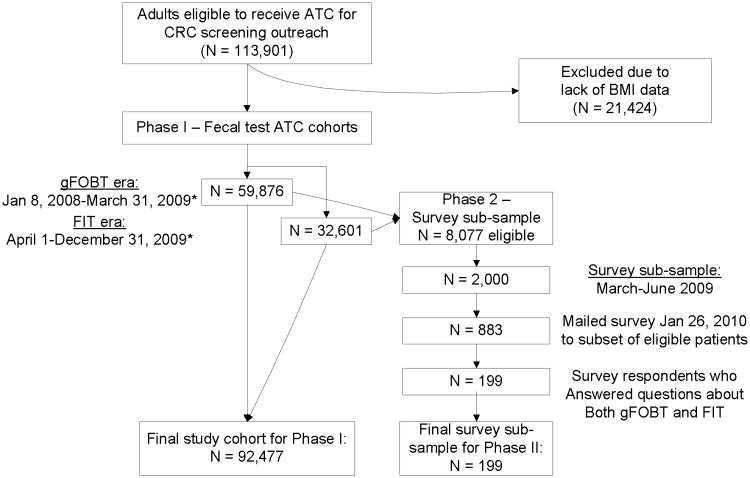
Using electronic medical records of 113,901 patients eligible for colorectal cancer screening, we examined test completion during 2 successive time periods among those who received an automated screening outreach call. The time periods were: 1) the "guaiac fecal occult blood test (gFOBT) era," a 15-month period during which only gFOBT was routinely offered, and 2) a 9-month "FIT era," when only a new FIT was routinely offered. In addition to analyzing completion rates, we analyzed the impact of practice-level variables and patient-level variables on overall screening completion during the 2 different observation periods.
The change from gFOBT to FIT in an integrated care delivery system increased the likelihood of screening completion by 7.7% overall, and the likelihood of screening with a fecal test by 8.9%. The greatest gains in screening completion using FIT were among women and elderly patients. Completion of FIT was not as strongly associated with medical office visits or with having a primary care provider as was screening with gFOBT.
Adoption of FIT within an integrated care system increased completion of colon cancer screening tests within a 9-month assessment period, compared with a previous 15-month gFOBT era. Higher completion rates of the FIT may allow for more effective dissemination of programs to increase colorectal cancer screening through centralized outreach programs.
比较在卫生维护组织中广泛采用粪便免疫化学检测(FIT)前后结直肠癌筛查检测的完成率。
回顾性队列研究。
利用 113901 名符合结直肠癌筛查条件的患者的电子病历,我们在接受自动筛查外拨电话的患者中,检查了连续两个时间段内的检测完成情况。时间段为:1)“愈创木脂粪便潜血试验(gFOBT)时代”,这是一个 15 个月的时期,仅常规提供 gFOBT;2)9 个月的“FIT 时代”,仅常规提供新的 FIT。除了分析完成率外,我们还分析了实践水平变量和患者水平变量对两个不同观察期内总体筛查完成情况的影响。
在综合医疗服务提供系统中,从 gFOBT 转为 FIT 总体上增加了 7.7%的筛查完成率,粪便检测的筛查率增加了 8.9%。在女性和老年患者中,使用 FIT 进行筛查的完成率增加幅度最大。与 gFOBT 相比,FIT 完成情况与医疗就诊次数或有初级保健提供者的关联不那么密切。
在综合医疗系统中采用 FIT 可在 9 个月的评估期内增加结肠癌筛查检测的完成率,而之前的 15 个月 gFOBT 时代则没有。FIT 更高的完成率可能允许通过集中外展计划更有效地传播项目,以增加结直肠癌的筛查。