Department of Pathology and Forensic Medicine, Institute of Clinical Medicine, University of Eastern Finland, Cancer Center of Eastern Finland, Kuopio, Finland.
BMC Cancer. 2012 Nov 14;12:516. doi: 10.1186/1471-2407-12-516.
The histone demethylase GASC1 (JMJD2C) is an epigenetic factor suspected of involvement in development of different cancers, including breast cancer. It is thought to be overexpressed in the more aggressive breast cancer types based on mRNA expression studies on cell lines and meta analysis of human breast cancer sets. This study aimed to evaluate the prognostic and predictive value of GASC1 for women with invasive breast cancer.
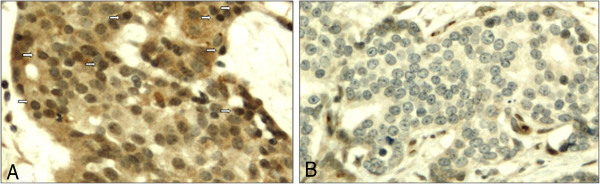
All the 355 cases were selected from a cohort enrolled in the Kuopio Breast Cancer Project between April 1990 and December 1995. The expression of GASC1 was studied by immunohistochemistry (IHC) on tissue microarrays. Additionally relative GASC1 mRNA expression was measured from available 57 cases.
In our material, 56% of the cases were GASC1 negative and 44% positive in IHC staining. Women with GASC1 negative tumors had two years shorter breast cancer specific survival and time to relapse than the women with GASC1 positive tumors (p=0.017 and p=0.034 respectively). The majority of GASC1 negative tumors were ductal cases (72%) of higher histological grade (84% of grade II and III altogether). When we evaluated estrogen receptor negative and progesterone receptor negative cases separately, there was 2 times more GASC1 negative than GASC1 positive tumors in each group (chi2, p= 0.033 and 0.001 respectively). In the HER2 positive cases, there was 3 times more GASC1 negative cases than GASC1 positives (chi2, p= 0.029). Patients treated with radiotherapy (n=206) and hormonal treatment (n=62) had better breast cancer specific survival, when they were GASC1 positive (Cox regression: HR=0.49, p=0.007 and HR=0.33, p=0.015, respectively). The expression of GASC1 mRNA was in agreement with the protein analysis.
This study indicates that the GASC1 is both a prognostic and a predictive factor for women with invasive breast cancer. GASC1 negativity is associated with tumors of more aggressive histopathological types (ductal type, grade II and III, ER negative, PR negative). Patients with GASC1 positive tumors have better breast cancer specific survival and respond better to radiotherapy and hormonal treatment.
组蛋白去甲基化酶 GASC1(JMJD2C)是一种表观遗传因子,疑似参与多种癌症的发展,包括乳腺癌。基于细胞系的 mRNA 表达研究和人类乳腺癌数据集的荟萃分析,认为其在侵袭性乳腺癌中过表达。本研究旨在评估 GASC1 对浸润性乳腺癌女性的预后和预测价值。
所有 355 例病例均选自 1990 年 4 月至 1995 年 12 月期间参加库奥皮奥乳腺癌项目的队列中。通过组织微阵列的免疫组织化学(IHC)研究 GASC1 的表达。此外,还从 57 例可用病例中测量了相对 GASC1 mRNA 表达。
在我们的材料中,56%的病例在 IHC 染色中为 GASC1 阴性,44%为阳性。GASC1 阴性肿瘤的女性乳腺癌特异性生存时间和复发时间比 GASC1 阳性肿瘤的女性短两年(p=0.017 和 p=0.034)。GASC1 阴性肿瘤大多为导管癌(72%),组织学分级较高(共 84%为 II 级和 III 级)。当我们分别评估雌激素受体阴性和孕激素受体阴性病例时,每个组中 GASC1 阴性肿瘤的数量是 GASC1 阳性肿瘤的两倍(卡方,p=0.033 和 0.001)。在 HER2 阳性病例中,GASC1 阴性病例是 GASC1 阳性病例的三倍(卡方,p=0.029)。接受放疗(n=206)和激素治疗(n=62)的患者,如果 GASC1 阳性,则乳腺癌特异性生存更好(Cox 回归:HR=0.49,p=0.007 和 HR=0.33,p=0.015)。GASC1 mRNA 的表达与蛋白分析一致。
本研究表明,GASC1 既是浸润性乳腺癌患者的预后因素,也是预测因素。GASC1 阴性与侵袭性组织病理学类型的肿瘤相关(导管型、II 级和 III 级、ER 阴性、PR 阴性)。GASC1 阳性肿瘤患者的乳腺癌特异性生存率更高,对放疗和激素治疗反应更好。