School of Clinical Medicine, Southwest Medical University, Luzhou, Sichuan, China (mainland).
Department of Breast Surgery, The First People's Hospital of Yibin, Yibin, Sichuan, China (mainland).
Med Sci Monit. 2018 Apr 22;24:2456-2464. doi: 10.12659/msm.906576.
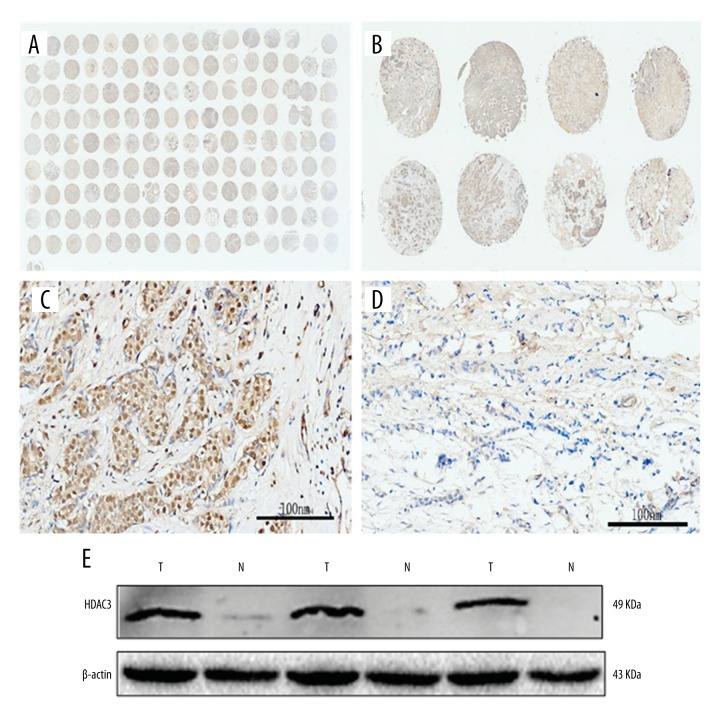
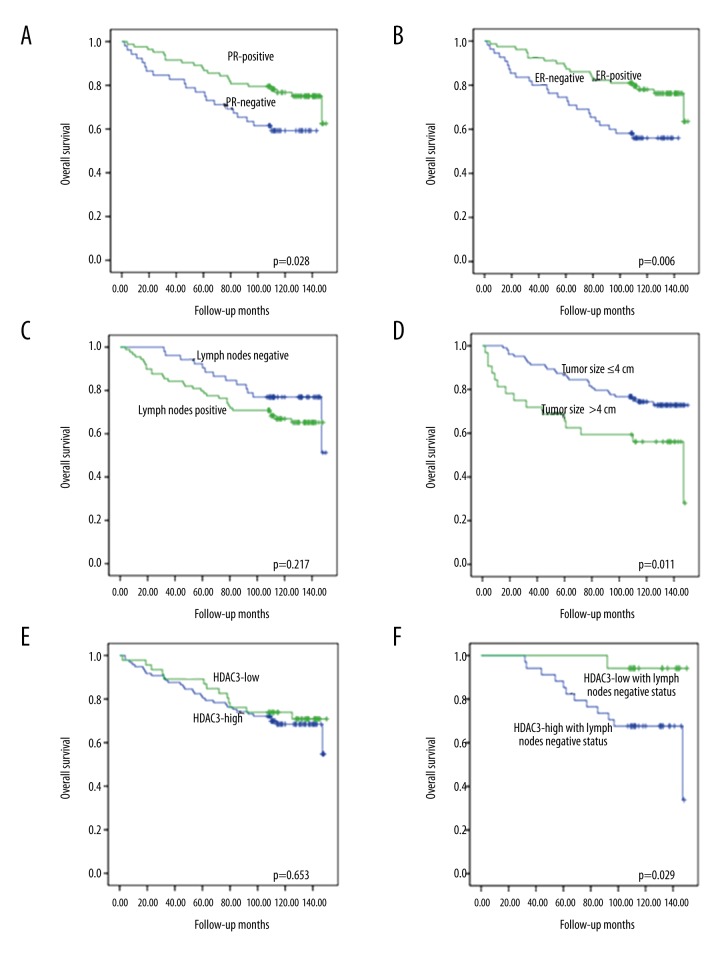
BACKGROUND The modification of histone acetylation and deacetylation is the most important mechanism of chromatin remodeling. These modifications are a subset of epigenetic alterations which affect tumorigenesis and progression through changes in gene expression and cell growth. Results of histone modification studies prompted us to explore the therapeutic and prognostic significance of histone deacetylase 3 (HDAC3) expression in patients with breast cancer. MATERIAL AND METHODS Immunohistochemical (IHC) staining was used to detect HDAC3 expression in a tissue microarray (TMA) that included 145 patients diagnosed with invasive ductal breast carcinoma. IHC scoring was used to evaluate the staining intensity and the proportion of positive cells. RESULTS HDAC3 expression was significantly correlated with estrogen receptor (ER)-negative expression (P=0.036) and progesterone receptor (PR)-negative expression (P=0.024). Additionally, HDAC3 expression was significantly positively correlated with human epidermal growth factor 2 (HER2) overexpression (P=0.037). Our study also indicated that high expression of HDAC3 was more frequently observed in breast tumors with PT2 classification (74%) versus PT1 (50.0%) and PT3 (71.4%) (P=0.040). Furthermore, HDAC3 was correlated with clinical stage II (P=0.046). Univariate and multivariate survival analyses showed that high expression of HDAC3 was correlated with poor overall survival (OS) (P=0.029 and P=0.033, respectively) in patients without lymph node involvement. CONCLUSIONS High HDAC3 expression is closely correlated with ER-negative expression, PR-negative expression, HER2 overexpression, PT stage, and clinical stage of breast tumors. HDAC3 may be an appropriate prognostic indicator in patients with invasive ductal breast cancer.
组蛋白乙酰化和去乙酰化的修饰是染色质重塑的最重要机制。这些修饰是表观遗传改变的一个子集,通过改变基因表达和细胞生长来影响肿瘤发生和进展。组蛋白修饰研究的结果促使我们探讨组蛋白去乙酰化酶 3(HDAC3)在乳腺癌患者中的表达的治疗和预后意义。
使用免疫组织化学(IHC)染色检测组织微阵列(TMA)中 145 例浸润性导管乳腺癌患者的 HDAC3 表达。使用 IHC 评分评估染色强度和阳性细胞的比例。
HDAC3 表达与雌激素受体(ER)阴性表达(P=0.036)和孕激素受体(PR)阴性表达(P=0.024)显著相关。此外,HDAC3 表达与人类表皮生长因子 2(HER2)过表达显著正相关(P=0.037)。我们的研究还表明,HDAC3 高表达在 PT2 分级(74%)的乳腺肿瘤中比 PT1(50.0%)和 PT3(71.4%)更常见(P=0.040)。此外,HDAC3 与临床分期 II 期相关(P=0.046)。单因素和多因素生存分析表明,在无淋巴结受累的患者中,HDAC3 高表达与总生存(OS)不良相关(P=0.029 和 P=0.033)。
HDAC3 高表达与 ER 阴性表达、PR 阴性表达、HER2 过表达、PT 分期和乳腺肿瘤的临床分期密切相关。HDAC3 可能是浸润性导管乳腺癌患者的一个合适的预后指标。