Department of Genome Sciences, University of Washington School of Medicine, Seattle, WA 98195, USA.
Science. 2012 Dec 21;338(6114):1619-22. doi: 10.1126/science.1227764. Epub 2012 Nov 15.
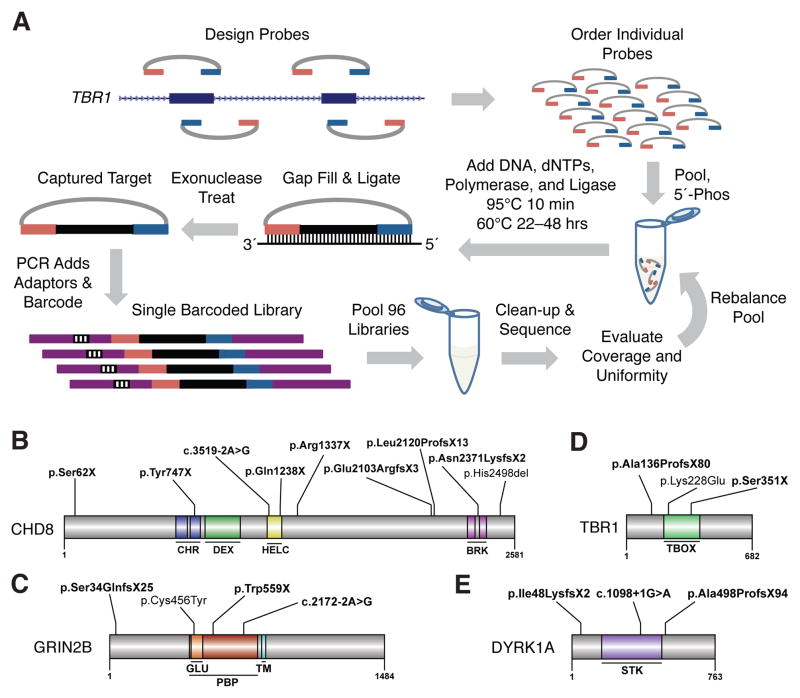
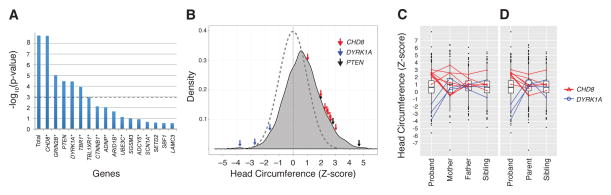
Exome sequencing studies of autism spectrum disorders (ASDs) have identified many de novo mutations but few recurrently disrupted genes. We therefore developed a modified molecular inversion probe method enabling ultra-low-cost candidate gene resequencing in very large cohorts. To demonstrate the power of this approach, we captured and sequenced 44 candidate genes in 2446 ASD probands. We discovered 27 de novo events in 16 genes, 59% of which are predicted to truncate proteins or disrupt splicing. We estimate that recurrent disruptive mutations in six genes-CHD8, DYRK1A, GRIN2B, TBR1, PTEN, and TBL1XR1-may contribute to 1% of sporadic ASDs. Our data support associations between specific genes and reciprocal subphenotypes (CHD8-macrocephaly and DYRK1A-microcephaly) and replicate the importance of a β-catenin-chromatin-remodeling network to ASD etiology.
自闭症谱系障碍(ASD)的外显子组测序研究已经鉴定出许多新生突变,但很少有反复出现的基因功能紊乱。因此,我们开发了一种改良的分子反转探针方法,可以在非常大的队列中进行超低成本的候选基因重测序。为了证明这种方法的有效性,我们对 2446 名 ASD 先证者中的 44 个候选基因进行了捕获和测序。我们在 16 个基因中发现了 27 个新生事件,其中 59%的基因被预测会导致蛋白质截短或剪接异常。我们估计,六个基因(CHD8、DYRK1A、GRIN2B、TBR1、PTEN 和 TBL1XR1)中的反复出现的功能紊乱突变可能导致 1%的散发性 ASD。我们的数据支持特定基因与相互对应的亚表型(CHD8-大头畸形和 DYRK1A-小头畸形)之间的关联,并复制了β-连环蛋白-染色质重塑网络对 ASD 病因的重要性。