Lee Hyebin, Park Hee Chul, Park Won, Choi Doo Ho, Kim Young-Il, Park Young Suk, Park Joon Oh, Chun Ho-Kyung, Lee Woo-Yong, Kim Hee Cheol, Yun Seong Hyeon, Cho Yong Beom, Park Yoon Ah
Department of Radiation Oncology, Samsung Medical Center, Sungkyunkwan University School of Medicine, Seoul, Korea.
Radiat Oncol J. 2012 Sep;30(3):117-23. doi: 10.3857/roj.2012.30.3.117. Epub 2012 Sep 30.
Although anemia is considered to be a contributor to intra-tumoral hypoxia and tumor resistance to ionizing radiation in cancer patients, the impact of pretreatment anemia on local control after neoadjuvant concurrent chemoradiotherapy (NACRT) and surgery for rectal cancer remains unclear.
We reviewed the records of 247 patients with locally advanced rectal cancer who were treated with NACRT followed by curative-intent surgery.
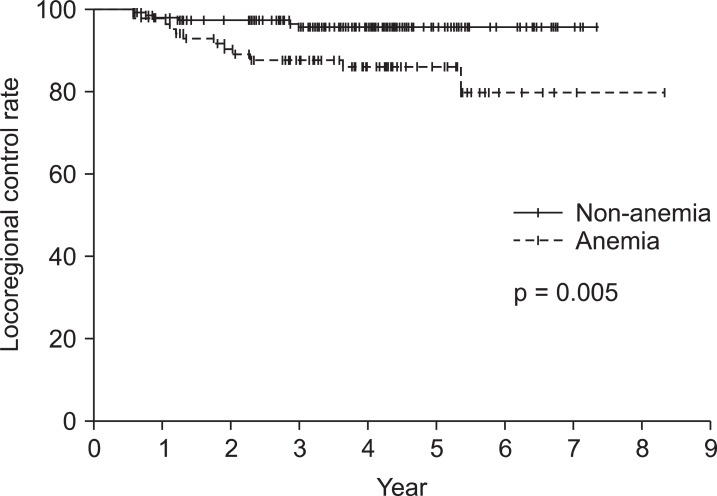
The patients with anemia before NACRT (36.0%, 89/247) achieved less pathologic complete response (pCR) than those without anemia (p = 0.012). The patients with pretreatment anemia had worse 3-year local control than those without pretreatment anemia (86.0% vs. 95.7%, p = 0.005). Multivariate analysis showed that pretreatment anemia (p = 0.035), pathologic tumor and nodal stage (p = 0.020 and 0.032, respectively) were independently significant factors for local control.
Pretreatment anemia had negative impacts on pCR and local control among patients who underwent NACRT and surgery for rectal cancer. Strategies maintaining hemoglobin level within normal range could potentially be used to improve local control in rectal cancer patients.
尽管贫血被认为是癌症患者肿瘤内缺氧及肿瘤对电离辐射产生抗性的一个因素,但新辅助同步放化疗(NACRT)及直肠癌手术后,术前贫血对局部控制的影响仍不明确。
我们回顾了247例接受NACRT继而进行根治性手术的局部晚期直肠癌患者的病历。
NACRT前贫血的患者(36.0%,89/247)病理完全缓解(pCR)率低于无贫血的患者(p = 0.012)。术前贫血的患者3年局部控制情况比术前无贫血的患者差(86.0% 对95.7%,p = 0.005)。多因素分析显示,术前贫血(p = 0.035)、病理肿瘤及淋巴结分期(分别为p = 0.020和0.032)是局部控制的独立显著因素。
术前贫血对接受NACRT及手术的直肠癌患者的pCR和局部控制有负面影响。维持血红蛋白水平在正常范围内的策略可能有助于改善直肠癌患者的局部控制。