Cardin Fabrizio, Ambrosio Francesco, Amodio Piero, Minazzato Lina, Bombonato Giancarlo, Schiff Sami, Finotti Katiuscia, Giuliani Daria, Bianco Tonino, Terranova Claudio, Militello Carmelo, Ori Carlo
Department of Surgical and Gastroenterological Sciences, Padova University Hospital, Italy, Via Giustiniani n 2, 35126 Padova, Italy.
BMC Surg. 2012;12 Suppl 1(Suppl 1):S10. doi: 10.1186/1471-2482-12-S1-S10. Epub 2012 Nov 15.
Differences in health-related quality of life perception in patients with chronic disease may depend on pre-existing differences in personality profile. The purpose of the study was to investigate in a cohort of female patients with chronic diseases the relationship between the Quality of Life perception and the potential presence of depressive symptoms.
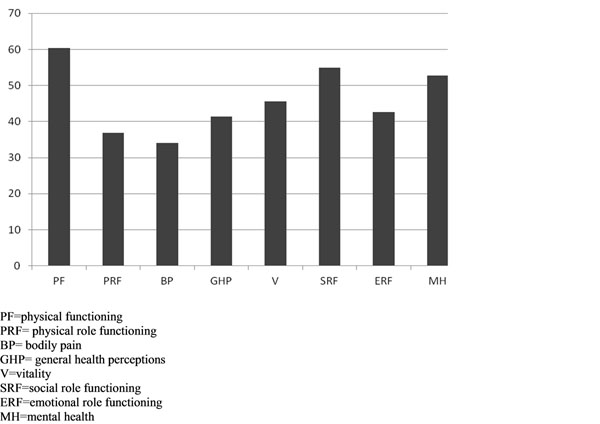
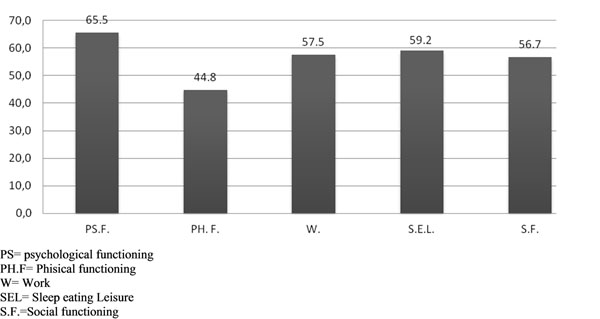
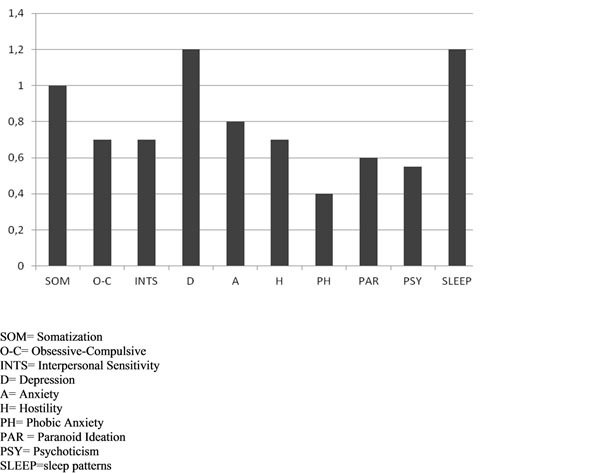
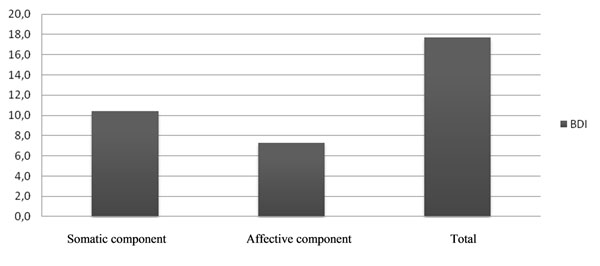
Female patients with chronic diseases were enrolled in the study. Exclusion criteria were diagnosis of psychopathological condition, treatment with psychoactive substances.Methodological approach was based on administration of the following test. Short Form health survey SF-36, Symptom Check List SCL-90-R, Satisfaction Profile test (SAT-P) and Beck Depression Inventory-II (BDI-II). The Pearson correlation coefficient was used to evaluate the relationship between depressive symptoms and Quality of life as assessed by psychometric test.
57 patients, aged 52(± 3,4), responded to inclusion criteria. 57% of patients had a diagnosis of functional dyspepsia or gastro-oesophageal reflux not complicated, and the remaining 43% musculoskeletal diseases. The statistical analysis showed an inverse correlation between the variable Bodily Pain of the SF-36 and the variable Depression scales of the SCL-90-R.In a second phase another sample of female patients was enrolled in the study. 64 patients, aged 49(± 3,2), responded to inclusion criteria.Another significant negative correlation was found between the Somatic-Affective factor of the BDI-II and the scale Physical Functioning of the SAT-P.
In female patients with chronic disease depressive symptoms resulted influenced by pain and vice versa. The treatment of depressive symptoms could improve the quality of life of patients.
慢性病患者健康相关生活质量认知的差异可能取决于人格特征方面预先存在的差异。本研究的目的是在一组患有慢性病的女性患者中调查生活质量认知与抑郁症状潜在存在之间的关系。
患有慢性病的女性患者被纳入本研究。排除标准为精神病理状况诊断、使用精神活性物质治疗。方法学方法基于以下测试的实施:简短健康调查问卷SF - 36、症状自评量表SCL - 90 - R、满意度概况测试(SAT - P)和贝克抑郁量表第二版(BDI - II)。皮尔逊相关系数用于评估抑郁症状与通过心理测量测试评估的生活质量之间的关系。
57名年龄为52(±3.4)岁的患者符合纳入标准。57%的患者诊断为功能性消化不良或无并发症的胃食管反流,其余43%为肌肉骨骼疾病。统计分析显示SF - 36的身体疼痛变量与SCL - 90 - R的抑郁量表变量之间呈负相关。在第二阶段,另一组女性患者样本被纳入研究。64名年龄为49(±3.2)岁的患者符合纳入标准。在BDI - II的躯体 - 情感因子与SAT - P的身体功能量表之间又发现了显著的负相关。
在患有慢性病的女性患者中,抑郁症状受疼痛影响,反之亦然。抑郁症状的治疗可以改善患者的生活质量。