Chen Xia, Li Ping, Wang Fei, Ji Guozhong, Miao Lin, You Sihong
Department of Gastroenterology, The Second Affiliated Hospital of Nanjing Medical University, Nanjing, Jiangsu, China.
Euroasian J Hepatogastroenterol. 2017 Jul-Dec;7(2):117-121. doi: 10.5005/jp-journals-10018-1230. Epub 2017 Sep 29.
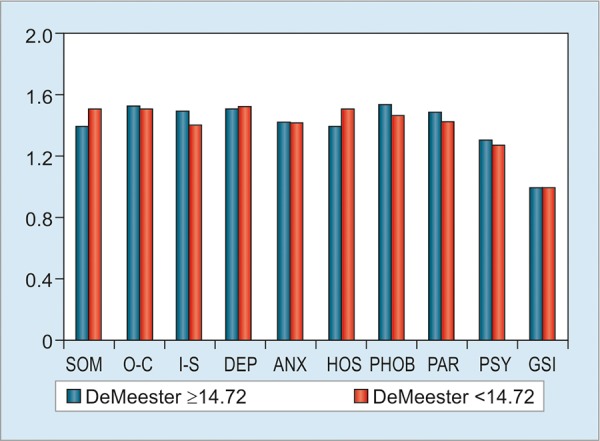
Gastroesophageal reflux disease (GERD) affects mental state and social activities. On the contrary, mental disorders may also play a crucial role in GERD symptoms. The purpose of the study was to analyze the data of Symptom Checklist 90-Revised (SCL-90-R) questionnaire from patients with persisting GERD and to explore the impact of psychological factors on them.
The patients accepted SCL-90-R questionnaire survey, following endoscopy, high-resolution manometry (HRM), and ambulatory impedance-pH monitoring. Based on these results, we divided patients into different groups. The result of SCL-90-R was also compared with degree of acid reflux, symptoms, symptom duration, and gender.
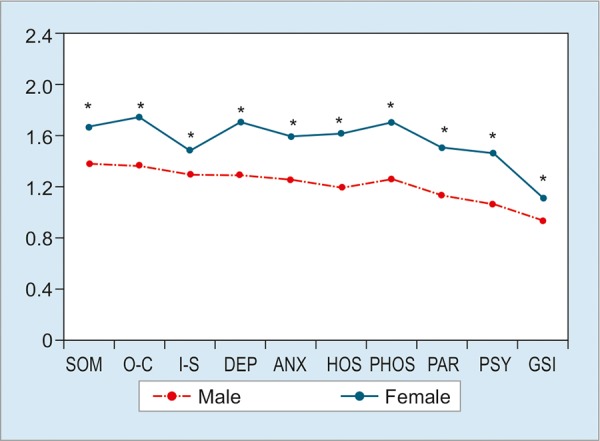
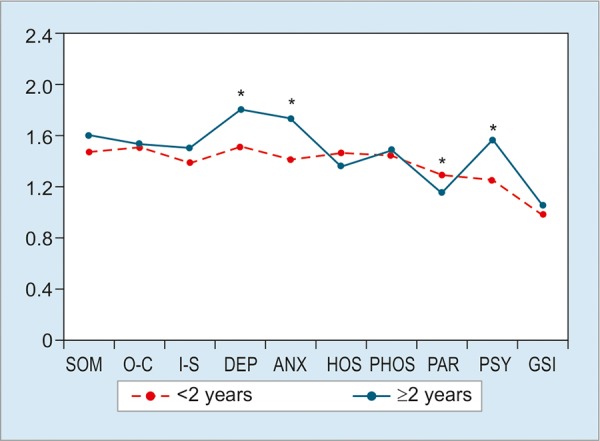
The data from 438 patients were analyzed. All patients were divided into reflux esophagitis (RE; 63, 14.38%); nonerosive gastroesophageal reflux disease (NERD; 106, 24.20%); functional heartburn (FH; 123, 28.08%), hypersensitive esophagus (HE; 67, 15.29%), diffuse esophageal spasm (DES; 5: 1.14%), hypertensive (10, 3.42%); weak peristalsis (14, 3.20%); achalasia (50, 11.42%). There were significant differences between different groups regarding depression (DEP), anxiety (ANX), paranoid ideation (PAR), and psychoticism (PSY). The patients with ≥2 years with GERD presented with increased scores in DEP, ANX, and PSY. Women had dramatically higher scores than men in each domain (p < 0.05).
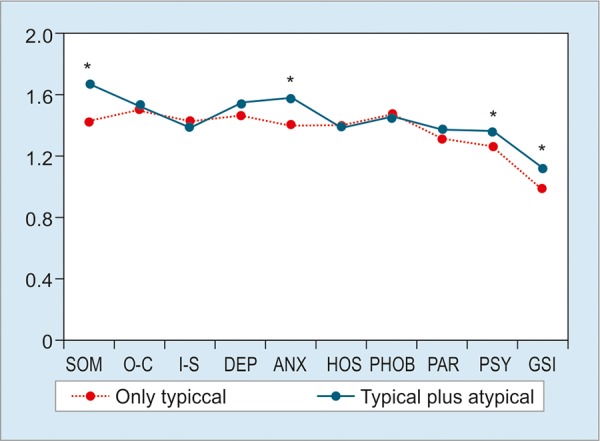
Data have shown that GERD patients exhibit differential levels of psychological symptoms. Long duration of GERD was related to typical plus atypical symptoms and females seem to be more prone to develop psychological disorders. Chen X, Li P, Wang F, Ji G, Miao L, You S. Psychological Results of 438 Patients with persisting Gastroesophageal Reflux Disease Symptoms by Symptom Checklist 90-Revised Questionnaire. Euroasian J Hepato-Gastroenterol 2017;7(2):117-121.
胃食管反流病(GERD)会影响精神状态和社交活动。相反,精神障碍在GERD症状中可能也起着关键作用。本研究的目的是分析持续性GERD患者的症状自评量表90修订版(SCL-90-R)问卷数据,并探讨心理因素对其的影响。
患者在接受内镜检查、高分辨率测压(HRM)和动态阻抗-pH监测后,接受SCL-90-R问卷调查。基于这些结果,我们将患者分为不同组。SCL-90-R的结果还与酸反流程度、症状、症状持续时间及性别进行了比较。
分析了438例患者的数据。所有患者分为反流性食管炎(RE;63例,14.38%);非糜烂性胃食管反流病(NERD;106例,24.20%);功能性烧心(FH;123例,28.08%),高敏食管(HE;67例,15.29%),弥漫性食管痉挛(DES;5例,1.14%),高血压(10例,3.42%);蠕动减弱(14例,3.20%);贲门失弛缓症(50例,11.42%)。不同组在抑郁(DEP)、焦虑(ANX)、偏执观念(PAR)和精神质(PSY)方面存在显著差异。GERD病程≥2年的患者在DEP、ANX和PSY方面得分升高。女性在各领域的得分均显著高于男性(p<0.05)。
数据表明,GERD患者表现出不同程度的心理症状。GERD病程较长与典型及非典型症状相关,女性似乎更易发生心理障碍。陈X,李P,王F,季G,苗L,尤S。通过症状自评量表90修订版问卷对438例持续性胃食管反流病症状患者的心理结果分析。《欧亚肝脏胃肠病学杂志》2017;7(2):117 - 121。