
尼日利亚本土绵羊的形态和微卫星 DNA 多样性。
Morphological and microsatellite DNA diversity of Nigerian indigenous sheep.
机构信息
Dept of Animal Science, Cornell University, Ithaca, NY, 14853, USA.
出版信息
J Anim Sci Biotechnol. 2012 Nov 24;3(1):38. doi: 10.1186/2049-1891-3-38.
BACKGROUND
Sheep is important in the socio-economic lives of people around the world. It is estimated that more than half of our once common livestock breeds are now endangered. Since genetic characterization of Nigerian sheep is still lacking, we analyzed ten morphological traits on 402 animals and 15 microsatellite DNA markers in 384 animals of the 4 Nigerian sheep breeds to better understand genetic diversity for breeding management and germplasm conservation.
RESULTS
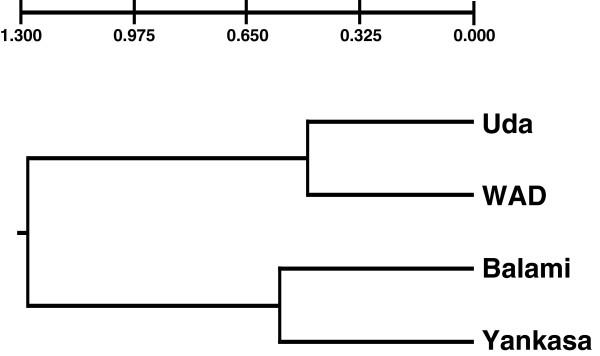
Morphological traits of Uda and Balami were significantly (P < 0.05) higher than Yankasa, which were both higher than West African Dwarf (WAD) sheep. Stepwise discriminant analysis showed tail length, rump height, chest girth, ear length and chest depth as the most discriminating variables for classification. Mahalanobis distances show the least differentiation between Uda and Balami and the largest between WAD and Balami sheep. While 93.3% of WAD sheep were correctly assigned to their source genetic group, 63.9% of Yankasa, 61.2% of Balami and 45.2% of Uda were classified correctly by nearest neighbour discriminant analysis. The overall high Polymorphism Information Content (PIC) of all microsatellite markers ranged from 0.751 to 0.927 supporting their use in genetic characterization. Expected heterozygosity was high for all loci (0.783 to 0.93). Mean heterozygote deficiency across all populations (0.171 to 0.534) possibly indicate significant inbreeding (P < 0.05). Mean values for FST, FIT and FIS statistics across all loci were 0.088, 0.394 and 0.336 respectively. Yankasa and Balami are the most closely related breeds (DA = 0.184) while WAD and Balami are the farthest apart breeds (DA = 0.665), which is coincident with distance based on morphological analysis and population structure assessed by STRUCTURE.
CONCLUSIONS
These results suggest that within-breed genetic variation in Nigerian sheep is higher than between-breeds and may be a valuable tool for genetic improvement and conservation. The higher genetic variability in Yankasa suggests the presence of unique ancestral alleles reflecting the presence of certain functional genes which may result in better adaptability in more agro-ecological zones of Nigeria. These genetic characteristics are potentially useful in planning improvement and conservation strategies in Nigerian indigenous sheep.
背景
绵羊在世界各地人们的社会经济生活中都很重要。据估计,我们曾经常见的一半以上的家畜品种现在都处于濒危状态。由于尼日利亚绵羊的遗传特征仍然缺乏,我们对 4 个尼日利亚绵羊品种的 402 只动物进行了 10 项形态特征分析,并对 384 只动物进行了 15 个微卫星 DNA 标记分析,以更好地了解遗传多样性,从而进行繁殖管理和种质资源保护。
结果
uda 和 balami 的形态特征明显(P<0.05)高于 yankasa,而 yankasa 又高于西非矮羊(wad)。逐步判别分析显示,尾巴长度、臀部高度、胸围、耳朵长度和胸部深度是分类的最具判别力的变量。马氏距离显示 uda 和 balami 之间的分化最小,而 wad 和 balami 之间的分化最大。93.3%的 wad 绵羊被正确分配到其原始遗传群体,63.9%的 yankasa、61.2%的 balami 和 45.2%的 uda 绵羊被最近邻判别分析正确分类。所有微卫星标记的总体高多态信息含量(pic)范围为 0.751 至 0.927,支持其用于遗传特征。所有位点的预期杂合度均较高(0.783 至 0.93)。所有群体的平均杂合子缺失值(0.171 至 0.534)可能表明存在显著的近亲繁殖(P<0.05)。所有位点的平均 FST、FIT 和 FIS 统计值分别为 0.088、0.394 和 0.336。yankasa 和 balami 是最密切相关的品种(DA=0.184),而 wad 和 balami 是最远的品种(DA=0.665),这与基于形态分析的距离和结构评估的种群结构一致。
结论
这些结果表明,尼日利亚绵羊的品种内遗传变异高于品种间遗传变异,可能是遗传改良和保护的有价值工具。yankasa 中的遗传多样性较高,表明存在独特的祖先等位基因,反映出某些功能基因的存在,这可能导致其在尼日利亚更多的农业生态区具有更好的适应性。这些遗传特征在规划尼日利亚本土绵羊的改良和保护策略方面具有潜在的用途。


 Zotero 插件