
微卫星分析揭示保加利亚本土绵羊品种的遗传多样性和种群结构
Genetic Diversity and Population Structure of Bulgarian Autochthonous Sheep Breeds Revealed by Microsatellite Analysis.
作者信息
Mihailova Yanka, Rusanov Krasimir, Rusanova Mila, Vassileva Pavlina, Atanassov Ivan, Nikolov Vasil, Todorovska Elena G
机构信息
Agricultural Academy, 30 Suhodolska Str., 1373 Sofia, Bulgaria.
Department of Agrobiotechnology, AgroBioInstitute, Agricultural Academy, 8 Dragan Tsankov Blvd., 1164 Sofia, Bulgaria.
出版信息
Animals (Basel). 2023 Jun 5;13(11):1878. doi: 10.3390/ani13111878.
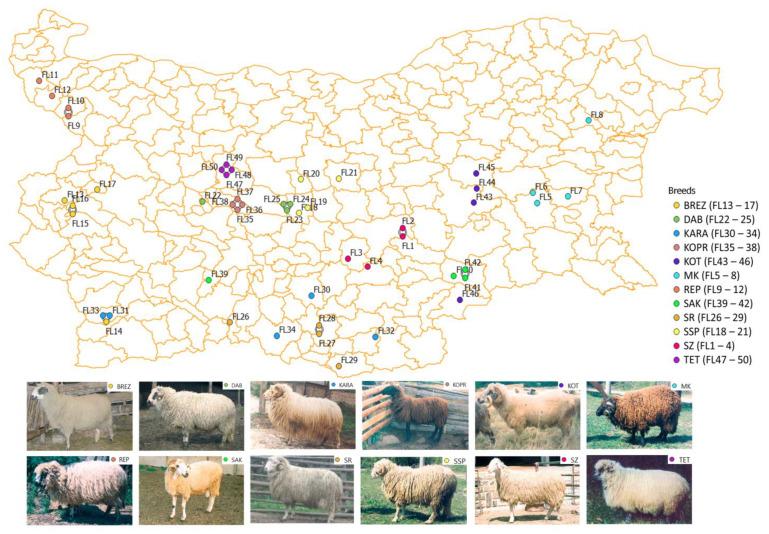
This study attempts to provide a deeper insight into the current genetic status of 12 Bulgarian autochthonous sheep breeds using microsatellite (SSR) markers. A total of 600 individuals from 50 flocks were analyzed using a panel of 13 SSR markers. In total, 228 alleles were found in the studied microsatellite loci. The mean number of alleles, the effective number of alleles, and the polymorphic information content (PIC) values per locus were 17.54, 5.250, and 0.799, respectively. The expected heterozygosity (He) for all breeds ranged from 0.70 to 0.82. The within-population heterozygote deficit (Fis) varied from -0.03 to 0.1, reflecting significant levels for 10 of the 12 breeds. The average genetic differentiation (Fst) was 0.046, revealing a low discrimination between the breeds. The genetic distance, principal coordinate analysis, and the structure analysis showed that two of the studied breeds-Local Stara Zagora/SZ/ and Local Karnobat/MK/-were the most distinct sheep populations. The Bayesian clustering approach suggested poor breed differentiation for the remaining 10 sheep breeds. The results suggest that proper management strategies and specific breeding policies need to be implemented in Bulgaria to avoid the intermixing of breeds and to reduce the erosion of breed purity observed in some breeds.
本研究试图利用微卫星(SSR)标记,更深入地了解12个保加利亚本土绵羊品种的当前遗传状况。使用一组13个SSR标记对来自50个羊群的总共600只个体进行了分析。在所研究的微卫星位点总共发现了228个等位基因。每个位点的等位基因平均数、有效等位基因数和多态信息含量(PIC)值分别为17.54、5.250和0.799。所有品种的预期杂合度(He)在0.70至0.82之间。群体内杂合子缺失(Fis)在-0.03至0.1之间变化,反映出12个品种中有10个品种达到显著水平。平均遗传分化(Fst)为0.046,表明品种间的区分度较低。遗传距离、主坐标分析和结构分析表明,所研究的两个品种——当地旧扎戈拉/SZ/和当地卡尔诺巴特/MK/——是最独特的绵羊群体。贝叶斯聚类方法表明,其余10个绵羊品种的品种分化较差。结果表明,保加利亚需要实施适当的管理策略和具体的育种政策,以避免品种混杂,并减少在一些品种中观察到的品种纯度下降。

 Zotero 插件