Department of Pediatrics, Amrita Institute of Medical Sciences, Amrita Vishwa Vidyapeetham University, Cochin, India.
Pediatr Rheumatol Online J. 2012 Nov 23;10(1):40. doi: 10.1186/1546-0096-10-40.
Many children with sJIA may have a delayed onset of arthritis and so fail to fulfil the ILAR criteria for sJIA. This study was undertaken to determine whether the Yamaguchi criteria (for adult onset Still's disease) is useful in classification of children with systemic juvenile idiopathic arthritis (sJIA) particularly in "pre-arthritic", pure systemic, phase of the illness. A secondary objective was to determine the time delay between disease onset and onset of arthritis in our sJIA cohort.
Retrospective chart review all patients with a diagnosis of systemic juvenile arthritis in our department from Jan 1, 2004 to Jan 1, 2010.
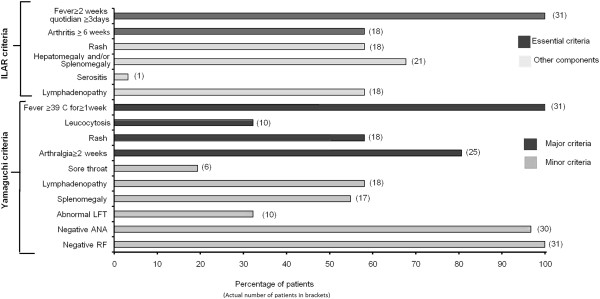
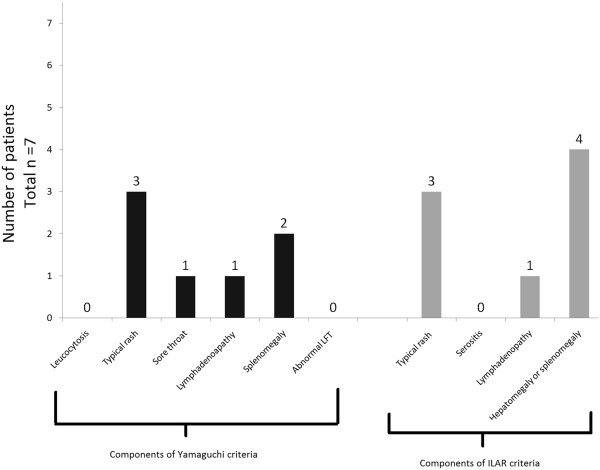
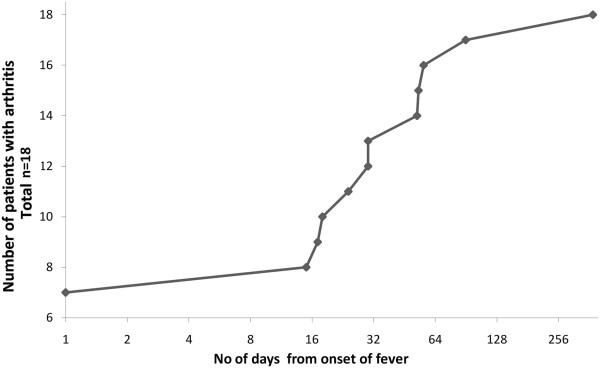
Twenty boys and eleven girls formed the study cohort. Thirteen patients were diagnosed with "suspected" sJIA due to typical systemic features but an absence of arthritis. Overall, the Yamaguchi criteria was fulfilled in a higher number of patients in the study (n=23) as compared to the ILAR criteria (n=18). Among the 13 "suspected" sJIA patients, 12 fulfilled the Yamaguchi criteria. Overall, either ILAR criteria or Yamaguchi criteria was fulfilled in 30 patients (96.8% of patients). The degree of association between the two criteria was poor (Phi coefficient = -0.352, p=0.05). Eleven out of eighteen patients with arthritis gave a history of delay in onset of arthritis (range=15 days to more than a year; median=30 days). Thus a total of 24 patients (75%) had a delay in onset of arthritis at onset of disease.
Patients with sJIA can have a significant period during their course (particularly at onset) when they do not have arthritis. The Yamaguchi criteria may be useful in this subset of patients in the "pre-arthritic" phase of the disease. Future criteria should incorporate the strengths of both, the Yamaguchi and the ILAR criteria.
许多幼年特发性关节炎(sJIA)患儿可能存在关节炎发病延迟,因此不符合幼年特发性关节炎国际研究组(ILAR)的 sJIA 诊断标准。本研究旨在明确是否 Yamaguchi 标准(成人Still 病的诊断标准)有助于 sJIA 患儿的分类,尤其是在疾病的“关节炎前期”、单纯全身型阶段。次要目的是确定我们 sJIA 患儿队列中疾病发作与关节炎发作之间的时间延迟。
回顾性分析 2004 年 1 月 1 日至 2010 年 1 月 1 日期间在我科诊断为全身型幼年特发性关节炎的所有患者的病历。
研究队列包括 20 名男孩和 11 名女孩。由于存在典型全身表现但无关节炎,13 例患者被诊断为“疑似”sJIA。总体而言,与 ILAR 标准(18 例)相比,Yamaguchi 标准在研究中满足的患者更多(n=23)。在 13 例“疑似”sJIA 患者中,12 例符合 Yamaguchi 标准。总体而言,30 例(96.8%的患者)符合 ILAR 标准或 Yamaguchi 标准。两种标准之间的关联程度较差(Phi 系数=-0.352,p=0.05)。18 例关节炎患者中有 11 例(61.1%)存在关节炎发病延迟(发病时间延迟 15 天至 1 年以上,中位数为 30 天)。因此,共有 24 例(75%)患者在疾病发作时存在关节炎发病延迟。
sJIA 患者在病程中会有相当长的一段时间(尤其是在疾病发作时)没有关节炎。Yamaguchi 标准可能对疾病“关节炎前期”阶段的这部分患者有用。未来的标准应综合 Yamaguchi 和 ILAR 标准的优势。