Department of Biology of Physical Activity, University of Jyväskylä, P,O, Box 35 (VIV), Jyväskylä, FIN-40014, Finland.
J Int Soc Sports Nutr. 2012 Nov 26;9(1):50. doi: 10.1186/1550-2783-9-50.
Acid-base balance refers to the equilibrium between acids and bases in the human body. Nutrition may affect acid-base balance and further physical performance. With the help of PRAL (potential renal acid load), a low-protein vegetarian diet (LPVD) was designed to enhance the production of bases in body. The aim of this study was to investigate if LPVD has an effect on blood acid-base status and performance during submaximal and maximal aerobic cycling.
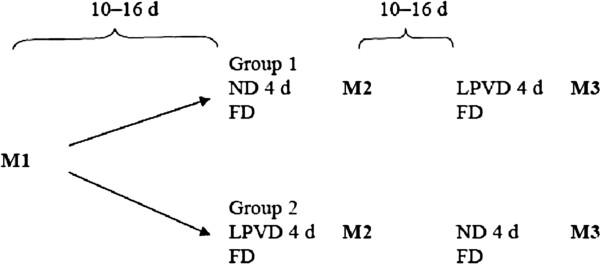
Nine healthy, recreationally active men (age 23.5 ± 3.4 yr) participated in the study and were randomly divided into two groups in a cross-over study design. Group 1 followed LPVD for 4 days and group 2 ate normally (ND) before performing a cycle ergometer test. The test included three 10-min stages at 40, 60 and 80% of VO2max. The fourth stage was performed at 100% of VO2max until exhaustion. After 10-16 days, the groups started a second 4-day diet, and at the end performed the similar ergometer test. Venous blood samples were collected at the beginning and at the end of both diet periods and after every stage cycled.
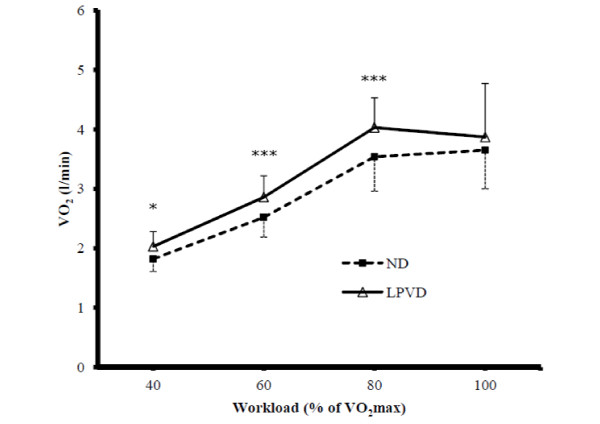
Diet caused no significant difference in venous blood pH, strong ion difference (SID), total concentration of weak acids (Atot), partial pressure of CO2 (pCO2) or HCO3- at rest or during cycling between LPVD and ND. In the LPVD group, at rest SID significantly increased over the diet period (38.6 ± 1.8 vs. 39.8 ± 0.9, p=0.009). Diet had no significant effect on exercise time to exhaustion, but VO2 was significantly higher at 40, 60 and 80% of VO2max after LPVD compared to ND (2.03 ± 0.25 vs. 1.82 ± 0.21 l/min, p=0.035; 2.86 ± 0.36 vs. 2.52 ± 0.33 l/min, p<0.001 and 4.03 ± 0.50 vs. 3.54 ± 0.58 l/min, p<0.001; respectively).
There was no difference in venous blood acid-base status between a 4-day LPVD and ND. VO2 was increased during submaximal cycling after LPVD suggesting that the exercise economy was poorer. This had no further effect on maximal aerobic performance. More studies are needed to define how nutrition affects acid-base balance and performance.
酸碱平衡是指人体内酸碱的平衡。营养可能会影响酸碱平衡和进一步的身体表现。借助 PRAL(潜在肾酸负荷),设计了低蛋白素食饮食(LPVD)以增加体内碱的产生。本研究的目的是调查 LPVD 是否会对亚最大和最大有氧自行车运动期间的血液酸碱状态和表现产生影响。
9 名健康、有业余运动经验的男性(年龄 23.5±3.4 岁)参与了这项研究,并按照交叉研究设计随机分为两组。第 1 组在 4 天内进行 LPVD,第 2 组在进行自行车测力计测试前正常饮食(ND)。测试包括在 40%、60%和 80%VO2max 下进行三个 10 分钟的阶段。第四个阶段在 100%VO2max 下进行,直到力竭。在 10-16 天后,两组开始进行第二个为期 4 天的饮食,最后进行类似的测力计测试。在两个饮食期的开始和结束时以及每次循环结束后采集静脉血样。
饮食在 LPVD 和 ND 之间的静息或运动期间对静脉血 pH 值、强离子差(SID)、总弱酸浓度(Atot)、二氧化碳分压(pCO2)或 HCO3-没有显著差异。在 LPVD 组中,SID 在饮食期间显著增加(38.6±1.8 对 39.8±0.9,p=0.009)。饮食对力竭时间没有显著影响,但 LPVD 后在 40%、60%和 80%VO2max 时的 VO2 明显更高,与 ND 相比(2.03±0.25 对 1.82±0.21 l/min,p=0.035;2.86±0.36 对 2.52±0.33 l/min,p<0.001 和 4.03±0.50 对 3.54±0.58 l/min,p<0.001;分别)。
LPVD 和 ND 之间静脉血液酸碱状态无差异。LPVD 后亚最大循环时的 VO2 增加,表明运动经济性更差。这对最大有氧表现没有进一步影响。需要更多的研究来确定营养如何影响酸碱平衡和表现。