Department of Medicine, University of Toronto, Toronto, Canada.
PLoS One. 2012;7(11):e49797. doi: 10.1371/journal.pone.0049797. Epub 2012 Nov 21.
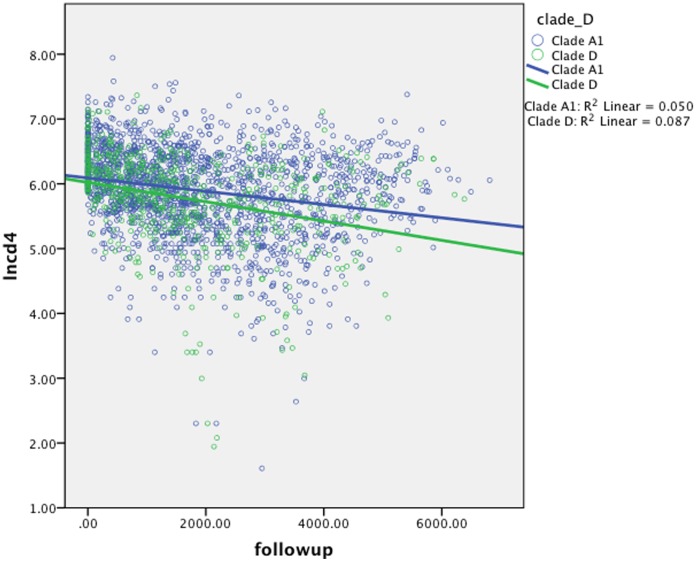
HIV-1 is grouped phylogenetically into clades, which may impact rates of HIV-1 disease progression. Clade D infection in particular has been shown to be more pathogenic. Here we confirm in a Nairobi-based prospective female sex worker cohort (1985-2004) that Clade D (n = 54) is associated with a more rapid CD4 decline than clade A1 (n = 150, 20.6% vs 13.4% decline per year, 1.53-fold increase, p = 0.015). This was independent of "protective" HLA and country of origin (p = 0.053), which in turn were also independent predictors of the rate of CD4 decline (p = 0.026 and 0.005, respectively). These data confirm that clade D is more pathogenic than clade A1. The precise reason for this difference is currently unclear, and requires further study. This is first study to demonstrate difference in HIV-1 disease progression between clades while controlling for protective HLA alleles.
HIV-1 按系统发生学分为群,这可能影响 HIV-1 疾病的进展速度。特别是 D 群感染已被证明更具致病性。在这里,我们在基于内罗毕的前瞻性女性性工作者队列(1985-2004 年)中证实,与 clade A1(每年下降 13.4%,1.53 倍,p = 0.015)相比,D 群(n = 54)与更快的 CD4 下降相关。这与“保护性”HLA 和原籍国无关(p = 0.053),而 HLA 和原籍国反过来也是 CD4 下降速度的独立预测因素(p = 0.026 和 0.005)。这些数据证实 D 群比 A1 群更具致病性。造成这种差异的确切原因目前尚不清楚,需要进一步研究。这是第一项在控制保护性 HLA 等位基因的情况下,证明 HIV-1 疾病进展中 clade 之间存在差异的研究。