Institute of Oncology, Provincial Hospital Affiliated to Shandong University, Shandong University, Jinan, People's Republic of China.
PLoS One. 2012;7(11):e49884. doi: 10.1371/journal.pone.0049884. Epub 2012 Nov 19.
The insulin-like growth factor (IGF) system was documented to play a predominant role in neoplasia. As lung cancer is one of the most malignant cancers, we conducted a meta-analysis in order to investigate the strength of association between circulating IGF-1 and IGFBP-3 levels and lung cancer.
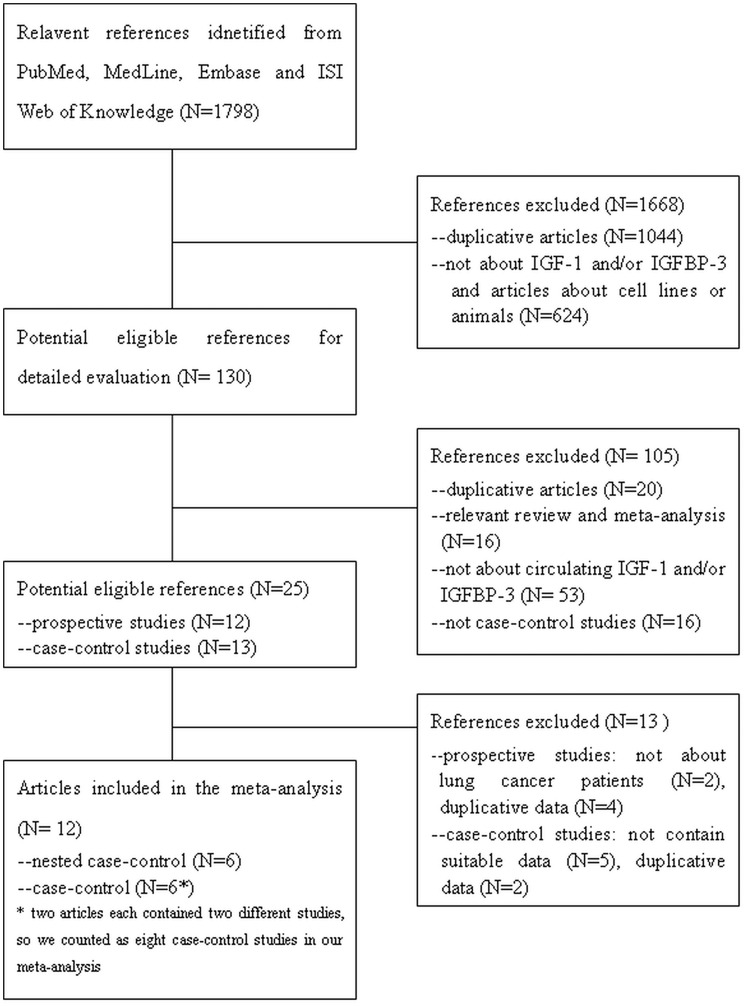
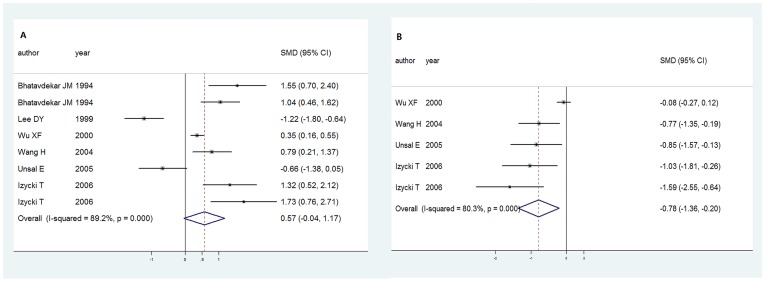
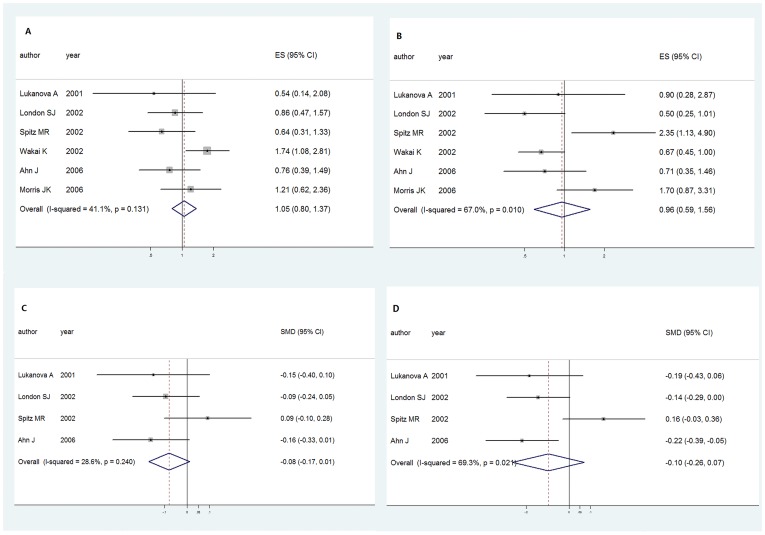
METHODOLOGY/PRINCIPAL FINDINGS: A systematic literature search was conducted to identify all prospective case-control studies and case-control studies on circulating IGFs and IGFBPs levels. Six nested case-control studies (1 043 case subjects and 11 472 control participants) and eight case-control studies (401 case subjects and 343 control participants) were included in this meta-analysis. Pooled measure was calculated as the inverse variance-weighted mean of the natural logarithm of multivariate adjusted OR with 95% CIs for highest vs. lowest levels to assess the association of circulating IGF-1 and IGFBP-3 concentrations and lung cancer. Standard mean difference (SMD) was also calculated to indicate the difference of the circulating IGF-1 and IGFBP-3 concentrations between the lung cancer case group and the control group. Of the nested case-control studies, ORs for the highest vs. lowest levels of IGF-1 and IGFBP-3 were 1.047 (95% CI: [0.802,1.367], P = 0.736) and 0.960 (95%CI: [0.591,1.559], P = 0.868) respectively; and SMDs were -0.079 (95%CI:[ -0.169, 0.011], P = 0.086) and -0.097 (95%CI:[ -0.264,0.071], P = 0.258) for IGF-1 and IGFBP-3 respectively. As to the case-control studies, SMDs were 0.568 (95%CI:[ -0.035, 1.171], P = 0.065) and -0.780 (95%CI:[ -1.358, -0.201], P = 0.008) for IGF-1 and IGFBP-3 respectively.
CONCLUSIONS/SIGNIFICANCE: Inverse association was shown between IGFBP-3 and lung cancer in the case-control studies,and the circulating level of IGFBP-3 underwent a decline during tumorogenesis and development of lung cancer, which suggested IGFBP-3 a promising candidate for the biomarker of lung cancer.
胰岛素样生长因子(IGF)系统被证明在肿瘤发生中起着主要作用。由于肺癌是最恶性的癌症之一,我们进行了一项荟萃分析,以研究循环 IGF-1 和 IGFBP-3 水平与肺癌之间的关联强度。
方法/主要发现:系统地进行了文献检索,以确定所有前瞻性病例对照研究和病例对照研究中关于循环 IGFs 和 IGFBPs 水平的研究。本荟萃分析纳入了 6 项巢式病例对照研究(1043 例病例和 11472 例对照参与者)和 8 项病例对照研究(401 例病例和 343 例对照参与者)。为评估循环 IGF-1 和 IGFBP-3 浓度与肺癌的关系,采用自然对数多变量调整的比值比的倒数方差加权均值作为汇总测量值,95%CI 为最高与最低水平。还计算了标准化均数差值(SMD)以表示肺癌病例组与对照组之间循环 IGF-1 和 IGFBP-3 浓度的差异。在巢式病例对照研究中,IGF-1 和 IGFBP-3 的最高与最低水平的比值比分别为 1.047(95%CI:[0.802,1.367],P=0.736)和 0.960(95%CI:[0.591,1.559],P=0.868);SMD 分别为-0.079(95%CI:[-0.169,0.011],P=0.086)和-0.097(95%CI:[-0.264,0.071],P=0.258)。对于病例对照研究,SMD 分别为 0.568(95%CI:[-0.035,1.171],P=0.065)和-0.780(95%CI:[-1.358,-0.201],P=0.008)。
结论/意义:病例对照研究显示 IGFBP-3 与肺癌呈负相关,循环 IGFBP-3 在肿瘤发生和肺癌发展过程中呈下降趋势,这表明 IGFBP-3 可能是肺癌的有前途的生物标志物。