International Institute of Molecular and Cell Biology, Warsaw, Poland.
PLoS One. 2012;7(11):e47114. doi: 10.1371/journal.pone.0047114. Epub 2012 Nov 26.
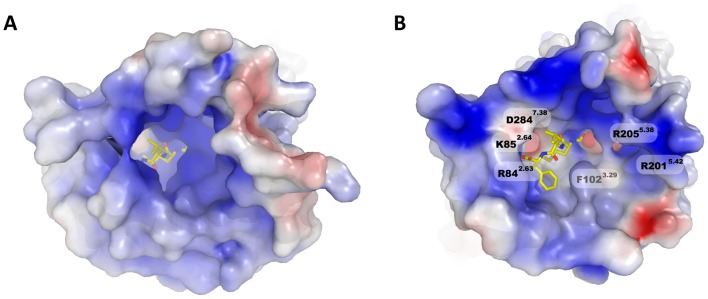
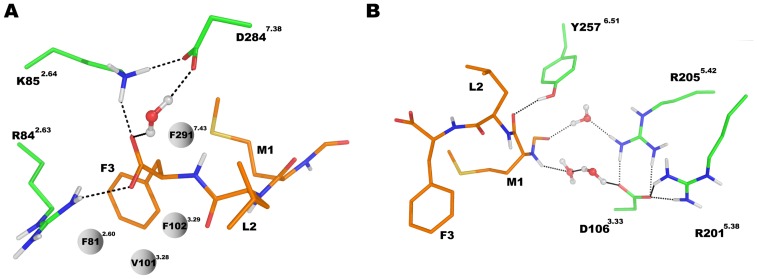
The Formyl Peptide Receptor 1 (FPR1) is an important chemotaxis receptor involved in various aspects of host defense and inflammatory processes. We constructed a model of FPR1 using as a novel template the chemokine receptor CXCR4 from the same branch of the phylogenetic tree of G-protein-coupled receptors. The previously employed template of rhodopsin contained a bulge at the extracellular part of TM2 which directly influenced binding of ligands. We also conducted molecular dynamics (MD) simulations of FPR1 in the apo form as well as in a form complexed with the agonist fMLF and the antagonist tBocMLF in the model membrane. During all MD simulation of the fMLF-FPR1 complex a water molecule transiently bridged the hydrogen bond between W254(6.48) and N108(3.35) in the middle of the receptor. We also observed a change in the cytoplasmic part of FPR1 of a rotamer of the Y301(7.53) residue (tyrosine rotamer switch). This effect facilitated movement of more water molecules toward the receptor center. Such rotamer of Y301(7.53) was not observed in any crystal structures of GPCRs which can suggest that this state is temporarily formed to pass the water molecules during the activation process. The presence of a distance between agonist and residues R201(5.38) and R205(5.42) on helix TM5 may suggest that the activation of FPR1 is similar to the activation of β-adrenergic receptors since their agonists are separated from serine residues on helix TM5. The removal of water molecules bridging these interactions in FPR1 can result in shrinking of the binding site during activation similarly to the shrinking observed in β-ARs. The number of GPCR crystal structures with agonists is still scarce so the designing of new ligands with agonistic properties is hampered, therefore homology modeling and docking can provide suitable models. Additionally, the MD simulations can be beneficial to outline the mechanisms of receptor activation and the agonist/antagonist sensing.
甲酰肽受体 1(FPR1)是一种重要的趋化因子受体,参与宿主防御和炎症过程的各个方面。我们使用趋化因子受体 CXCR4 作为新颖模板构建了 FPR1 模型,该模板来自 G 蛋白偶联受体的系统发育树的同一分支。先前使用的视紫红质模板在 TM2 的细胞外部分有一个凸起,这直接影响了配体的结合。我们还在模型膜中对apo 形式的 FPR1 以及与激动剂 fMLF 和拮抗剂 tBocMLF 复合的 FPR1 进行了分子动力学(MD)模拟。在 fMLF-FPR1 复合物的所有 MD 模拟中,一个水分子暂时桥接了受体中部 W254(6.48)和 N108(3.35)之间的氢键。我们还观察到 FPR1 的细胞质部分的 Y301(7.53)残基(酪氨酸旋转开关)的构象变化。这种效应促进了更多水分子向受体中心的运动。在任何 GPCR 晶体结构中都没有观察到这种 Y301(7.53)的构象,可以表明这种状态是暂时形成的,以便在激活过程中传递水分子。在 TM5 螺旋上,激动剂与残基 R201(5.38)和 R205(5.42)之间存在距离,这可能表明 FPR1 的激活类似于β-肾上腺素能受体的激活,因为它们的激动剂与 TM5 螺旋上的丝氨酸残基分离。在 FPR1 中去除桥接这些相互作用的水分子会导致结合位点在激活过程中收缩,类似于在β-AR 中观察到的收缩。具有激动剂的 GPCR 晶体结构数量仍然很少,因此新的具有激动性的配体的设计受到阻碍,因此同源建模和对接可以提供合适的模型。此外,MD 模拟可以有助于概述受体激活和激动剂/拮抗剂感应的机制。