Telematics Engineering Department, Carlos III University of Madrid, Avda. Universidad 30, 28911 Leganés, Madrid, Spain.
Sensors (Basel). 2012 Oct 16;12(10):13907-46. doi: 10.3390/s121013907.
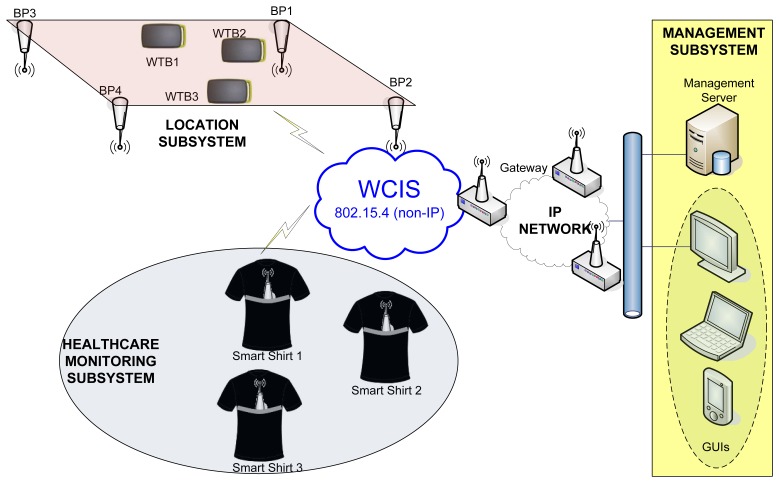
Nowadays society is demanding more and more smart healthcare services that allow monitoring patient status in a non-invasive way, anywhere and anytime. Thus, healthcare applications are currently facing important challenges guided by the u-health (ubiquitous health) and p-health (pervasive health) paradigms. New emerging technologies can be combined with other widely deployed ones to develop such next-generation healthcare systems. The main objective of this paper is to review and provide more details on the work presented in "LOBIN: E-Textile and Wireless-Sensor-Network-Based Platform for Healthcare Monitoring in Future Hospital Environments", published in the IEEE Transactions on Information Technology in Biomedicine, as well as to extend and update the comparison with other similar systems. As a result, the paper discusses the main advantages and disadvantages of using different architectures and communications technologies to develop wearable systems for pervasive healthcare applications.
如今,社会对能够随时随地以非侵入方式监测患者状况的智能医疗服务的需求越来越大。因此,医疗保健应用程序目前正面临着由 u-health(无处不在的健康)和 p-health(普及健康)范例指导的重要挑战。新兴技术可以与其他广泛部署的技术相结合,以开发此类下一代医疗保健系统。本文的主要目的是回顾并详细介绍发表在《IEEE Transactions on Information Technology in Biomedicine》上的“LOBIN:基于电子纺织品和无线传感器网络的未来医院环境中的医疗监测平台”一文中的工作,并对其进行扩展和更新,与其他类似系统进行比较。因此,本文讨论了为普及医疗保健应用开发可穿戴系统时使用不同架构和通信技术的主要优缺点。