Estonian Biocentre and Department of Evolutionary Biology, University of Tartu, Tartu, Estonia.
BMC Evol Biol. 2012 Dec 3;12:234. doi: 10.1186/1471-2148-12-234.
A Southwest Asian origin and dispersal to North Africa in the Early Upper Palaeolithic era has been inferred in previous studies for mtDNA haplogroups M1 and U6. Both haplogroups have been proposed to show similar geographic patterns and shared demographic histories.
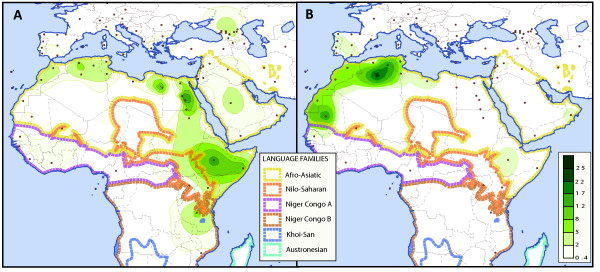
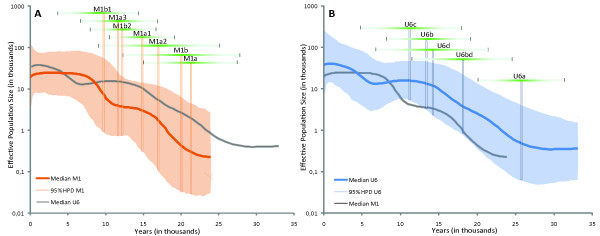
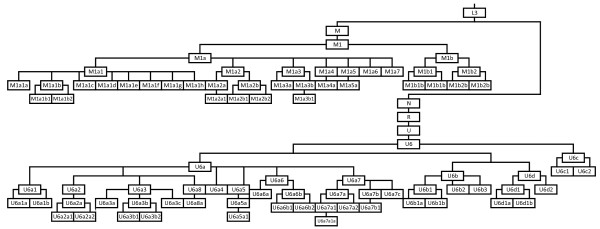
We report here 24 M1 and 33 U6 new complete mtDNA sequences that allow us to refine the existing phylogeny of these haplogroups. The resulting phylogenetic information was used to genotype a further 131 M1 and 91 U6 samples to determine the geographic spread of their sub-clades. No southwest Asian specific clades for M1 or U6 were discovered. U6 and M1 frequencies in North Africa, the Middle East and Europe do not follow similar patterns, and their sub-clade divisions do not appear to be compatible with their shared history reaching back to the Early Upper Palaeolithic. The Bayesian Skyline Plots testify to non-overlapping phases of expansion, and the haplogroups' phylogenies suggest that there are U6 sub-clades that expanded earlier than those in M1. Some M1 and U6 sub-clades could be linked with certain events. For example, U6a1 and M1b, with their coalescent ages of ~20,000-22,000 years ago and earliest inferred expansion in northwest Africa, could coincide with the flourishing of the Iberomaurusian industry, whilst U6b and M1b1 appeared at the time of the Capsian culture.
Our high-resolution phylogenetic dissection of both haplogroups and coalescent time assessments suggest that the extant main branching pattern of both haplogroups arose and diversified in the mid-later Upper Palaeolithic, with some sub-clades concomitantly with the expansion of the Iberomaurusian industry. Carriers of these maternal lineages have been later absorbed into and diversified further during the spread of Afro-Asiatic languages in North and East Africa.
先前的研究推断,线粒体 DNA 单倍群 M1 和 U6 起源于西南亚,并在旧石器时代晚期传播到北非。这两个单倍群被认为具有相似的地理分布模式和共同的人口历史。
我们在此报告了 24 个 M1 和 33 个 U6 的全新完整 mtDNA 序列,这些序列使我们能够完善这些单倍群的现有系统发育。由此产生的系统发育信息用于对另外 131 个 M1 和 91 个 U6 样本进行基因分型,以确定其亚群的地理分布。没有发现 M1 或 U6 的特定西南亚分支。北非、中东和欧洲的 U6 和 M1 频率并不遵循相似的模式,它们的亚群划分似乎与它们追溯到旧石器时代晚期的共同历史不一致。贝叶斯天空线图证明了扩张的非重叠阶段,而单倍群的系统发育表明,有些 U6 亚群的扩张时间早于 M1 亚群。一些 M1 和 U6 亚群可能与某些事件有关。例如,U6a1 和 M1b,其合并年龄约为 20000-22000 年前,最早的扩张在西北非,可能与伊博罗-毛里塔尼亚工业的繁荣相吻合,而 U6b 和 M1b1 则出现在卡普萨文化时期。
我们对这两个单倍群进行的高分辨率系统发育分析和合并时间评估表明,这两个单倍群的现存主要分支模式在中晚期旧石器时代形成并多样化,一些亚群与伊博罗-毛里塔尼亚工业的扩张同时发生。这些母系谱系的携带者在北非和东非的 Afro-Asiatic 语言传播过程中被吸收并进一步多样化。