Department of Dermatology, Wakayama Medical University, Wakayama, Japan.
Acta Histochem Cytochem. 2012 Oct 31;45(5):293-9. doi: 10.1267/ahc.12004. Epub 2012 Oct 12.
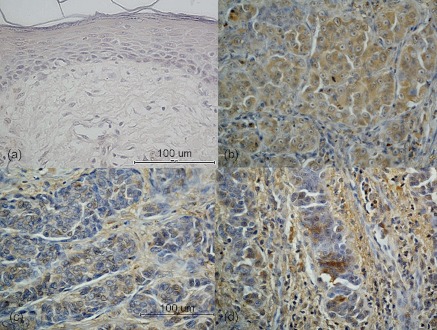
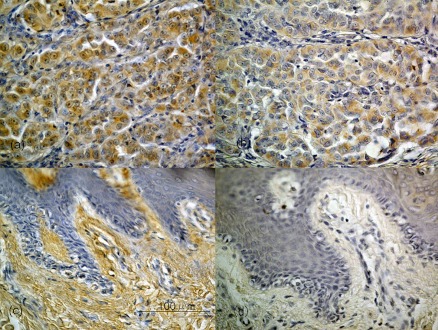
The CXCR4/CXCL12 pathway has recently been reported to be involved in stimulating the metastasis of many different neoplasms, in which CXCR4 activates various phenomena such as chemotaxis, invasion, angiogenesis and proliferation. The purpose of this study was to analyze a possible association between the expression of chemokine receptors CXCR4, CCR6 and CCR7 with the clinicopathological features of cutaneous malignant melanoma, and to assess the usefulness of these chemokine receptors for diagnosis and prognosis. In our study, a percentage of immunoexpression of both CXCR4 and its ligands CXCL12 was associated with high clinical risk. In contrast, the patients with a low immunoexpression of CXCR4 and CXCL12 had low clinical risk. CCR6 and CCR7 immunoexpressions were also correlated with some clinical parameters, but seemed no more useful than CXCR4. These data suggest that the assessment of CXCR4 immunoexpression is a novel tool for predicting tumor aggressiveness in malignant melanomas, and in particular, a high immunoexpression percentage of CXCR4 and CXCL12 might be a sign of a poor prognosis.
趋化因子受体 CXCR4/CXCL12 途径最近被报道参与刺激许多不同肿瘤的转移,其中 CXCR4 激活了趋化、侵袭、血管生成和增殖等各种现象。本研究旨在分析趋化因子受体 CXCR4、CCR6 和 CCR7 的表达与皮肤恶性黑色素瘤的临床病理特征之间可能存在的关联,并评估这些趋化因子受体在诊断和预后中的作用。在我们的研究中,CXCR4 及其配体 CXCL12 的免疫表达百分比与高临床风险相关。相比之下,CXCR4 和 CXCL12 免疫表达水平低的患者临床风险较低。CCR6 和 CCR7 的免疫表达也与一些临床参数相关,但似乎不如 CXCR4 有用。这些数据表明,评估 CXCR4 的免疫表达是预测恶性黑色素瘤肿瘤侵袭性的一种新工具,特别是 CXCR4 和 CXCL12 的高免疫表达百分比可能是预后不良的标志。