Interfaculty Institute of Microbiology and Infection Medicine, University of Tübingen, Tübingen, Germany.
PLoS Pathog. 2012;8(11):e1003016. doi: 10.1371/journal.ppat.1003016. Epub 2012 Nov 29.
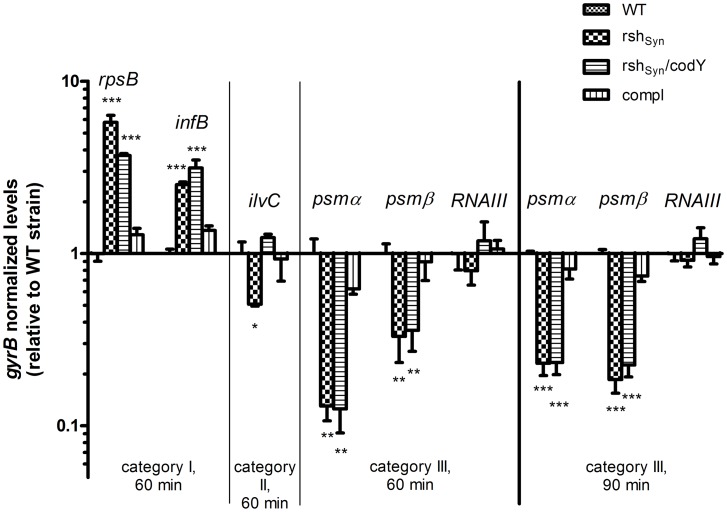
The stringent response is initiated by rapid (p)ppGpp synthesis, which leads to a profound reprogramming of gene expression in most bacteria. The stringent phenotype seems to be species specific and may be mediated by fundamentally different molecular mechanisms. In Staphylococcus aureus, (p)ppGpp synthesis upon amino acid deprivation is achieved through the synthase domain of the bifunctional enzyme RSH (RelA/SpoT homolog). In several firmicutes, a direct link between stringent response and the CodY regulon was proposed. Wild-type strain HG001, rsh(Syn), codY and rsh(Syn), codY double mutants were analyzed by transcriptome analysis to delineate different consequences of RSH-dependent (p)ppGpp synthesis after induction of the stringent response by amino-acid deprivation. Under these conditions genes coding for major components of the protein synthesis machinery and nucleotide metabolism were down-regulated only in rsh positive strains. Genes which became activated upon (p)ppGpp induction are mostly regulated indirectly via de-repression of the GTP-responsive repressor CodY. Only seven genes, including those coding for the cytotoxic phenol-soluble modulins (PSMs), were found to be up-regulated via RSH independently of CodY. qtRT-PCR analyses of hallmark genes of the stringent response indicate that an RSH activating stringent condition is induced after uptake of S. aureus in human polymorphonuclear neutrophils (PMNs). The RSH activity in turn is crucial for intracellular expression of psms. Accordingly, rsh(Syn) and rsh(Syn), codY mutants were less able to survive after phagocytosis similar to psm mutants. Intraphagosomal induction of psmα1-4 and/or psmβ1,2 could complement the survival of the rsh(Syn) mutant. Thus, an active RSH synthase is required for intracellular psm expression which contributes to survival after phagocytosis.
严格响应是由快速(p)ppGpp 合成引发的,这导致大多数细菌中的基因表达发生深刻重编程。严格表型似乎是物种特异性的,可能由根本不同的分子机制介导。在金黄色葡萄球菌中,氨基酸饥饿时(p)ppGpp 的合成是通过双功能酶 RSH(RelA/SpoT 同源物)的合成酶结构域实现的。在几种Firmicutes 中,提出了严格反应与 CodY 调控子之间的直接联系。通过转录组分析分析野生型 HG001 菌株、rsh(Syn)、codY 和 rsh(Syn)、codY 双突变体,以描绘在氨基酸剥夺诱导严格反应后,RSH 依赖性(p)ppGpp 合成的不同后果。在这些条件下,编码蛋白质合成机制和核苷酸代谢主要成分的基因仅在 rsh 阳性菌株中下调。在(p)ppGpp 诱导下激活的基因主要通过解除 GTP 响应抑制剂 CodY 的抑制而间接调节。只有七个基因,包括编码细胞毒性酚可溶性调制素(PSMs)的基因,被发现通过 RSH 独立于 CodY 被上调。严格反应标志性基因的 qtRT-PCR 分析表明,金黄色葡萄球菌摄取人多形核白细胞(PMN)后会诱导 RSH 激活严格条件。反过来,RSH 活性对于 psms 的细胞内表达至关重要。因此,类似于 psm 突变体,rsh(Syn)和 rsh(Syn)、codY 突变体在吞噬后存活能力降低。psmα1-4 和/或 psmβ1,2 的吞噬体内诱导可以补充 rsh(Syn)突变体的存活。因此,活性 RSH 合酶是细胞内 psm 表达所必需的,这有助于吞噬后存活。