Academic Neonatology, UCL Institute for Women's Health, London WC1E 6AU, UK.
BMJ. 2012 Dec 4;345:e7961. doi: 10.1136/bmj.e7961.
To determine outcomes at age 3 years in babies born before 27 completed weeks' gestation in 2006, and to evaluate changes in outcome since 1995 for babies born between 22 and 25 weeks' gestation.
Prospective national cohort studies, EPICure and EPICure 2.
Hospital and home based evaluations, England.
1031 surviving babies born in 2006 before 27 completed weeks' gestation. Outcomes for 584 babies born at 22-25 weeks' gestation were compared with those of 260 surviving babies of the same gestational age born in 1995.
Survival to age 3 years, impairment (2008 consensus definitions), and developmental scores. Multiple imputation was used to account for the high proportion of missing data in the 2006 cohort.
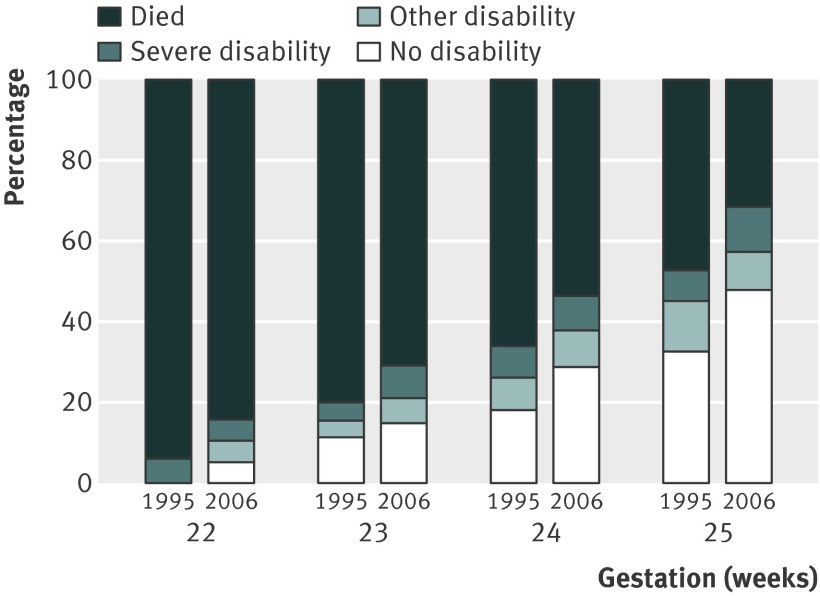
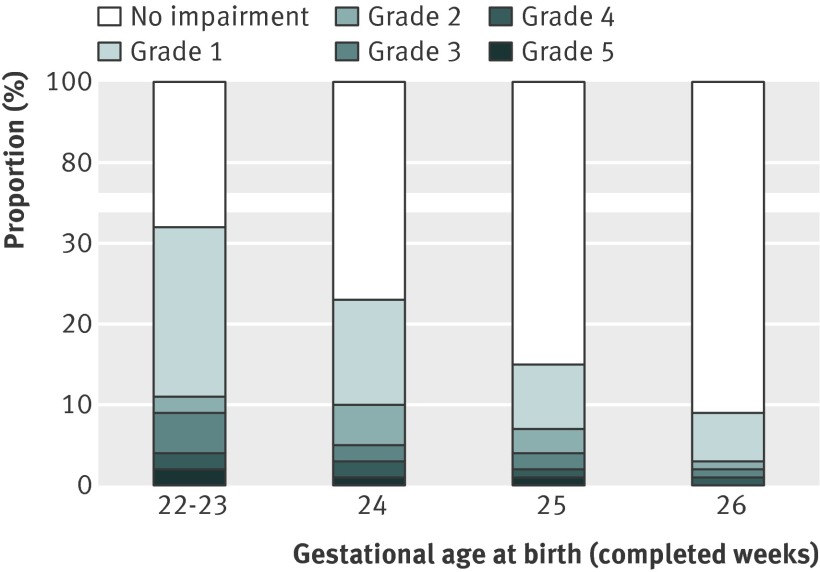
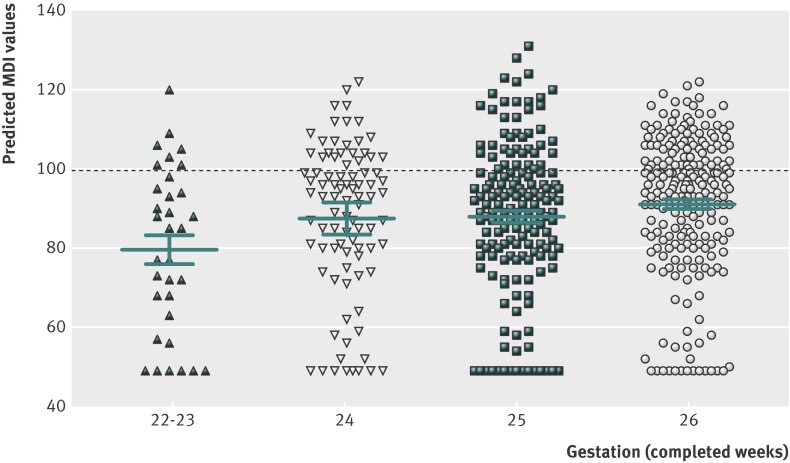
Of the 576 babies evaluated after birth in 2006, 13.4% (n=77) were categorised as having severe impairment and 11.8% (n=68) moderate impairment. The prevalence of neurodevelopmental impairment was significantly associated with length of gestation, with greater impairment as gestational age decreased: 45% at 22-23 weeks, 30% at 24 weeks, 25% at 25 weeks, and 20% at 26 weeks (P<0.001). Cerebral palsy was present in 83 (14%) survivors. Mean developmental quotients were lower than those of the general population (normal values 100 (SD 15)) and showed a direct relation with gestational age: 80 (SD 21) at 22-23 weeks, 87 (19) at 24 weeks, 88 (19) at 25 weeks, and 91 (18) at 26 weeks. These results did not differ significantly after imputation. Comparing imputed outcomes between the 2006 and 1995 cohorts, the proportion of survivors born between 22 and 25 weeks' gestation with severe disability, using 1995 definitions, was 18% (95% confidence interval 14% to 24%) in 1995 and 19% (14% to 23%) in 2006. Fewer survivors had shunted hydrocephalus or seizures. Survival of babies admitted for neonatal care increased from 39% (35% to 43%) in 1995 to 52% (49% to 55%) in 2006, an increase of 13% (8% to 18%), and survival without disability increased from 23% (20% to 26%) in 1995 to 34% (31% to 37%) in 2006, an increase of 11% (6% to 16%).
Survival and impairment in early childhood are both closely related to gestational age for babies born at less than 27 weeks' gestation. Using multiple imputation to account for the high proportion of missing values, a higher proportion of babies admitted for neonatal care now survive without disability, particularly those born at gestational ages 24 and 25 weeks.
确定在 2006 年出生于 27 周前的 27 周前早产儿的 3 岁时结局,并评估自 1995 年以来,22-25 周出生的婴儿的结局变化。
前瞻性全国队列研究,EPICure 和 EPICure 2。
医院和家庭评估,英国。
1031 名 2006 年出生于 27 周前的存活婴儿。将 22-25 周出生的 584 名婴儿的结局与 1995 年出生的 260 名具有相同胎龄的存活婴儿的结局进行比较。
3 岁时的存活率、损伤(2008 年共识定义)和发育评分。使用多重插补来解释 2006 年队列中高比例的缺失数据。
在 2006 年出生后接受评估的 576 名婴儿中,13.4%(n=77)被归类为严重损伤,11.8%(n=68)为中度损伤。神经发育损伤的患病率与胎龄显著相关,胎龄越小,损伤越严重:22-23 周时为 45%,24 周时为 30%,25 周时为 25%,26 周时为 20%(P<0.001)。83 名(14%)幸存者患有脑瘫。平均发育商低于一般人群(正常值 100(SD 15)),且与胎龄呈直接关系:22-23 周时为 80(SD 21),24 周时为 87(19),25 周时为 88(19),26 周时为 91(18)。这些结果在插补后没有显著差异。将 2006 年和 1995 年队列的插补结果进行比较,使用 1995 年的定义,在 1995 年出生于 22-25 周的幸存者中,严重残疾的比例为 18%(95%置信区间为 14%-24%),而在 2006 年为 19%(14%-23%)。存活的婴儿中,分流性脑积水或癫痫发作的比例减少。接受新生儿护理的婴儿存活率从 1995 年的 39%(35%-43%)增加到 2006 年的 52%(49%-55%),增加了 13%(8%-18%),而无残疾的存活率从 1995 年的 23%(20%-26%)增加到 2006 年的 34%(31%-37%),增加了 11%(6%-16%)。
在小于 27 周的早产儿中,出生时的胎龄与婴幼儿期的存活率和损伤密切相关。使用多重插补来解释高比例的缺失值,现在接受新生儿护理的婴儿中,存活率更高,且无残疾,特别是在胎龄为 24 和 25 周的婴儿中。