Stranski-Laboratorium, Department of Chemistry, TU Berlin, Strasse des 17. Juni 124, D-10623 Berlin, Germany.
Beilstein J Nanotechnol. 2012;3:778-88. doi: 10.3762/bjnano.3.87. Epub 2012 Nov 21.
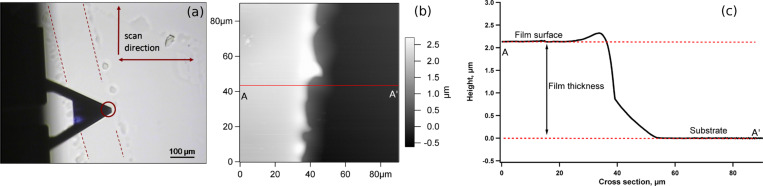
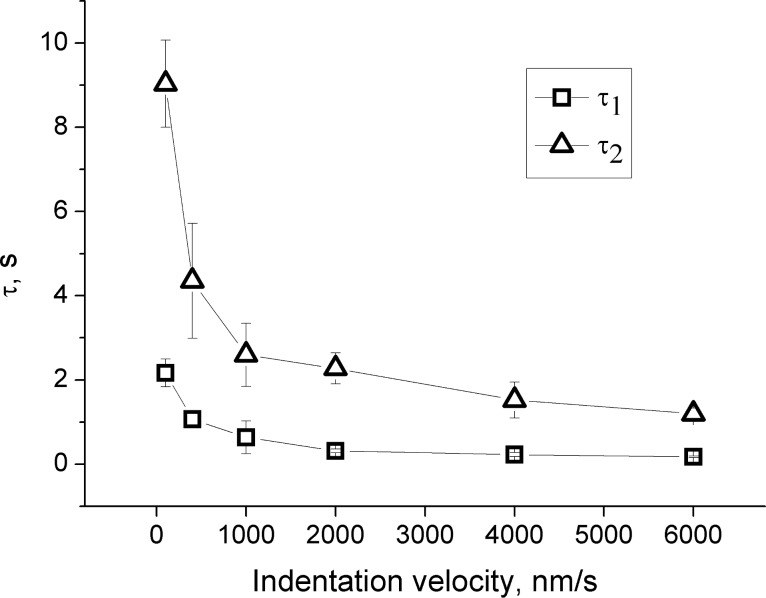
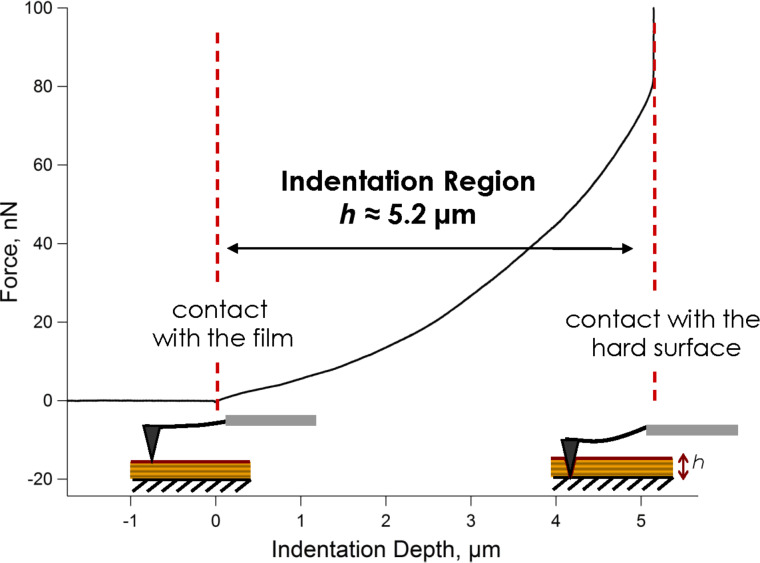
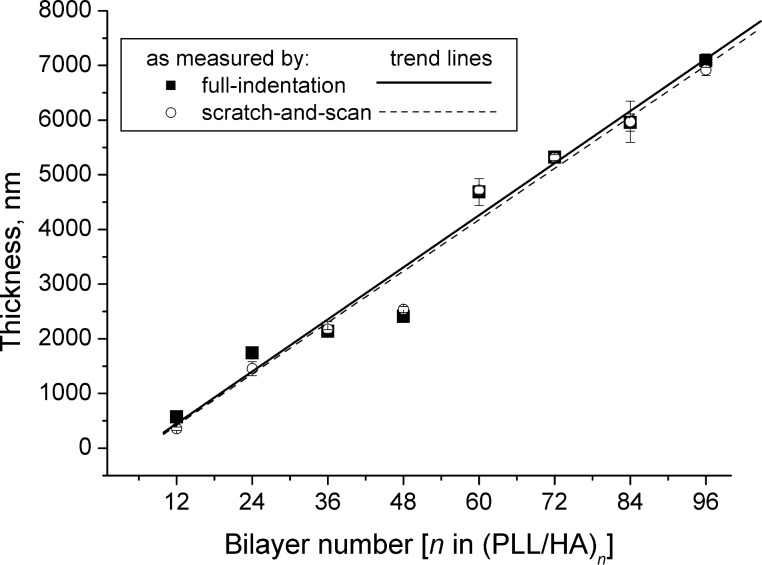
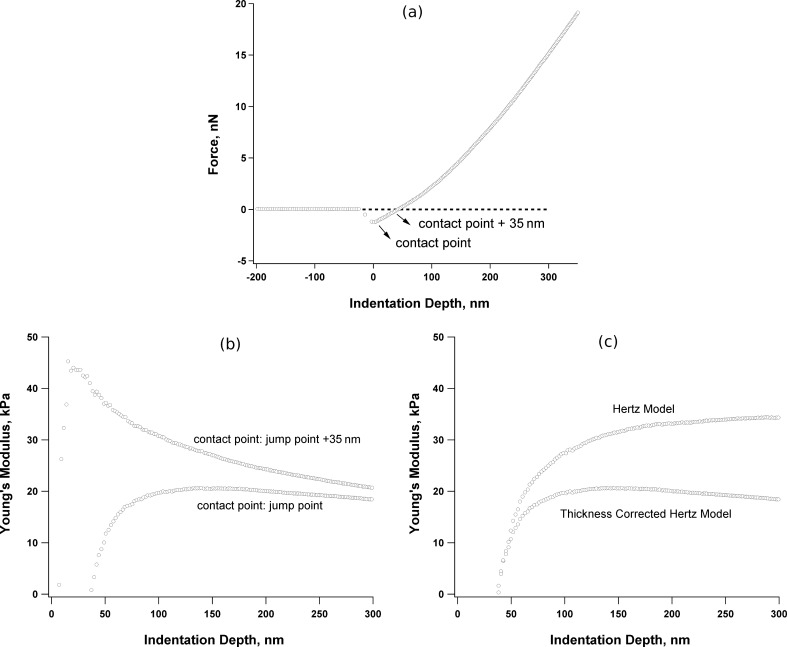
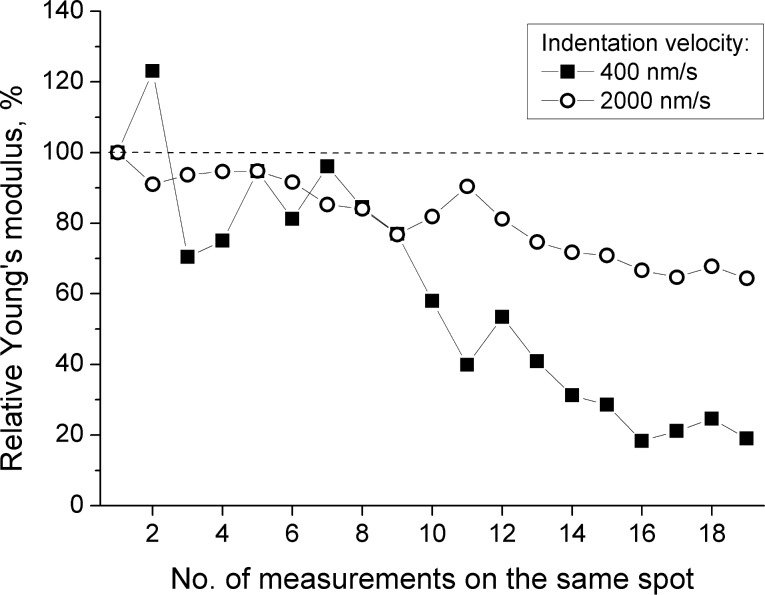
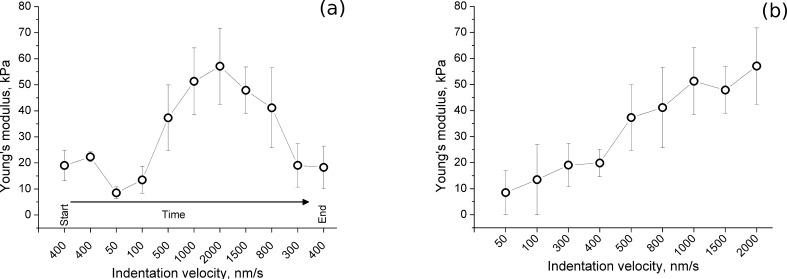
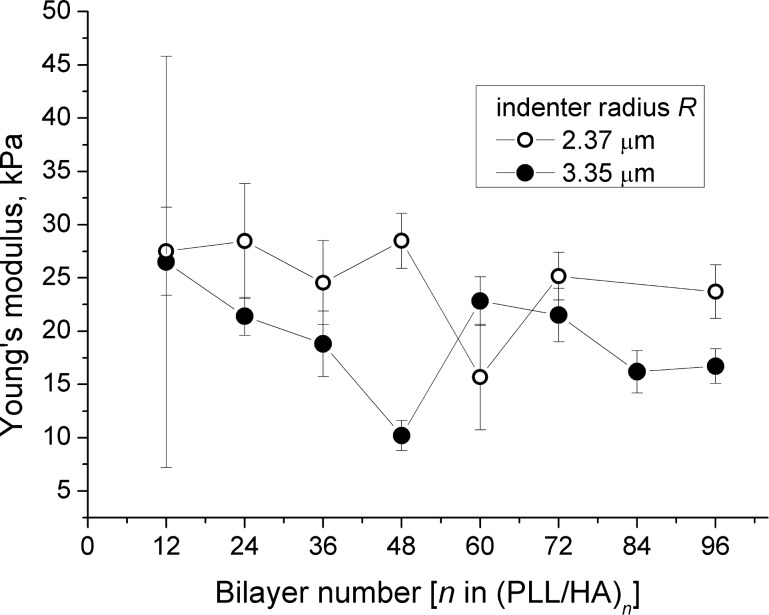
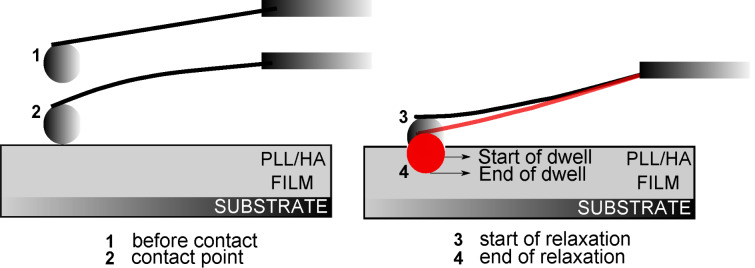
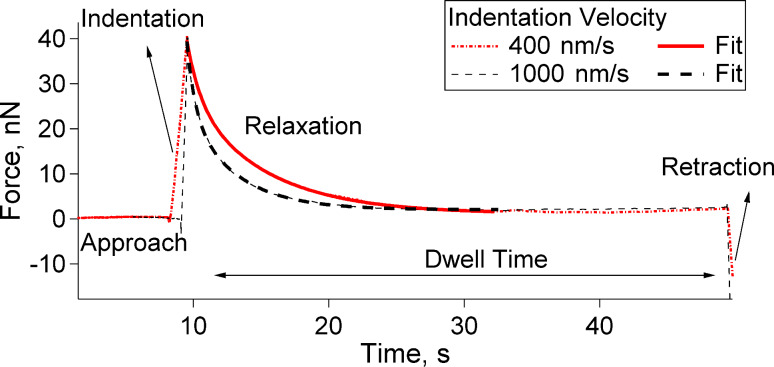
Scanning- and colloidal-probe atomic force microscopy were used to study the mechanical properties of poly(L-lysine)/hyaluronan (PLL/HA)(n) films as a function of indentation velocity and the number of polymer deposition steps n. The film thickness was determined by two independent AFM-based methods: scratch-and-scan and newly developed full-indentation. The advantages and disadvantages of both methods are highlighted, and error minimization techniques in elasticity measurements are addressed. It was found that the film thickness increases linearly with the bilayer number n, ranging between 400 and 7500 nm for n = 12 and 96, respectively. The apparent Young's modulus E ranges between 15 and 40 kPa and does not depend on the indenter size or the film bilayer number n. Stress relaxation measurements show that PLL/HA films have a viscoelastic behaviour, regardless of their thickness. If indentation is performed several times at the same lateral position on the film, a viscous/plastic deformation takes place.
扫描探针原子力显微镜和胶体探针原子力显微镜被用来研究聚(L-赖氨酸)/透明质酸(PLL/HA)(n)薄膜的力学性能,作为压痕速度和聚合物沉积步骤数 n 的函数。薄膜厚度由两种独立的基于原子力显微镜的方法确定:划痕和扫描以及新开发的全压痕。突出了这两种方法的优缺点,并解决了弹性测量中的误差最小化技术。结果发现,薄膜厚度与双层数 n 呈线性增加,对于 n = 12 和 96,分别在 400 和 7500 nm 之间。表观杨氏模量 E 在 15 和 40 kPa 之间变化,与压头尺寸或薄膜双层数 n 无关。应力松弛测量表明,PLL/HA 薄膜具有粘弹性行为,与其厚度无关。如果在薄膜的同一横向位置多次进行压痕,就会发生粘性/塑性变形。