Department of Parasitology, Institute of Biomedical Sciences, University of São Paulo, São Paulo, Brazil.
Department of Statistics, Institute of Mathematics and Statistics, University of São Paulo, São Paulo, Brazil.
PLoS One. 2019 Aug 9;14(8):e0220980. doi: 10.1371/journal.pone.0220980. eCollection 2019.
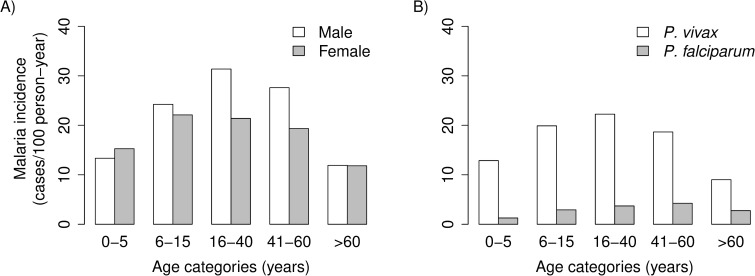
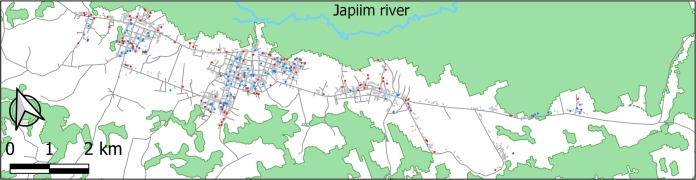
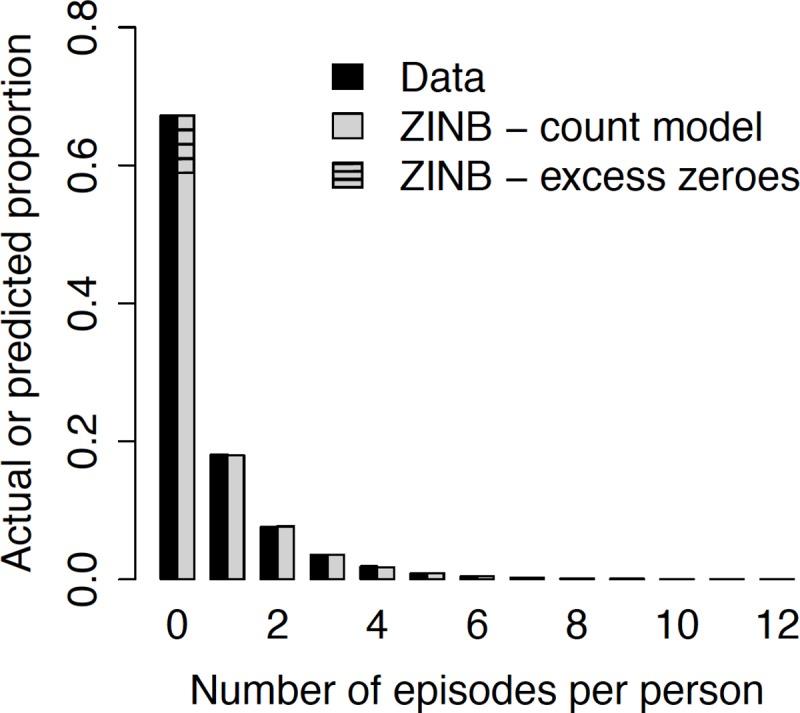
Despite the recent malaria burden reduction in the Americas, focal transmission persists across the Amazon Basin. Timely analysis of surveillance data is crucial to characterize high-risk individuals and households for better targeting of regional elimination efforts. Here we analyzed 5,480 records of laboratory-confirmed clinical malaria episodes combined with demographic and socioeconomic information to identify risk factors for elevated malaria incidence in Mâncio Lima, the main urban transmission hotspot of Brazil. Overdispersed malaria count data clustered into households were fitted with random-effects zero-inflated negative binomial regression models. Random-effect predictors were used to characterize the spatial heterogeneity in malaria risk at the household level. Adult males were identified as the population stratum at greatest risk, likely due to increased occupational exposure away of the town. However, poor housing and residence in the less urbanized periphery of the town were also found to be key predictors of malaria risk, consistent with a substantial local transmission. Two thirds of the 8,878 urban residents remained uninfected after 23,975 person-years of follow-up. Importantly, we estimated that nearly 14% of them, mostly children and older adults living in the central urban hub, were free of malaria risk, being either unexposed, naturally unsusceptible, or immune to infection. We conclude that statistical modeling of routinely collected, but often neglected, malaria surveillance data can be explored to characterize drivers of transmission heterogeneity at the community level and provide evidence for the rational deployment of control interventions.
尽管美洲地区最近疟疾负担有所减轻,但在亚马逊盆地仍存在局部传播。及时分析监测数据对于确定高风险人群和家庭至关重要,这有助于更有针对性地开展区域消除工作。在这里,我们分析了 5480 例实验室确诊的临床疟疾病例记录,结合人口统计学和社会经济信息,以确定巴西曼西尼奥利马(Mâncio Lima)疟疾发病率升高的危险因素,Mâncio Lima 是巴西主要的城市传播热点。将按户聚类的过度离散疟疾计数数据拟合具有随机效应的零膨胀负二项回归模型。随机效应预测因子用于描述家庭层面疟疾风险的空间异质性。成年男性被确定为风险最高的人群,这可能是由于他们离开城镇时职业暴露增加。然而,住房条件差和居住在城镇欠发达的外围地区也被发现是疟疾风险的关键预测因素,这与当地大量传播相一致。在 23975 人年的随访中,8878 名城市居民中有三分之二未感染疟疾。重要的是,我们估计其中近 14%的人,主要是居住在市中心的儿童和老年人,没有疟疾风险,他们要么没有暴露,要么自然不易感染,要么对感染具有免疫力。我们得出结论,对常规收集但经常被忽视的疟疾监测数据进行统计建模,可以用来描述社区层面传播异质性的驱动因素,并为合理部署控制干预措施提供证据。