Smith Nicholas, Campbell Brandon, Li Lin, Li Chuan, Alexov Emil
Computational Biophysics and Bioinformatics, Department of Physics, Clemson University, Clemson, SC 29634, USA.
BMC Struct Biol. 2012 Dec 5;12:31. doi: 10.1186/1472-6807-12-31.
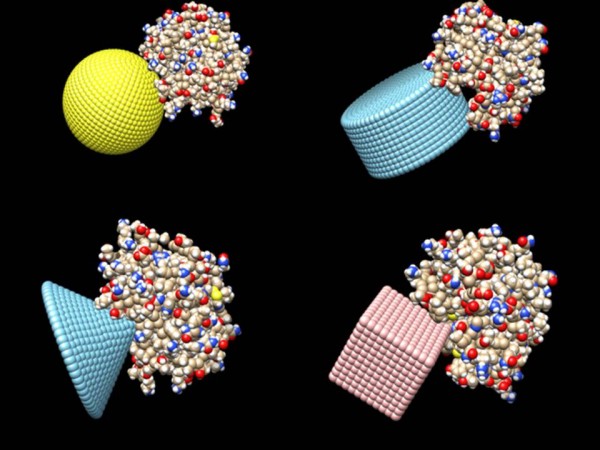
With the progress of nanotechnology, one frequently has to model biological macromolecules simultaneously with nano-objects. However, the atomic structures of the nano objects are typically not available or they are solid state entities. Because of that, the researchers have to investigate such nano systems by generating models of the nano objects in a manner that the existing software be able to carry the simulations. In addition, it should allow generating composite objects with complex shape by combining basic geometrical figures and embedding biological macromolecules within the system.
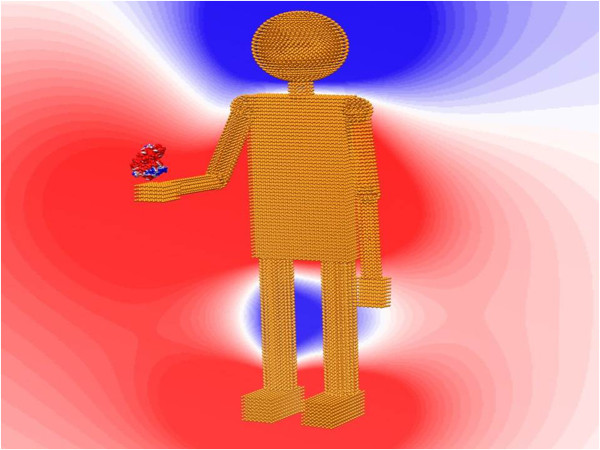
Here we report the Protein Nano-Object Integrator (ProNOI) which allows for generating atomic-style geometrical objects with user desired shape and dimensions. Unlimited number of objects can be created and combined with biological macromolecules in Protein Data Bank (PDB) format file. Once the objects are generated, the users can use sliders to manipulate their shape, dimension and absolute position. In addition, the software offers the option to charge the objects with either specified surface or volumetric charge density and to model them with user-desired dielectric constants. According to the user preference, the biological macromolecule atoms can be assigned charges and radii according to four different force fields: Amber, Charmm, OPLS and PARSE. The biological macromolecules and the atomic-style objects are exported as a position, charge and radius (PQR) file, or if a default dielectric constant distribution is not selected, it is exported as a position, charge, radius and epsilon (PQRE) file. As illustration of the capabilities of the ProNOI, we created a composite object in a shape of a robot, aptly named the Clemson Robot, whose parts are charged with various volumetric charge densities and holds the barnase-barstar protein complex in its hand.
The Protein Nano-Object Integrator (ProNOI) is a convenient tool for generating atomic-style nano shapes in conjunction with biological macromolecule(s). Charges and radii on the macromolecule atoms and the atoms in the shapes are assigned according to the user's preferences allowing various scenarios of modeling. The default output file is in PQR (PQRE) format which is readable by almost any software available in biophysical field. It can be downloaded from: http://compbio.clemson.edu/downloadDir/ProNO_integrator.tar.gz.
随着纳米技术的发展,人们常常需要同时对生物大分子和纳米物体进行建模。然而,纳米物体的原子结构通常无法获取,或者它们是固态实体。因此,研究人员必须通过以现有软件能够进行模拟的方式生成纳米物体模型来研究此类纳米系统。此外,它应该允许通过组合基本几何图形并将生物大分子嵌入系统中来生成具有复杂形状的复合物体。
在此我们报告蛋白质纳米物体整合器(ProNOI),它能够生成具有用户所需形状和尺寸的原子风格几何物体。可以创建无限数量的物体,并将其与蛋白质数据库(PDB)格式文件中的生物大分子相结合。一旦生成物体,用户可以使用滑块来操纵其形状、尺寸和绝对位置。此外,该软件提供了用指定的表面电荷或体电荷密度对物体进行充电并以用户所需的介电常数对其进行建模的选项。根据用户偏好,可以根据四种不同的力场(Amber、Charmm、OPLS和PARSE)为生物大分子原子分配电荷和半径。生物大分子和原子风格的物体被导出为位置、电荷和半径(PQR)文件,或者如果未选择默认介电常数分布,则导出为位置、电荷、半径和介电常数(PQRE)文件。作为ProNOI功能的示例,我们创建了一个机器人形状的复合物体,恰当地命名为克莱姆森机器人,其部件带有各种体电荷密度,并在手中持有巴纳酶 - 巴尔斯塔蛋白复合物。
蛋白质纳米物体整合器(ProNOI)是一种方便的工具,可用于结合生物大分子生成原子风格的纳米形状。根据用户偏好为大分子原子和形状中的原子分配电荷和半径,从而允许进行各种建模场景。默认输出文件为PQR(PQRE)格式,几乎可被生物物理领域的任何可用软件读取。它可以从以下网址下载:http://compbio.clemson.edu/downloadDir/ProNO_integrator.tar.gz。