Georgia State University, USA.
J Child Lang. 2013 Jan;40(1):69-105. doi: 10.1017/S0305000912000220.
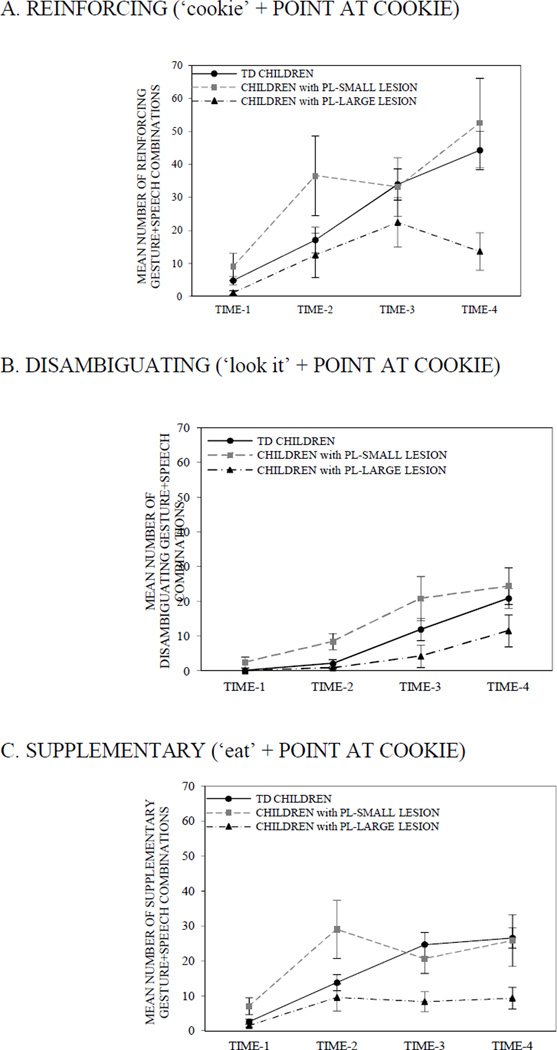
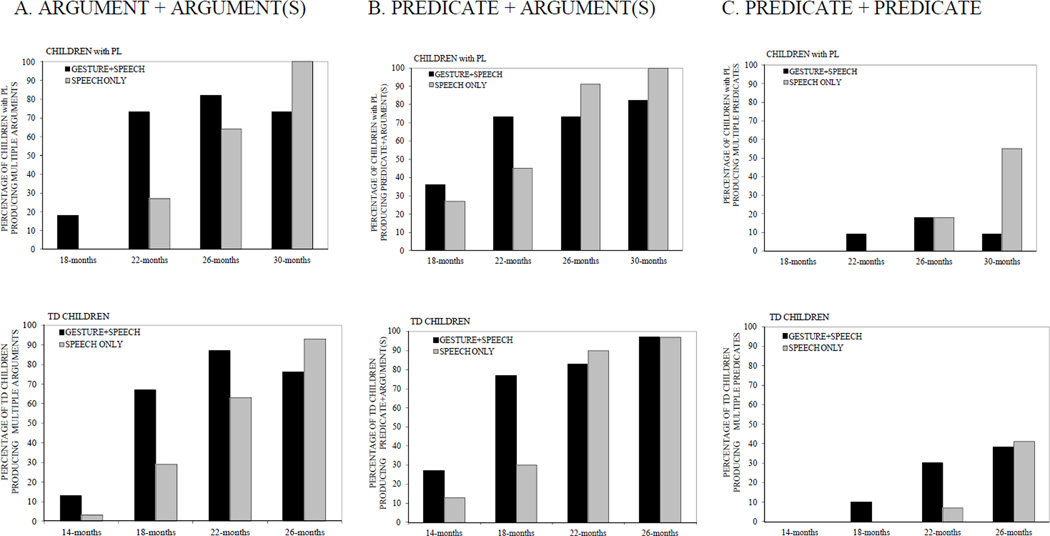
Children with pre/perinatal unilateral brain lesions (PL) show remarkable plasticity for language development. Is this plasticity characterized by the same developmental trajectory that characterizes typically developing (TD) children, with gesture leading the way into speech? We explored this question, comparing eleven children with PL - matched to thirty TD children on expressive vocabulary - in the second year of life. Children with PL showed similarities to TD children for simple but not complex sentence types. Children with PL produced simple sentences across gesture and speech several months before producing them entirely in speech, exhibiting parallel delays in both gesture + speech and speech-alone. However, unlike TD children, children with PL produced complex sentence types first in speech-alone. Overall, the gesture-speech system appears to be a robust feature of language learning for simple - but not complex - sentence constructions, acting as a harbinger of change in language development even when that language is developing in an injured brain.
患有围产期单侧脑损伤 (PL) 的儿童在语言发展方面表现出显著的可塑性。这种可塑性是否具有与典型发育 (TD) 儿童相同的发展轨迹,即手势先于言语?我们通过比较 11 名 PL 儿童和 30 名 TD 儿童的表达词汇,在生命的第二年探索了这个问题。PL 儿童的简单但不复杂的句型与 TD 儿童相似。PL 儿童在完全用言语表达之前,会通过手势和言语来表达简单的句子,并且在手势+言语和仅言语两种方式上都存在延迟。然而,与 TD 儿童不同的是,PL 儿童首先在仅言语的情况下表达复杂的句型。总的来说,对于简单的句型结构,手势-言语系统似乎是语言学习的一个强大特征,但对于复杂的句型结构则不然,即使语言是在受损的大脑中发展的,它也可以作为语言发展变化的预示。