Department of Ophthalmology and Visual Sciences, University of Michigan Medical School, Ann Arbor, Michigan, USA.
Am J Ophthalmol. 2013 Apr;155(4):688-96, 696.e1-2. doi: 10.1016/j.ajo.2012.10.003. Epub 2012 Dec 6.
To determine patterns of diffusion of diagnostic tests and therapeutic interventions in the United States through 2010 for patients with newly diagnosed exudative macular degeneration (AMD).
Retrospective longitudinal cohort analysis.
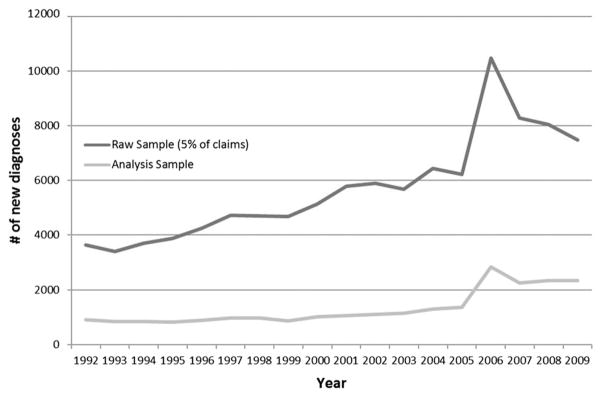
SETTING AND PATIENT POPULATION: A total of 23 941 Medicare beneficiaries with exudative AMD newly diagnosed during 1992-2009.
Current Procedural Technology (CPT-4) billing codes were used to identify use of diagnostic tests (optical coherence tomography, fluorescein angiography, and fundus photography) and therapeutic interventions (argon laser photocoagulation, photodynamic therapy, intravitreal corticosteroids, and anti-vascular endothelial growth factor [VEGF] agents) used by these beneficiaries during the first year following diagnosis.
Rates of use of study diagnostic and therapeutic procedures.
Diffusion was rapid for each successive new diagnostic and treatment modality, with use of newer procedures quickly replacing existing ones. The number of beneficiaries treated with anti-VEGF agents for exudative AMD was considerably greater than for prior innovations, rising from use in 4.0% of beneficiaries in 2004-05 to 62.7% in 2009-10. In each year from first diagnosis years 2006-2009 and in different practice settings, use of bevacizumab exceeded that of ranibizumab (60%-78% vs 33%-47%, respectively). Rates of diffusion of the various therapies were relatively similar in communities throughout the United States irrespective of presence of a major teaching hospital in the vicinity.
Newer, more effective therapeutic interventions for exudative AMD diffused rapidly throughout the United States, quickly replacing older, less effective interventions. Although improving patient outcomes, rapid diffusion raises important public policy issues for Medicare and other payers to consider.
通过 2010 年在美国对新诊断为渗出性年龄相关性黄斑变性(AMD)的患者,确定诊断性检查和治疗性干预措施的扩散模式。
回顾性纵向队列分析。
设置和患者人群:1992 年至 2009 年期间,共有 23941 名 Medicare 受益人被新诊断为渗出性 AMD。
使用当前程序技术(CPT-4)计费代码来识别这些受益人在诊断后第一年使用的诊断测试(光学相干断层扫描、荧光素血管造影和眼底摄影)和治疗性干预措施(氩激光光凝、光动力疗法、玻璃体内皮质类固醇和抗血管内皮生长因子[VEGF]药物)。
研究诊断和治疗程序的使用率。
每一种新的诊断和治疗方式的扩散速度都很快,新的治疗方法迅速取代了现有的方法。接受抗 VEGF 药物治疗渗出性 AMD 的受益人数大大超过了以前的创新药物,从 2004-05 年的 4.0%增加到 2009-10 年的 62.7%。从首次诊断后的 2006-2009 年的每一年,以及在不同的实践环境中,贝伐单抗的使用量都超过了雷珠单抗(分别为 60%-78%和 33%-47%)。无论附近是否有主要教学医院,美国各地社区各种治疗方法的扩散率都相对相似。
渗出性 AMD 的新的、更有效的治疗干预措施在美国迅速扩散,迅速取代了旧的、效果较差的干预措施。尽管改善了患者的治疗效果,但快速扩散给医疗保险和其他支付者带来了重要的公共政策问题,需要加以考虑。