Vostakolaei Fatemeh Asadzadeh, Broeders Mireille J M, Rostami Nematollah, van Dijck Jos A A M, Feuth Ton, Kiemeney Lambertus A L M, Verbeek André L M
Department of Epidemiology, Biostatistics and HTA, Radboud University Nijmegen Medical Centre, P.O. Box 9101, 6500 HB Nijmegen, The Netherlands ; Roessingh Research and Development (RRD), P.O. Box 310, 7500 AH Enschede, The Netherlands.
Int J Breast Cancer. 2012;2012:517976. doi: 10.1155/2012/517976. Epub 2012 Nov 22.
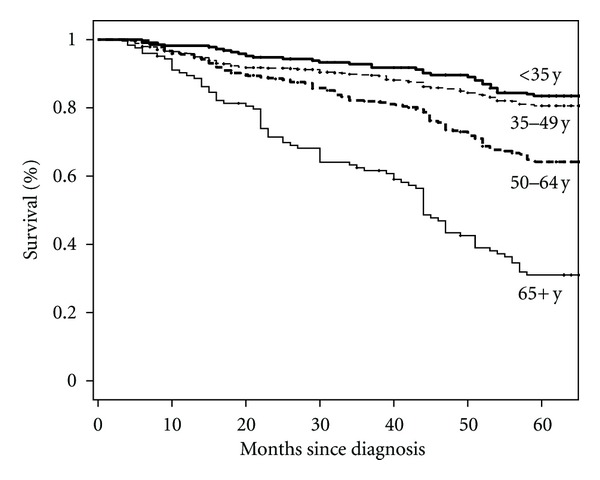
Background. Tumour characteristics are the most important prognostic factors in breast cancer. Patient-related factors such as young age at diagnosis, obesity, and smoking behaviour may also modify disease outcome. Due to the absence of a unique definition for "young age breast cancer" and the resulting variation in disease management, findings on the association between young age and prognosis of breast cancer are controversial. Methods. This study included 1500 patients with a primary diagnosis of breast cancer in six Iranian hospitals from 5 provinces. We modelled the relative excess risk (RER) of breast cancer death to age at diagnosis and tumour characteristics. Results. Excess risks of death were observed for stage IV disease and poorly differentiated tumours: RER of 4.3 (95% CI: 1.05-17.65) and 3.4 (95% CI: 1.17-9.87), respectively. "Older" patients, particularly those aged 50 and over, presented more often with advanced and poorly differentiated tumours (P = 0.001). After adjustment for stage, histological grade, Her-2 expression, estrogen and progesterone receptors, and place of residency, breast cancer mortality was not significantly different across age groups. Conclusion. We conclude that there is no prognostic effect of age at diagnosis of breast cancer among breast cancer patients treated at cancer centres in different parts of Iran; young and relatively old women have similar risks of dying from breast cancer.
背景。肿瘤特征是乳腺癌最重要的预后因素。与患者相关的因素,如诊断时年龄较轻、肥胖和吸烟行为,也可能改变疾病的预后。由于缺乏“年轻乳腺癌”的独特定义以及由此导致的疾病管理差异,关于年轻与乳腺癌预后之间关联的研究结果存在争议。
方法。本研究纳入了来自伊朗5个省份6家医院的1500例原发性乳腺癌患者。我们对乳腺癌死亡的相对超额风险(RER)与诊断时年龄和肿瘤特征进行了建模。
结果。观察到IV期疾病和低分化肿瘤的死亡超额风险:RER分别为4.3(95%CI:1.05 - 17.65)和3.4(95%CI:1.17 - 9.87)。“老年”患者,尤其是50岁及以上的患者,更常出现晚期和低分化肿瘤(P = 0.001)。在对分期、组织学分级、Her-2表达、雌激素和孕激素受体以及居住地进行调整后,各年龄组的乳腺癌死亡率无显著差异。
结论。我们得出结论,在伊朗不同地区癌症中心接受治疗的乳腺癌患者中,诊断时年龄对预后没有影响;年轻和相对年长的女性死于乳腺癌的风险相似。