Disease Dynamics Unit, Department of Veterinary Medicine. University of Cambridge, Cambridge, United Kingdom.
PLoS One. 2012;7(12):e51342. doi: 10.1371/journal.pone.0051342. Epub 2012 Dec 7.
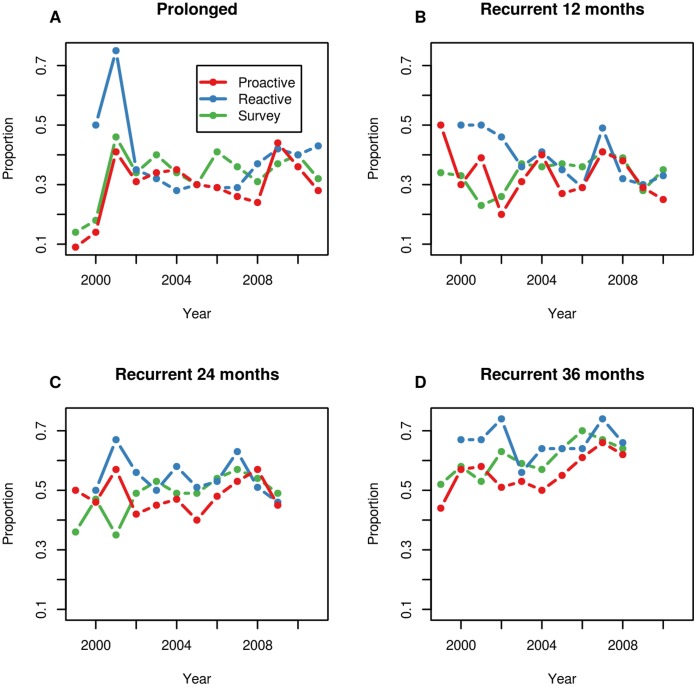
Bovine tuberculosis is endemic in cattle herds in Great Britain, with a substantial economic impact. A reservoir of Mycobacterium bovis within the Eurasian badger (Meles meles) population is thought to have hindered disease control. Cattle herd incidents, termed breakdowns, that are either 'prolonged' (lasting ≥ 240 days) or 'recurrent' (with another breakdown within a specified time period) may be important foci for onward spread of infection. They drain veterinary resources and can be demoralising for farmers. Randomised Badger Culling Trial (RBCT) data were re-analysed to examine the effects of two culling strategies on breakdown prolongation and recurrence, during and after culling, using a Bayesian hierarchical model. Separate effect estimates were obtained for the 'core' trial areas (where culling occurred) and the 'buffer' zones (up to 2 km outside of the core areas). For breakdowns that started during the culling period, 'reactive' (localised) culling was associated with marginally increased odds of prolongation, with an odds ratio (OR) of 1.7 (95% credible interval [CI] 1.1-2.4) within the core areas. This effect was not present after the culling ceased. There was no notable effect of 'proactive' culling on prolongation. In contrast, reactive culling had no effect on breakdown recurrence, though there was evidence of a reduced risk of recurrence in proactive core areas during the culling period (ORs and 95% CIs: 0.82 (0.64-1.0) and 0.69 (0.54-0.86) for 24- and 36-month recurrence respectively). Again these effects were not present after the culling ceased. There seemed to be no effect of culling on breakdown prolongation or recurrence in the buffer zones. These results suggest that the RBCT badger culling strategies are unlikely to reduce either the prolongation or recurrence of breakdowns in the long term, and that reactive strategies (such as employed during the RBCT) are, if anything, likely to impact detrimentally on breakdown persistence.
英国牛结核病在牛群中流行,对经济有重大影响。欧亚猞猁(Meles meles)种群中的牛分枝杆菌(Mycobacterium bovis)被认为是阻碍疾病控制的一个因素。牛群事件,称为疫情,要么是“持续”(持续时间≥240 天),要么是“复发”(在特定时间段内再次发生),可能是感染继续传播的重要焦点。它们消耗了兽医资源,可能会让农民士气低落。使用贝叶斯层次模型,重新分析随机选择的扑杀试验(Randomised Badger Culling Trial,RBCT)的数据,以检查在扑杀期间和之后,两种扑杀策略对疫情持续时间和复发的影响。为疫情开始于扑杀期间的情况,获得了针对“核心”试验区(发生扑杀的地区)和“缓冲区”(核心地区外 2 公里范围内)的单独效应估计值。对于核心地区内,局部性“反应性”扑杀与延长疫情的几率略有增加相关,比值比(odds ratio,OR)为 1.7(95%可信区间[credible interval,CI]1.1-2.4)。在扑杀停止后,这种效果不存在。“主动性”扑杀对延长疫情没有明显影响。相比之下,反应性扑杀对疫情复发没有影响,尽管在扑杀期间,主动核心地区的疫情复发风险降低(OR 和 95%CI:24 个月和 36 个月时分别为 0.82(0.64-1.0)和 0.69(0.54-0.86))。在扑杀停止后,这些效果也不存在。缓冲区中扑杀对疫情延长或复发似乎没有影响。这些结果表明,长期来看,RBCT 的扑杀策略不太可能减少疫情的延长或复发,而且反应性策略(如 RBCT 期间采用的策略)可能会对疫情的持续产生不利影响。